
Diagnosis and recovery operations
- Make
- Fiat
- Model
- Seicento Factory Service Manual
- Year
- 1998–2010
- Section
- Description and operation: Clutch release control › Diagnosis and recovery operations
(Continued)
When the solenoid valve is open, the hydraulic circuit cannot be pressurised and the clutch is always engaged. This conditions ensures safety if the power is accidentally cut. It also allows to take up clutch disc wear and to exploit a low gear as parking brake.
In order to close the solenoid valve, the control unit provides battery voltage for 100 ms, with a maximum current of 1.5A. To maintain the solenoid closed the control unit limits the current to 225 mA on an inductive load of 18 Ω.
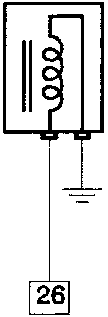
Diagnosis and recovery operations
During normal operation the system control the status of its sensors.
If a fault is repeatedly detected in a sensor, the system starts a recovery procedure.
The following a stored in the control unit memory: detected faults, engagement time, tolerated level of energy over the threshold, number of starts and gear shifts.
The data can be accessed by means of EXAMINER.
POTENTIOMETER SENSORS SELF-TEST
The system permanently detects power down, broken tracks and short circuits between power and cursor in all the potentiometer sensors.
VEHICLE SPEED SELF-TEST
The system permanently detects information on vehicle speed and signals a fault if the maximum limit is exceeded.
Moreover, when the clutch is engaged, a fault is signalled if the vehicle speed is not consistent with the speed value computed on the basis of the engine revs and the gear engaged.
ENGINE SPEED SELF-TEST
The system permanently detects information on the engine revs and signals a fault if the maximum limit is exceeded.
Moreover, when the clutch is engaged, a fault is signalled if the engine revs are not consistent with the speed value computed on the basis of the vehicle speed and the gear engaged.
GEAR LEVER SENSOR (PUSH-PULL) SELF-TEST
The system signals a fault if no signal is received from this sensor although a gear has been shifted.
SYSTEM POWER UP CLUTCH DISENGAGEMENT TEST
A fault is signalled if an inconsistency is detected between the disengagement signal and the position of the actuator.
RECOVER PROCEDURES
In most cases, these procedures allow to drive the vehicle to the nearest service station is safety.
GEAR DETECTION POTENTIOMETER FAILURE
Having disengaged the clutch after a pre-set period of time the system control re-engagement considering, by default, the 2nd gear is engaged.
ACTUATOR POTENTIOMETER FAILURE
The system control open cycle engagement transmitting a pre-set sequence of impulses.
NO VEHICLE SPEED INFORMATION
The system controls an open circuit engagement, transmitting a pre-set sequence of impulses. In these conditions, bump starting and engine braking are inhibited.
NO ENGINE REV INFORMATION
The system generates this information on the basis of the throttle valve opening.
In these conditions, the engine may stop if incorrect manoeuvres are performed.
Parts & tools for this job For 1998 Fiat Seicento
- PARTClutch kitSearch: Fiat Seicento 1998 clutch kit
- TOOLClutch alignment toolSearch: clutch alignment tool
- FLUIDGear oilSearch: Fiat Seicento manual gearbox oil
Links open Amazon search results in a new tab. As an Amazon Associate I earn from qualifying purchases.