1st Clutch
- Make
- Rover
- Model
- 600 Rover 600 Repair Manual - Volumes 1 and 2 - 2nd Edition
- Section
- Fault finding › 1st Clutch
Automatic gearbox1st Clutch
WARNING: While testing, be careful of the rotating front wheels.
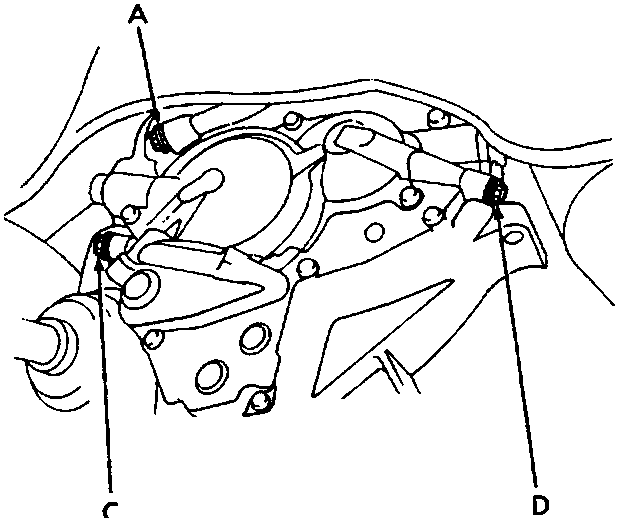
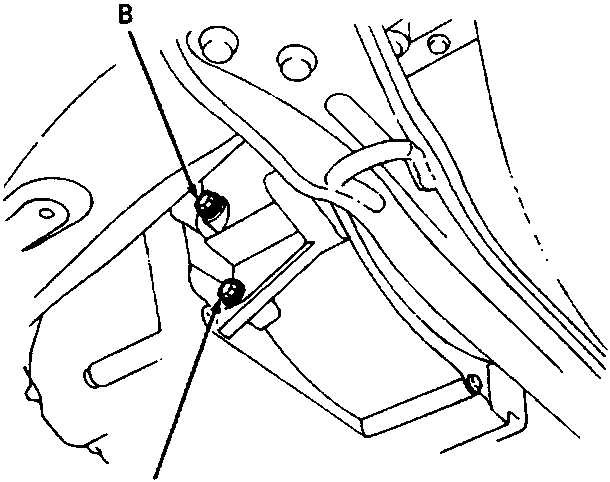
A 1st clutch pressure inspection hole
B 2nd clutch pressure inspection hole
C 1st hold clutch pressure inspection hole
D 4th clutch pressure inspection hole
E 3rd clutch pressure inspection hole
- Apply the handbrake and chock both rear wheels securely.
- Raise the front of the car and support it with axle stands.
- Allow the front wheels to rotate freely.
- Measure each clutch pressure.
1st Clutch
- Select 1 or D4, increase engine speed to 2000 rev/min and note line pressure reading.
Line pressure = 7.5 to 8.5 kg/cm². - If line pressure is low or non – existent, suspect 1st clutch fault.
1st hold clutch
- Select 1, increase engine speed to 2000 rev/min and note line pressure reading.
Line pressure 7.5 to 8.5 kg/cm². - If line pressure is low or non – existent, suspect 1st hold clutch fault.
2nd Clutch
- Select 2, increase engine speed to 2000 rev/min and note line pressure reading.
Line pressure = 7.5 to 8.5 kg/cm². - Select D3 or D4, allow engine to idle and note line pressure reading.
Line pressure = 4.5 to 5.0 kg/cm². - Depress accelerator to a quarter of its travel and note line pressure reading obtained.
Line pressure = 7.5 to 8.5 kg/cm². - If line pressure in above tests is low or non – existent, suspect 2nd clutch fault.
3rd Clutch
- Select D4 or D3, allow engine to idle, record line pressure reading obtained.
Line pressure = 4.5 to 5.0 kg/cm². - Depress accelerator to a quarter of its travel and note line pressure reading obtained.
Line pressure = 7.5 to 8.5 kg/cm². - If line pressure in above tests is low or non – existent, suspect 3rd clutch faults.
4th Clutch
- Select D4, allow engine to idle, record line pressure reading obtained.
Line pressure = 4.8 to 5.3 kg/cm². - Depress accelerator to a quarter of its travel and note line pressure reading obtained.
Line pressure 7.5 to 8.5 kg/cm². - If line pressure in above tests is low or non – existent, suspect 4th clutch fault.
- Select R, increase engine speed to 2000 rev/min and note line pressure reading.
Line pressure = 7.5 to 8.5 kg/cm².
Parts & tools for this job For Rover 600
- PARTClutch kitSearch: Rover 600 clutch kit
- TOOLClutch alignment toolSearch: clutch alignment tool
- FLUIDGear oilSearch: Rover 600 manual gearbox oil
Links open Amazon search results in a new tab. As an Amazon Associate I earn from qualifying purchases.