
Immobilizer – Function
- Make
- Volvo
- Model
- S80 Factory Service Manual
- Year
- 1999–2006
- Section
- 09 Miscellaneous › Design and Function › Immobilizer – Function
Immobilizer – Function
The immobilizer system
The function of the immobilizer is to make the vehicle unusable unless a genuine Volvo key that belongs to the vehicle is used. When the ignition key is turned to position II, a check is performed electronically to ensure that the correct key is being used. If the key is not approved, the engine will not start. The function of the system will not be noticed by the customer as long as an approved key is used and there are no faults.
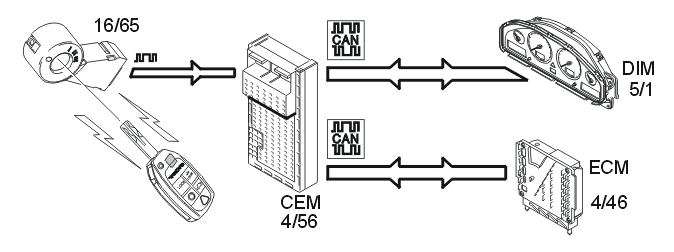
Deactivation
When the ignition key is turned to position II, the central electronic module (CEM) performs an identity check of the transponder in the key via the antenna ring. In response, the central electronic module (CEM) receives a code from the transponder, which is compared to the codes that are stored in the central electronic module (CEM). If the codes correspond, the key is approved.
At the same time, the central electronic module (CEM) activates the relay for the starter motor and commences an identity check between the central electronic module (CEM) and the engine control module (ECM). The engine control module (ECM) transmits a code to the central electronic module (CEM) and receives a code back. The central electronic module (CEM) also transmits the results of the key check to the engine control module (ECM). If the identity check between the engine control module (ECM) and the central electronic module (CEM) as well as the check on the key are OK, the engine control module (ECM) will transmit a command to the central electronic module (CEM) that the starter motor may be activated. The engine control module (ECM) will then also activate the ignition system.
NOTE: The engine control module (ECM) allows the starter motor to turn once the identity check between the engine control module (ECM) and the central electronic module (CEM) is complete. The starter motor will not be allowed to operate until the check on the ignition key is complete. Depending on the outcome of these two checks, the engine control module (ECM) will then determine whether the starter motor is to be allowed to operate.
If either of the checks fails, a message will appear in the display on the driver information module (DIM) and the engine will not start.
Activation
The immobilizer system is activated when the ignition key is turned to position 0 and the engine stops. The engine control module (ECM) then sends a command to the central electronic module (CEM) that the starter motor is no longer permitted to turn.
The immobilizer system contains safety functions for preventing the system from being activated in the event the engine should stop while the ignition is still switched on. In this case the engine control module (ECM) will wait for a while before a command is sent to the central electronic module (CEM) indicating that the immobilizer is to be activated. If an attempt is made to start the vehicle within this time, there will be no new communication between the engine control module (ECM) and the central electronic module (CEM).
The immobilizer system will neither be activated if the vehicle is still moving when the engine stops. Similarly, the engine will not stop if the engine control module (ECM) conducts an internal restart while driving.
If the ignition key is turned to position 0 but the key is not removed from the ignition switch, the engine control module (ECM) will wait for a while but then send a command to the central electronic module (CEM) to activate the immobilizer, despite the fact that the key has not been removed from the ignition switch.
Error message in the Driver information module (DIM).
Two different error messages may be displayed in the Driver information module (DIM) display for the immobilizer function in the S80/S60/V70/XC70/XC90:
NOTE: Because the information is sensitive to change the exact wording cannot be written here.
- Message regarding fault in the system for the immobilizer with reference to the user manual. The message is displayed when a problem has occurred in communication between the Central electronic module (CEM) and the Engine control module (ECM).
- Message regarding prevented start with new attempt request. The message is displayed if a fault has occurred when reading the transponder in the key.
NOTE: There are rare cases of faults related to the immobiliser system that do not store any diagnostic trouble codes, no diagnostic trouble code appears in the Driver Information Module (DIM) either.
For further information, see Diagnostic trouble code (DTC) information for the relevant diagnostic trouble codes (DTCs) in the Information manager.
The immobilizer system
The function of the immobilizer is to make the vehicle unusable unless a genuine Volvo key that belongs to the vehicle is used. When the ignition key is turned to position II, a check is performed electronically to ensure that the correct key is being used. If the key is not approved, the engine will not start. The function of the system will not be noticed by the customer as long as an approved key is used and there are no faults.
Deactivation
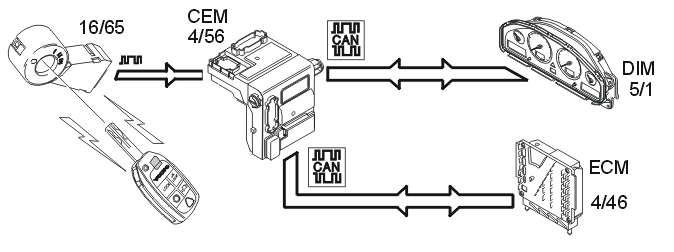
When the ignition key is turned to position II, the central electronic module (CEM) performs an identity check of the transponder in the key via the antenna ring. In response, the central electronic module (CEM) receives a code from the transponder, which is compared to the codes that are stored in the central electronic module (CEM). If the codes correspond, the key is approved.
At the same time, the central electronic module (CEM) activates the fuel pump and commences an identity check between the central electronic module (CEM) and the engine control module (ECM). The engine control module (ECM) transmits a code to the central electronic module (CEM) and receives a code back. The central electronic module (CEM) also transmits the result of the key check to the engine control module (ECM).
For B8444S, the following applies: if the identity check between the engine control module (ECM) and the central electronic module (CEM), plus the key check, are okay, the engine control module (ECM) will send a command to the central electronic module (CEM) indicating that the fuel pump is permitted to continue running. The engine control module (ECM) will then also activate the starter motor relay and the ignition system.
For other engines, the following applies: if the identity check between the engine control module (ECM) and the central electronic module (CEM), plus the key check, are okay, the engine control module (ECM) will send a command to the central electronic module (CEM) indicating that the fuel pump is permitted to continue running and that the starter motor may be activated. The engine control module (ECM) will then also activate the ignition system.
NOTE: The engine control module (ECM) allows the fuel pump (FP) to run until the key check and identity check between the engine control module (ECM) and the central electronic module (CEM) is complete. The starter motor will not be activated until the check on the ignition key is complete. Depending on the outcome of these two checks, the engine control module (ECM) will then determine whether the starter motor and fuel pump (FP) should be allowed to continue to operate.
If either of the checks fails, a message will appear in the display on the driver information module (DIM) and the engine will not start.
Activation
The electronic immobilizer system is activated when the ignition key is turned to position 0 and the engine stops.
For B8444S, the following applies: the engine control module (ECM) will then block activation of the starter motor relay and send a command to the central electronic module (CEM) stating that the fuel pump must not be activated.
For other engines, the following applies: the engine control module (ECM) then sends a command to the central electronic module (CEM) stating that the fuel pump is not permitted to turn over and that the fuel pump must not be activated.
The immobilizer system contains safety functions for preventing the system from being activated in the event the engine should stop while the ignition is still switched on. In this case the engine control module (ECM) will wait for a while before a command is sent to the central electronic module (CEM) indicating that the immobilizer is to be activated. If an attempt is made to start the vehicle within this time, there will be no new communication between the engine control module (ECM) and the central electronic module (CEM).
The immobilizer system will neither be activated if the vehicle is still moving when the engine stops. Similarly, the engine will not stop if the engine control module (ECM) conducts an internal restart while driving.
If the ignition key is turned to position 0 but the key is not removed from the ignition switch, the engine control module (ECM) will wait for a while but then send a command to the central electronic module (CEM) to activate the immobilizer, despite the fact that the key has not been removed from the ignition switch.
Remote-controlled immobilization
Applies for the English, Dutch, and Belgian market. A special version with stricter requirements is available for the Brazilian market. Applies from and incl. structure week 201020.
On certain markets there is a function for remote-controlled immobilization and mobilization. The purpose of the function is to nullify the vehicle's programmed keys in case the vehicle is stolen, for example. The vehicle can be immobilized and mobilized either using Volvo On Call service center or via diagnostic commands in VIDA. For certain markets vehicles can only be mobilized by Volvo On Call service center.
If the vehicle is running when immobilization is requested, the vehicle is immobilized at the next start attempt. Central electronic module (CEM) can, in certain markets, request immobilization if the module detects that Phone module (PHM) does not answer to communication.
The function remote-controlled immobilization is diagnosed by Central electronic module (CEM). Immobilization and mobilization of vehicles via diagnostic commands takes place via Phone module (PHM).
Error message in the Driver information module (DIM).
Two different error messages may be displayed in the Driver information module (DIM) display for the immobilizer function in the S80/S60/V70/XC70/XC90:
NOTE: Because the information is sensitive to change the exact wording cannot be written here.
- Message regarding fault in the system for the immobilizer with reference to the user manual. The message is displayed when a problem has occurred in communication between the Central electronic module (CEM) and the Engine control module (ECM).
- Message regarding prevented start with new attempt request. The message is displayed if a fault has occurred when reading the transponder in the key.
For further information, see Diagnostic trouble code (DTC) information for the relevant diagnostic trouble codes (DTCs) in the Information manager.
Parts & tools for this job For 1999 Volvo S80
- TOOLTorque wrenchSearch: 3/8 inch torque wrench
- TOOLSocket setSearch: socket set metric
- BOOKHaynes manualSearch: Haynes manual Volvo S80
Links open Amazon search results in a new tab. As an Amazon Associate I earn from qualifying purchases.