
Transmission – Function
- Make
- Volvo
- Model
- S80 Factory Service Manual
- Year
- 1999–2006
- Section
- 09 Miscellaneous › Design and Function › Transmission – Function
Transmission – Function
Transmission, general
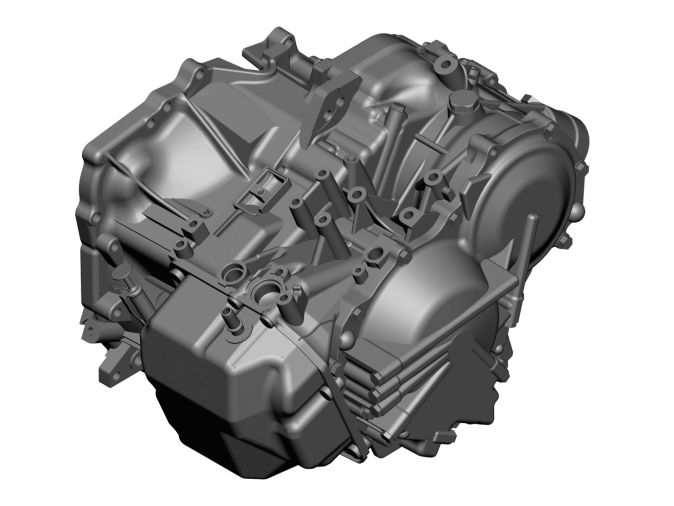
The basic parameters for shifting are the accelerator pedal (AP) position and the vehicle speed.
The gear shift quality is determined by the torque control by reading off speed changes of the transmission input shaft and comparing the calculated value.
This is used to calculate the pressure setting for the clutches and brakes.
Torque converter
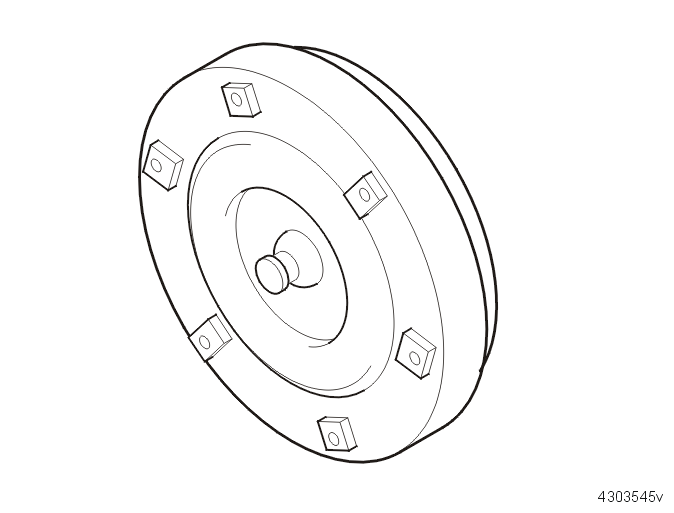
The torque converter functions as an hydraulic automatic clutch. When the engine is idling the pump effect is too weak to drive the turbine and the vehicle will not move. As the engine speed (RPM) rises it successively starts to drive in a gradual way. At higher engine speeds (RPM) the power transfer to the turbine can be up to 95%. The torque converter functions as an hydraulic clutch.
Thanks to a third, smaller wheel, the stator wheel, the torque converter also reinforces the engine torque at low engine speeds.
The rotating impellers and the oil in the torque converter ”slip” slightly and create a slight loss of power, which increases fuel consumption slightly.
Differential
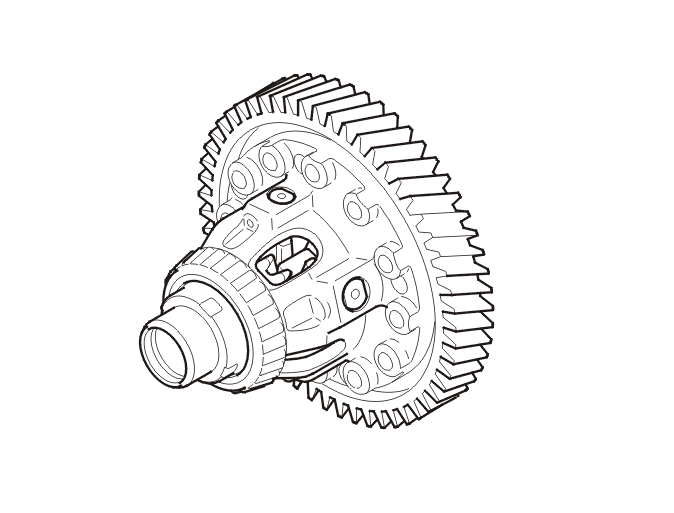
The differential distributes power equally between the drive wheels, even if they are rotating at different speeds.
When driving straight ahead, the ring wheel and differential housing rotate at the same speed as the drive shafts and the driving wheels.
When cornering, the differential gears rotate to compensate for the different speeds of the wheels. Because the small side gears are rotating on the shaft journal, the drive shafts can rotate at different speeds. Power is transferred from the differential housing to the drive shafts via the small side gears in the same way as when driving straight ahead. Both drive wheels still have the same driven power.
Cars with four wheel drive have a splined pin on the differential housing. The sleeve on the pin connects the differential housing with the bevel gear. This transfers the power to the rear wheels.
Gear selector assembly
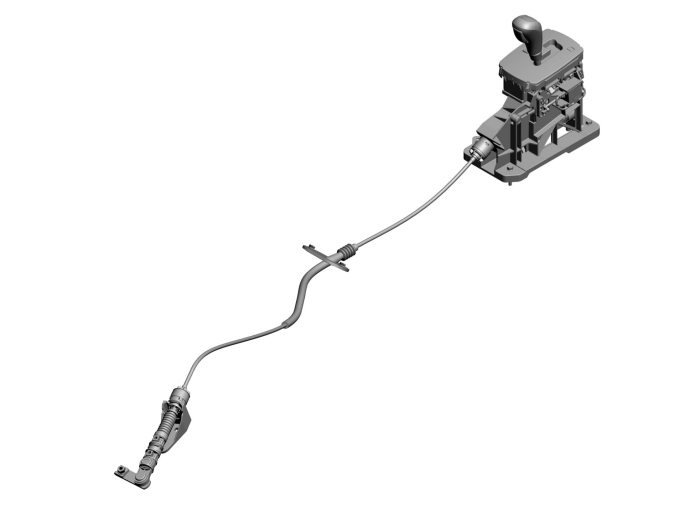
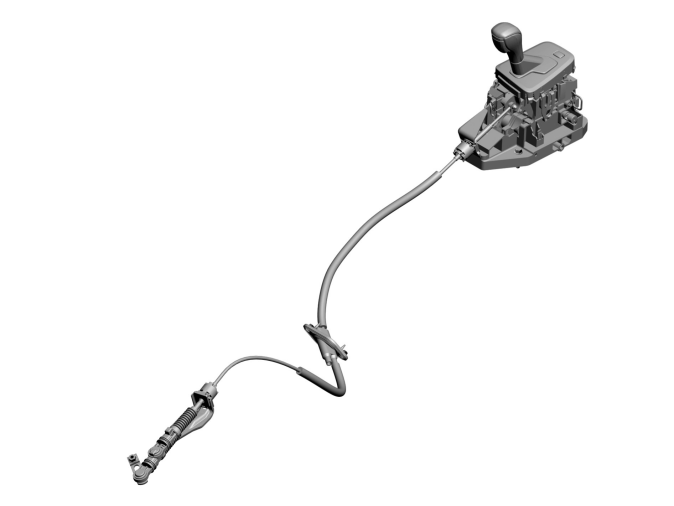
The gear selector assembly is positioned in the center console and is mechanically connected to the transmission by a cable which affects the gear valve.
Gear selectors and cables are shaped differently depending on which car model they are installed in.
Gear selector assemblies with Geartronic, in addition to P/R/N/D modes, also have a manual (M) shifting mode. The manual gear positions can be selected at any point while driving. The engaged gear is locked until the driver selects another gear. The automatic transmission only down shifts if the vehicle slows down to very low speed.
To downshift the gear selector must be moved to minus (-). To upshift the gear selector must be moved to plus (+). At start, 3rd is the highest possible gear.
The engine can only be started in position P or N.
The different gear selector positions
| Position | Meaning | Function |
|---|---|---|
| P | Parking | The output shaft of the transmission is locked, so that the vehicle does not roll. This position should be selected when the vehicle is parked or the engine is started. |
| R | Back-up | Back-up (reverse) gear. This position must only be selected when the vehicle is stationary. |
| N | Neutral | Neutral means that no gear is engaged and the vehicle can roll freely. The engine can be started in this position. |
| D | Drive | The D position is used for all forward motion. When D is engaged the engine drives the vehicle forward. Up and down shifting occurs automatically depending on acceleration and speed. |
| M | Manual | This position allows the driver to change gears manually. |
Power flow
When throttling off, the output shaft's power in 5th, 4th, 3rd, 2nd or reverse gear goes directly to the input shaft without any freewheel, which provides engine braking. 1st gear does not have any engine braking since the power transmission is interrupted by freewheel F2.
Position P (parking)
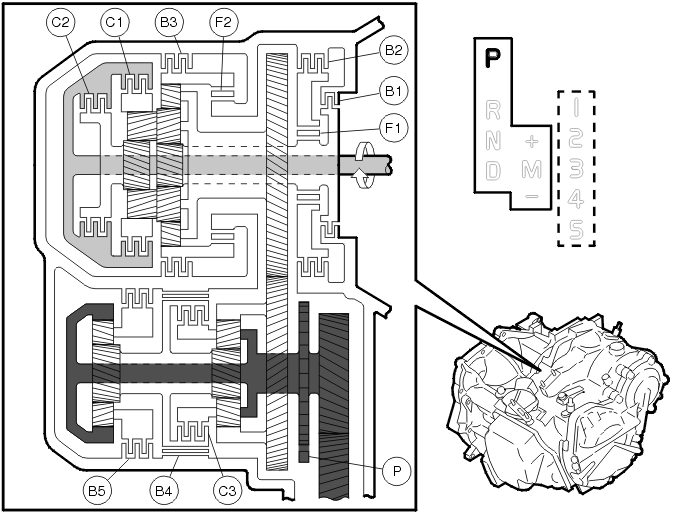
Primary shaft
The input shaft rotates clockwise. All clutches and brakes are disengaged, and no power is transferred to the planetary trains.
Output (secondary) shaft
No power is transmitted to the output (secondary) shaft. Brake band B4locks the sun gear so that it cannot rotate in any direction. Shiftlock P, which is affected by the mechanical link system, is engaged with the lock wheel on the output shaft and prevents the vehicle from rolling.
Position N (neutral)
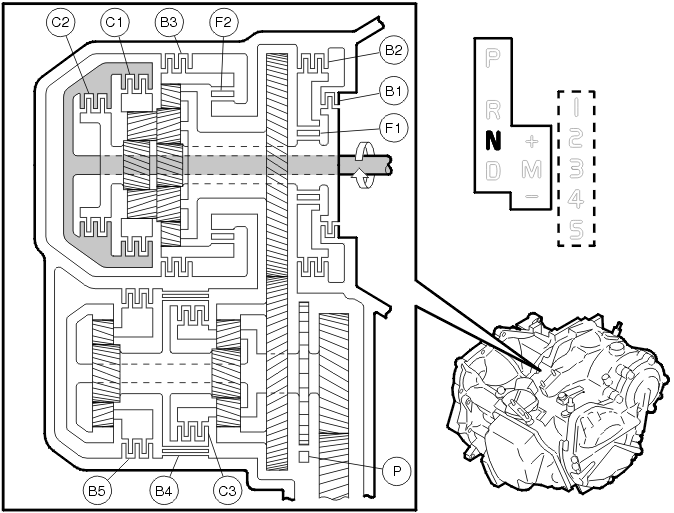
Primary shaft
The input shaft rotates clockwise. All clutches and brakes are disengaged, and no power is transferred to the planetary trains.
Output (secondary) shaft
No power is transmitted to the output (secondary) shaft. Brake band B4 locks the sun gear so that it cannot rotate in any direction. Shift-lock P is disengaged. The planetary gears can rotate freely around the sun gear and the vehicle will start to roll if it is on an incline.
The reason for the brake B4 being activated in both P as N-position is to minimize the engagement shock that otherwise is produced when several brakes and clutches are activated at the same time when the gear selector is moved to D or R-position. Since B4 is still activated in both first gear and reverse, in this way simultaneous engagements are reduced.
Position D (drive) and 1st gear
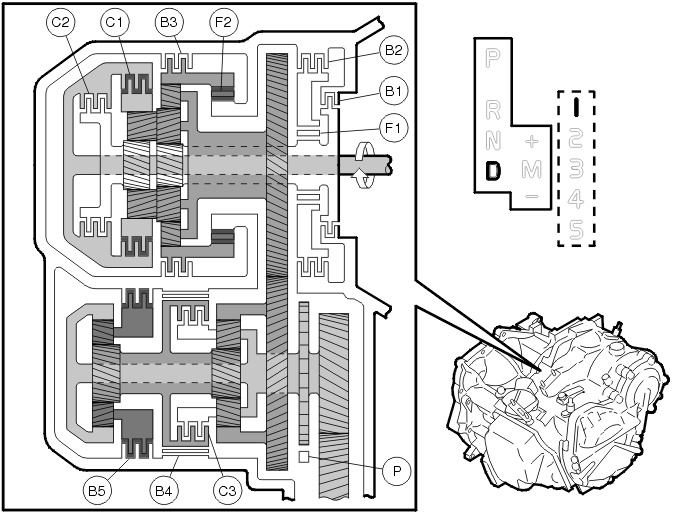
Main section
The input shaft rotates clockwise. Clutch C1 connects the input shaft to the rear ring gear, which rotates clockwise. The rear planetary gear rotates clockwise. The front large planetary gear rotates clockwise with the rear planetary gear as a unit.
The front small planetary gear rotates clockwise. The front ring gear rotates counter-clockwise. Freewheel F2 locks the front ring gear's rotation counter-clockwise.
The front and rear planetary carriers are turned clockwise because of the reactive forces from the small gear. The primary intermediate gear rotates clockwise with the front and rear planetary carriers as a unit.
U/D section
The secondary intermediate gear rotates counter-clockwise. The front ring gear rotates counter-clockwise with secondary intermediate gear as a unit.
The front planetary gear rotates clockwise. The front planetary gear rotates clockwise. The rear sun gear rotates clockwise with the front sun gear as a unit.
The rear planetary gear rotates counter-clockwise. Brake B5 locks the rear planetary carrier's rotation. The rear ring gear rotates counter-clockwise. The front planetary carrier and final drive pinion rotates counter-clockwise with the rear ring gear as a unit. The final drive rotates clockwise.
Engine brake
The primary intermediate gear and front and rear main planetary carriers rotate clockwise. The rear planetary carrier rotates clockwise. The rear planetary gear is turned counter-clockwise while it rotates counter-clockwise because of the resistance from the rear ring gear.
The front large gear wheel is turned clockwise while it rotates counter-clockwise and the small gear wheel is turned clockwise while it rotates clockwise. The front planetary carrier is turned clockwise.
The front ring gear rotates clockwise because the front small gear rotates clockwise, but drive force is reduced because freewheel F2 is disengaged. Therefore the engine brake does not operate.
Position D and 2nd gear
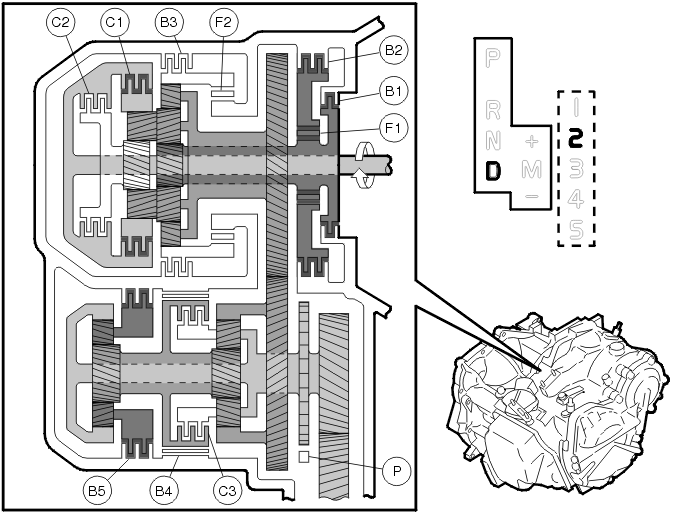
Main section
The input shaft rotates clockwise. Clutch C1 connects the input shaft to the rear ring gear. The rear ring gear rotates clockwise. The rear planetary gear rotates clockwise.
The front large planetary gear rotates clockwise with the rear planetary gear as a unit. Brake B2, freewheel F1 and brake B1 lock the sun gear's rotation.
The front and rear planetary carriers are turned clockwise because of the reactive forces from the front large gear. The primary intermediate gear rotates clockwise with the front and rear planetary carriers as a unit.
U/D section
The secondary intermediate gear rotates counter-clockwise. The front ring gear rotates counter-clockwise with the secondary intermediate gear as a unit. The front planetary gear rotates clockwise. The front planetary gear rotates clockwise.
The rear sun gear rotates clockwise with the front sun gear as a unit. The rear planetary gear rotates counter-clockwise. Brake B5 locks the rear planetary carrier's rotation. The rear ring gear rotates counter-clockwise.
The front planetary carrier and final drive pinion rotates clockwise with the rear ring gear as a unit. The final drive rotates clockwise.
Engine brake
Drive force is transferred directly to the input shaft without the one way clutch. Therefore the engine brake operates.
Position D and 3rd gear
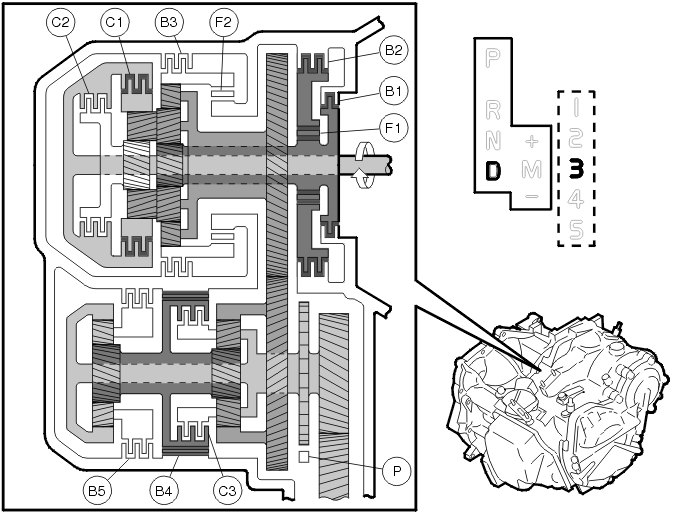
Main section
The input shaft rotates clockwise. Clutch C1 connects the input shaft to the rear ring gear. The rear ring gear rotates clockwise. The rear planetary gear rotates clockwise.
The front large planetary gear rotates clockwise with the rear planetary gear as a unit. Brake B2, freewheel F1 and brake B1 lock the sun gear's rotation.
The front and rear planetary carriers are turned clockwise because of the reactive forces from the front large gear. The primary intermediate gear rotates clockwise with the front and rear planetary carriers as a unit.
U/D section
The secondary intermediate gear rotates counter-clockwise. The front ring gear rotates counter-clockwise with the secondary intermediate gear as a unit. The front planetary gear rotates clockwise. Brake B4 locks the rotation of the front and rear sun gear.
The front planetary carrier is turned clockwise because of the reactive forces from the front large planetary gear. The front planetary carrier and final drive pinion rotate clockwise with the rear ring gear as a unit. The final drive rotates clockwise.
Engine brake
Drive force is transferred directly to the input shaft without the one way clutch. Therefore the engine brake operates
Position D and 4th gear
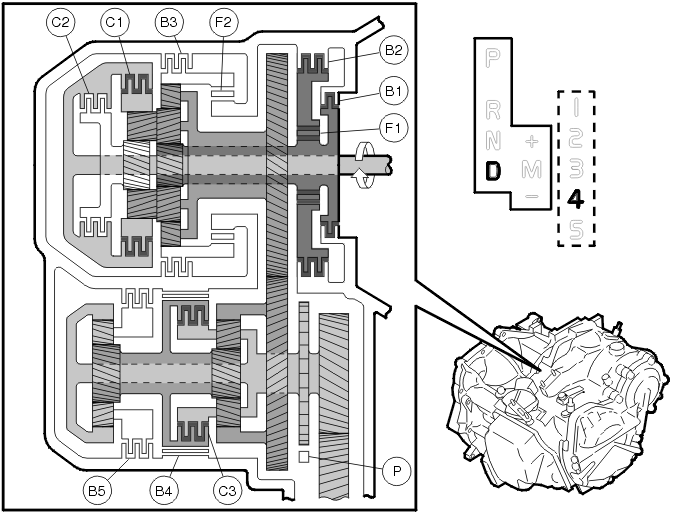
Main section
The input shaft rotates clockwise. Clutch C1 connects the input shaft to the rear ring gear. The rear ring gear rotates clockwise. The rear planetary gear rotates clockwise.
The front large planetary gear rotates clockwise with the rear planetary gear as a unit. Brake B2, freewheel F1 and brake B1 lock the sun gear's rotation.
The front and rear planetary carriers are turned clockwise because of the reactive forces from the front large gear. The primary intermediate gear rotates clockwise with the front and rear planetary carriers as a unit.
U/D section
The secondary intermediate gear rotates clockwise. The front ring gear rotates counter-clockwise with the secondary intermediate gear as a unit. Clutch C3 connects the sun gear to the front planetary carrier.
The front planetary gear cannot rotate and the U/D unit rotates counter-clockwise as a unit. The final drive pinion rotates counter-clockwise with the U/D unit as a unit. The final drive rotates clockwise.
Engine brake
Drive force is transferred directly to the input shaft without the one way clutch. Therefore the engine brake operates.
Position D and 5th gear
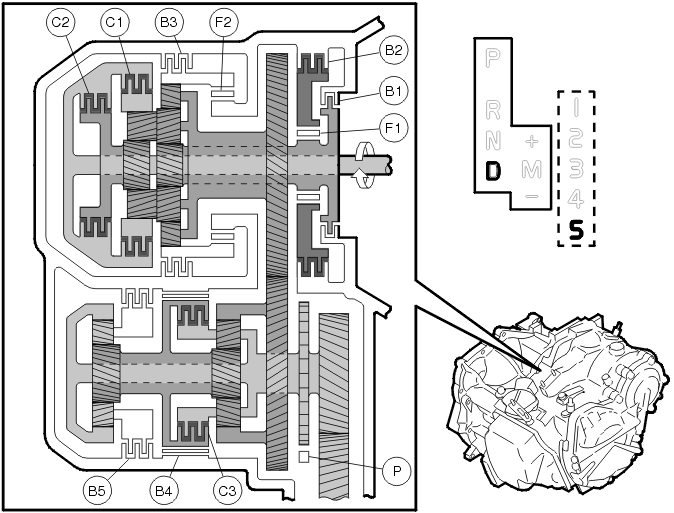
Main section
The input shaft rotates clockwise. Clutch C1 connects the input shaft to the rear ring gear. Clutch C2 connects the input shaft to the sun gear.
The rear planetary gear cannot rotate and the rear planetary gear unit rotates clockwise as a unit. The front planetary gear cannot rotate with the rear planetary gear as a unit. The front planetary unit rotates clockwise as a unit. The primary intermediate gear rotates clockwise with the front planetary unit as a unit.
U/D section
The secondary intermediate gear rotates counter-clockwise. The front ring gear rotates counter-clockwise with the secondary intermediate gear as a unit. Clutch C3 connects the sun gear to the front planetary carrier.
The front planetary gear cannot rotate and the U/D unit rotates counter-clockwise as a unit. The final drive pinion rotates counter-clockwise with the U/D unit as a unit. The final drive rotates clockwise.
Engine brake
Drive force is transferred directly to the input shaft without the one way clutch. Therefore the engine brake operates.
Position R (reverse gear)
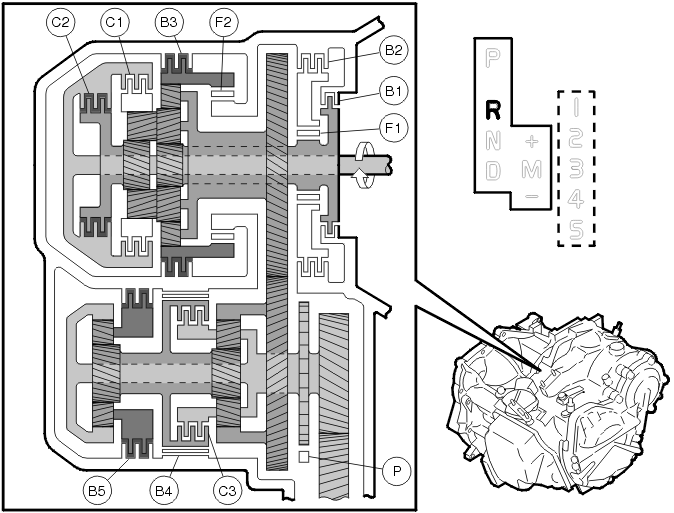
Main section
The input shaft rotates clockwise. Clutch C2 connects the input shaft to the sun gear. The sun gear rotates clockwise.
The rear planetary gear rotates counter-clockwise. The front large planetary gear rotates counter-clockwise with the rear planetary gear as a unit. The front small planetary gear rotates clockwise.
Brake B3 locks the front ring gear's rotation counter-clockwise. The front and rear planetary carriers are turned clockwise because of the reaction forces from the front small gear. The primary intermediate gear rotates counter-clockwise with the front and rear planetary carriers as a unit.
U/D section
The secondary intermediate gear rotates clockwise. The front ring gear rotates clockwise with the secondary intermediate gear as a unit. The front planetary gear rotates clockwise. The front sun gear rotates counter-clockwise.
The rear sun gear rotates counter-clockwise with the front sun gear as a unit. The rear planetary gear rotates clockwise. Brake B5 locks the rear planetary carrier's rotation. The rear ring gear rotates clockwise. The front planetary carrier and final drive pinion rotate clockwise with the rear ring gear as a unit. The final drive rotates counter-clockwise.
Engine brake
Drive force is transferred directly to the input shaft without the one way clutch. Therefore the engine brake operates.
Towing
Towing is only permitted in the vehicle's forward direction at max. 80 km/h for max. 80 km.
The gear selector shall be in position N.
CAUTION: The car must not be towed backwards under any circumstances.
Parts & tools for this job For 1999 Volvo S80
- TOOLTorque wrenchSearch: 3/8 inch torque wrench
- TOOLSocket setSearch: socket set metric
- BOOKHaynes manualSearch: Haynes manual Volvo S80
Links open Amazon search results in a new tab. As an Amazon Associate I earn from qualifying purchases.