
Removal/refitting
- Make
- Alfa Romeo
- Model
- 145/146 Engines, 146 Bodywork and Engine Overhaul Manual
- Year
- 1994–2001
- Section
- Exhaust system › Removal/refitting
The trivalent catalytic converter makes it possible to contemporaneously reduce the three pollutants in the exhaust gases:
- unburnt hydrocarbons (HC);
- carbon monoxide (CO);
- nitric oxide (NOx)
Two types of chemical reactions take place inside the converter:
- oxidation of CO and HC, transformed into carbon dioxide (CO2) and water (H2O)
- reduction of NOx transformed into Nitrogen (N2).
The converter comprises a monolith, a metal mesh support to dampen shocks and vibrations and an outer cover resistant to high temperatures and the weather.
The monolith is made with a honeycomb structure formed of ceramic material coated with a very fine layer of catalytically active substances, platinum or rhodium, which accelerate the decomposition of the harmful gases contained in the exhaust gases, which passing through the cells of the heart at temperatures of above 300° + 350°C, activate the catalysts starting the oxidation and reduction reactions.
To optimise the efficiency and life of the catalyst, a perforated steel sheet cone improves the diffusion of the exhaust gas in the cells of the ceramic heart.
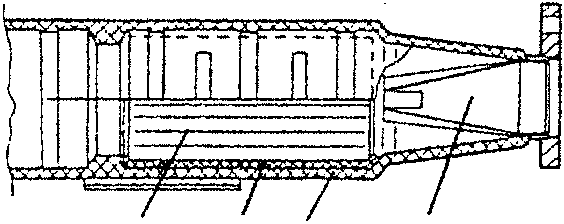
- Ceramic monolith
- Metal support
- Outer cover
- Perforated steel sheet cone
The causes which rapidly and irreversibly damage the catalytic converter are:
- the presence of lead in the fuel, which lowers the degree of conversion to levels that make its presence in the system useless;
- the presence of unburnt fuel in the converter: in fact a flow of petrol for 30 s in an environment at 800°C (inside temperature of the catalyst) is sufficient to melt or break the catalyst.
The ignition system must be in perfect operating conditions, therefore, for no reason at all should the spark plug cables be disconnected with the engine running and, in the event of tests, the silencer should be replaced with an equivalent length of pipe.
If used correctly, the converter will work efficiently for no less than 80.000 km or for at least five years.
The precious metals contained in the catalytic converter, also due to the high temperature, are subject to chemical attack by lead.
FOR THIS REASON, PETROL CONTAINING LEAD MUST NOT BE USED AS THIS WOULD QUICKLY AND IRREVERSIBLY DAMAGE THE CONVERTER. NEVER USE PETROL CONTAINING LEAD EVEN IN AN EMERGENCY OR FOR VERY SHORT PERIODS.
REMOVAL/REFITTING
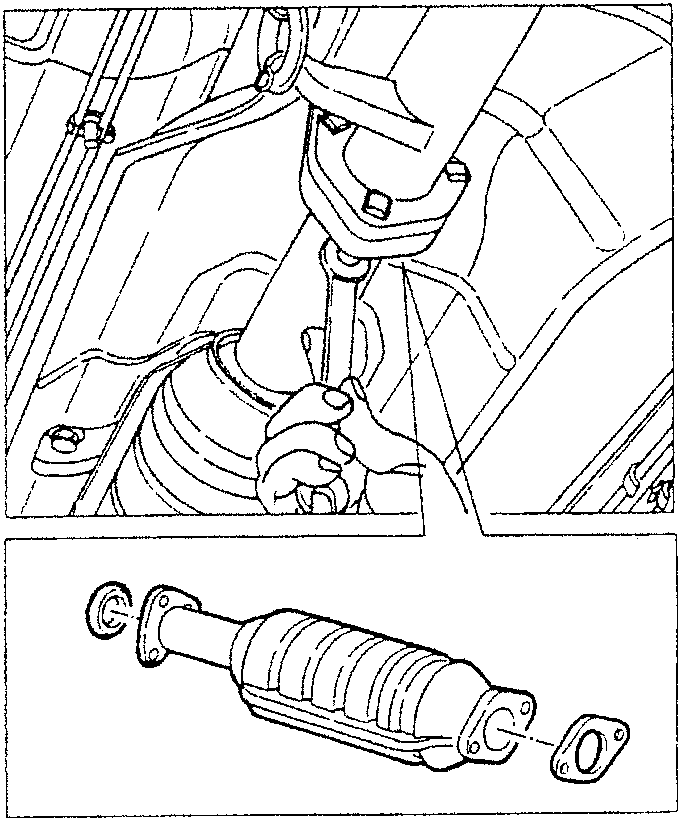
- Set the car on a lift and raise it.
- Remove the fastening bolts of the connection flanges and remove the catalytic converter.
Parts & tools for this job For 1994 Alfa Romeo 145/146
- PARTExhaust gasketSearch: Alfa Romeo 145/146 1994 exhaust gasket
- TOOLPenetrating oilSearch: penetrating oil
- TOOLOBD2 scannerSearch: OBD2 scanner
Links open Amazon search results in a new tab. As an Amazon Associate I earn from qualifying purchases.