
Removal/refitting
- Make
- Alfa Romeo
- Model
- 145/146 Engines, 146 Bodywork and Engine Overhaul Manual
- Year
- 1994–2001
- Section
- Exhaust system › Removal/refitting
The operation of the sensor is based on the fact that with temperatures of above 300°C, the ceramic material used becomes a conductor of oxygen ions. Under these conditions, if the quantity of oxygen at the two sides of the sensor (A and B) is in different percentage, a voltage change is generated between the two ends which is an index of measurement for the difference in the quantity of oxygen in the two environments (environment air side and exhaust gas side) and it alerts the control unit that the oxygen residues in the exhaust gas are not in sufficient percentage to warrant combustion with a low amount of harmful substances. For temperatures below 300°C the ceramic material is not active, therefore the sensor does not send serviceable signals and a special circuit in the control unit stops loop adjustment of the mixture while the sensor heats up. To ensure that the sensor quickly reaches its operating temperature it is fitted with an electrical resistance suitably supplied by the battery; this also makes it possible to install the sensor in cooler areas of the exhaust pipe.
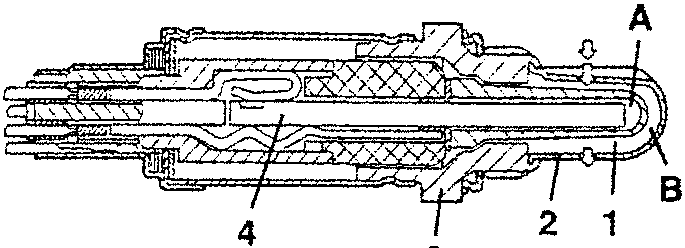
- Ceramic body
- Protective tube
- Metal body
- Electric resistance
REMOVAL/REFITTING
- Disconnect the two electrical connections of the lambda sensor.
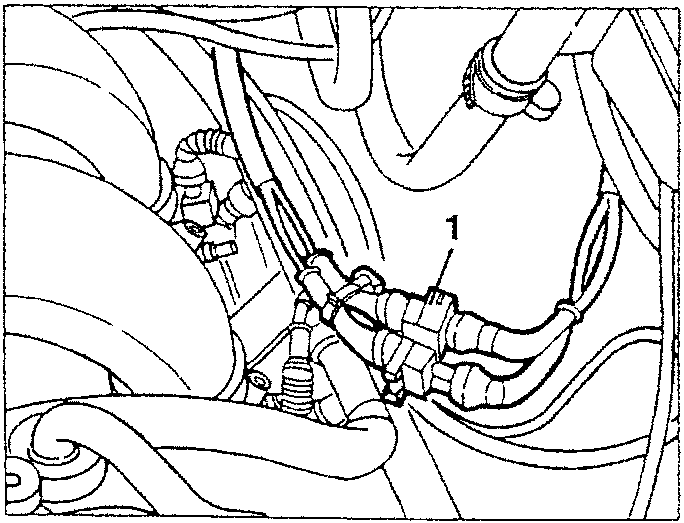
- Slacken and remove the lambda sensor complete with wiring.
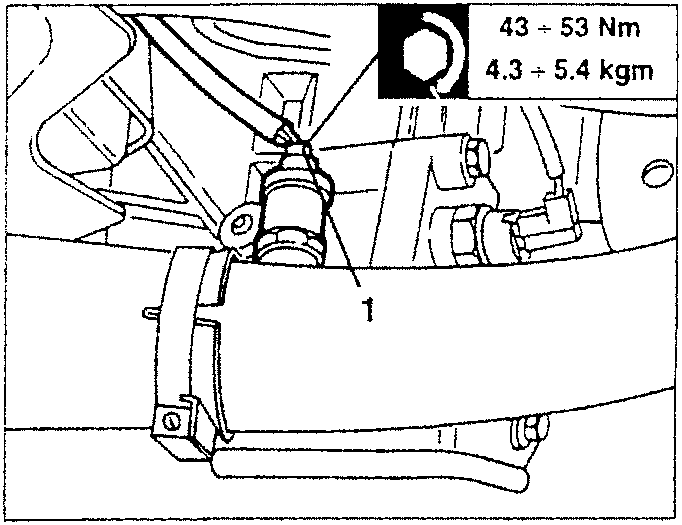
43 ÷ 53 Nm
4.3 ÷ 5.4 kgm
CHECKING EMISSIONS AT THE EXHAUST
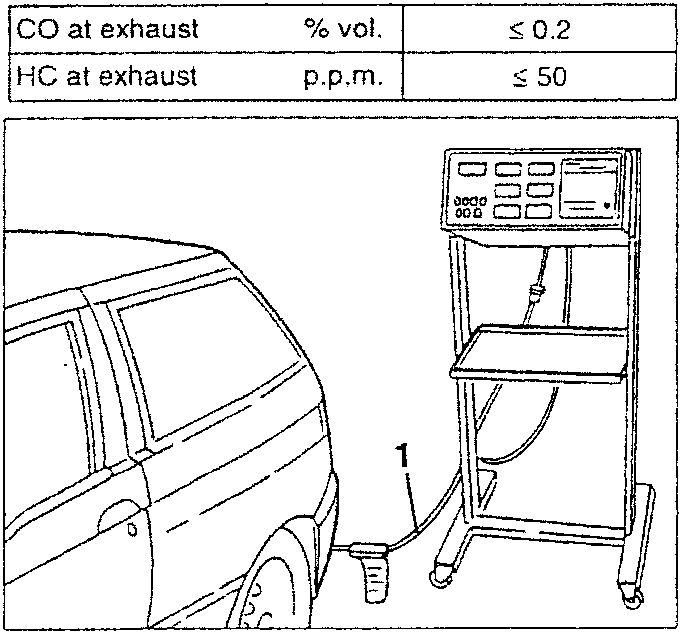
The exhaust emissions must be checked in the open or in a suitable area equipped in accordance with current regulations.
The check must be carried out with the engine at normal operating temperature (i.e. after the fan has turned on and then off) and at idle speed (see: GROUP 00 - "ENGINE TECHNICAL DATA"). If the idle speed is not within the specified limits check that the constant idle speed actuator is working properly.
- Check that the engine oil level is correct and that the air cleaner cartridge is clean.
- Start the engine and run it at idle speed.
- Insert the probe of the analyzer in the end piece of the exhaust pipe and check that the percentages of CO and HC are within the specified limits.
| CO at exhaust | % vol. | ≤ 0.2 |
|---|---|---|
| HC at exhaust | p.p.m. | ≤ 50 |
Parts & tools for this job For 1994 Alfa Romeo 145/146
- PARTExhaust gasketSearch: Alfa Romeo 145/146 1994 exhaust gasket
- TOOLPenetrating oilSearch: penetrating oil
- TOOLOBD2 scannerSearch: OBD2 scanner
Links open Amazon search results in a new tab. As an Amazon Associate I earn from qualifying purchases.