
Care of Alloy Road Wheels
- Make
- Aston Martin
- Model
- DB9 Factory Workshop Manual
- Year
- Issue 2, 2005
- Section
- Road Wheels and Tyres › Care of Alloy Road Wheels
In view of the high performance capability of the vehicle, damaged tyres should be renewed and not repaired.
Caution
When a new tyre is installed, always renew the tyre valve.
Care of Alloy Road Wheels
Aluminium alloy road wheels are covered with a protective coating. To prevent corrosion it is essential that this coating is not damaged. When removing or installing tyres only equipment utilizing spigot or stud hole clamping must be used. The equipment must not have any moving parts which contact the road wheel, and tyre levers must not be used.
To clean road wheels use warm soapy water; stubborn stains can be removed using a soft brush or by using a proprietary alloy road wheel cleaner.
Road Wheel Alignment
It is important that correct road wheel alignment be maintained. Misalignment causes tyre tread to be scrubbed off laterally because the natural direction of the road wheel differs from that of the vehicle.
A sharp ‘fin’ protrusion on the edge of each pattern rib is a sure sign of misalignment.
- ‘Fins’ on the inside edges of the pattern ribs, particularly on the nearside tyre, indicate Toe-in.
- ‘Fins’ on the outside edges, particularly on the offside tyre, indicate Toe-out.
With minor misalignment, the evidence is less noticeable and sharp pattern edges may be caused by road camber even when the road wheel alignment is correct. In such cases it is better to make sure by checking with an alignment gauge. Road camber affects the direction of the vehicle by imposing a side thrust and, if left to follow its natural course, the vehicle will drift towards its nearside. This is instinctively corrected by steering towards the road centre and, as a result, the vehicle runs crabwise. The diagram shows why nearside tyres are very sensitive to too much Toe-in and offside tyres to Toe-out.
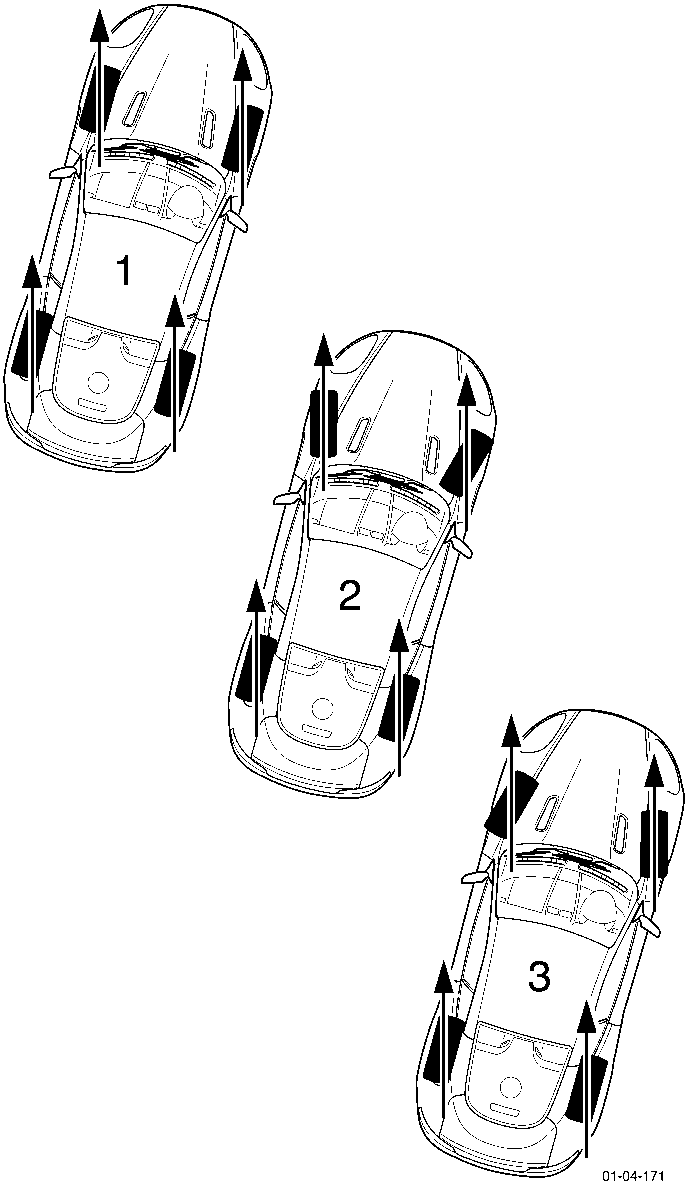
It also shows why sharp ‘fins’ appear on one tyre but not on the other, and why the direction of misalignment can be determined by noting the position of the ‘fins’. Severe misalignment produces clear evidence on both tyres.
Front road wheels on a moving vehicle should be parallel. Tyre wear can be affected noticeably by quite small variations from this condition. It will be noted from the diagram that even with parallel road wheels, the vehicle is still out of line with its direction of movement, but there is less tendency for the wear to be concentrated on one tyre.
The near front tyre sometimes persists in wearing faster and more unevenly than the other tyres, even when the mechanical condition of the vehicle and tyre maintenance are satisfactory. The more severe the average road camber, the more marked this tendency will be.
Parts & tools for this job For 2005 Aston Martin DB9
- TOOLTyre pressure gaugeSearch: digital tyre pressure gauge
- TOOLTorque wrenchSearch: 1/2 inch torque wrench
- TOOLBreaker barSearch: breaker bar
Links open Amazon search results in a new tab. As an Amazon Associate I earn from qualifying purchases.