
Connectors
- Make
- Aston Martin
- Model
- DB9 Factory Workshop Manual
- Year
- Issue 2, 2005
- Section
- Wiring and Circuit Protection › Connectors
A fibre optic carries out a similar function to that of a wire in that it transmits data signals. The differences being that where a wire is made up of copper strands in an insulated sleeve a fibre optic is a plastic tube with a highly polished reflective inside surface.
The fibre optic carries the data in the form of a pulse of light, which is sent via an infrared transmitter and picked up at the next component in the loop via an infrared receiver. The light pulse is then converted to an electrical signal that is used by that module or component.
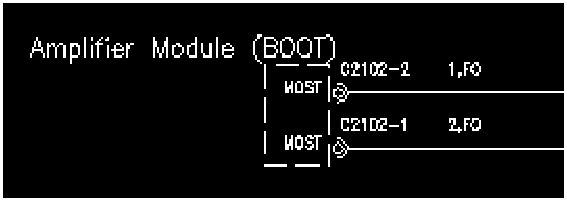
The CAN sends signals around the vehicle where the modules or components remove their specific signals. The fibre optic is in a loop with the module components in that loop, one fibre goes in and one fibre goes out. This is shown below.
| Fibre optic in harness | 1 | FO |
| Fibre Optic |
Connectors
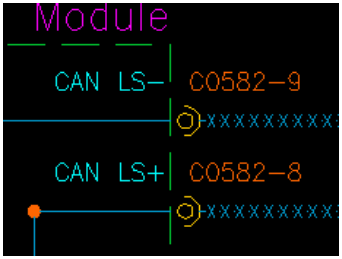
There are 2 types of interconnect shown on the circuits. Each connector is given a dedicated ‘C’ number. The number after the dash is the pin number, also known as the cavity number. The example below is C0582 that when checked on the attached list refers to the CEM Connector Cockpit 2 (C3).
The 1st type is shown for a connector that is on a module or component with a mating harness connector attached to it.
| Connector C number | C0582 | 9 |
| Connector pin / cavity number |
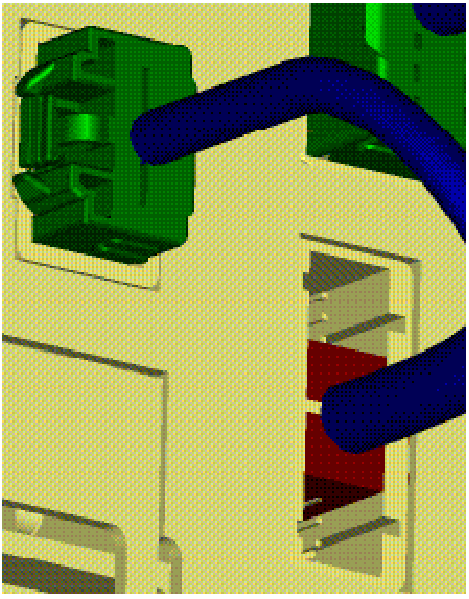
The 2nd type is shown for a connector on a harness with the mating connector on another harness. This is known as an Inline. Again the above naming convention applies.
Parts & tools for this job For 2005 Aston Martin DB9
- TOOLDigital multimeterSearch: automotive digital multimeter
- PARTAssorted fuse kitSearch: car fuse assortment kit
- TOOLWire crimper and connector kitSearch: wire crimper connector kit
Links open Amazon search results in a new tab. As an Amazon Associate I earn from qualifying purchases.