Workshop Manuals Factory service & repair Fiat
01 00 Introduction and technical data02 10 Engine03 18 Clutch04 21 Gearbox and differential05 33 Braking system06 41 Steering07 44 Suspension and wheels08 50 Auxiliary units09 55 Electrical system10 70 Bodywork
Fiat Punto (176) Factory Service Manual (1993-1999)02 · 10 Engine
02 · Engine

Pyrolysis

Make
Fiat
Model
Punto (176) Factory Service Manual
Year
1993–1999
Section
Fuel system (1372 T) › Pyrolysis
10 EnginePyrolysis
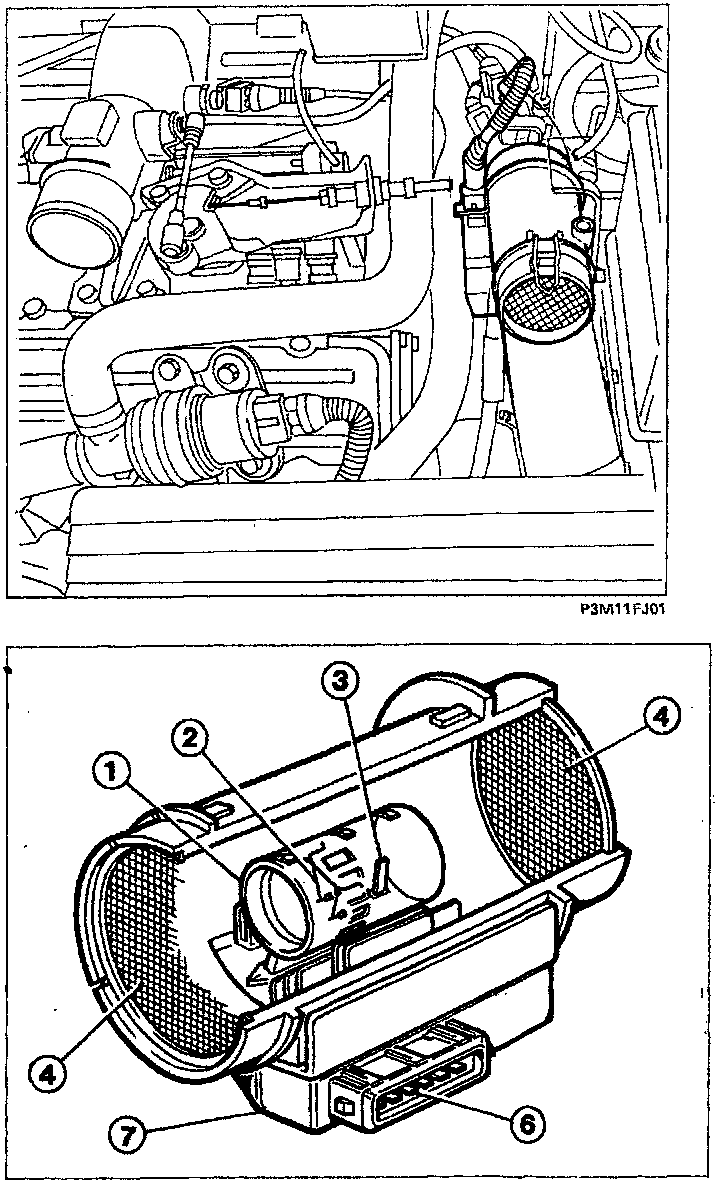
Engine bay showing the location of the hot wire air meter assembly
Cutaway diagram of the hot wire air meter showing internal components
  1. Support conveying air to hot wire
  2. Platinum filament or hot wire
  3. Resistance (constantan) for comparing hot wire temperature
  4. Filter mesh
  5. Supply terminal
  6. Meter ECU in aluminium case
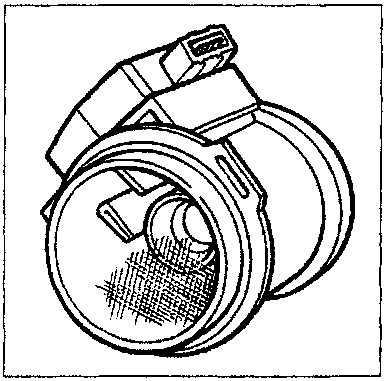
Direct measurement of the air mass taken in by the engine is carried out by a hot wire debimeter. Air taken in by the engine strikes a filament maintained constantly 100°C above intake air temperature by an electrical current, despite the cooling experienced by the filament when the intake air volume increases. The volume of air taken in by the engine can be established by the amount of this change. The hot wire current variation is proportional to intake air volume, density and speed. Barometric changes due to high altitude do not therefore affect intake air volume directly. Hot wire temperature and current changes are closely related because the hot wire forms part of a precision measuring circuit made up of a Wheatstone bridge and an electronic amplification system of which two components: hot wire (2) and constantan comparison resistance (3) are in contact with the mass of air taken into the engine, whereas the other parts of the circuit (resistances) are located in the top part (7) of the meter inside an aluminium container.

Pyrolysis

Whenever the engine stops after speeds in excess of 2400/min, filament (2) carries a current governed by the ECU for about 1 second that takes the temperature to 1000°C in order to burn off all the carbon deposits on the wire because otherwise these would alter the 100°C hot wire maintenance current and thus the exact air-fuel ratio calculated by the ECU.

If the hot wire is broken, the engine may continue to work (with very rich mixtures) using data stored in the ECU. This allows the vehicle to be driven to a repair workshop (RECOVERY function). Engines being recovered must not be allowed to cool because otherwise they will not be able to start again.

Parts & tools for this job For 1993 Fiat Punto

Links open Amazon search results in a new tab. As an Amazon Associate I earn from qualifying purchases.