
Modular inlet manifold (v.i.s.)
- Make
- Fiat
- Model
- Stilo Factory Service Manual
- Year
- 2001–2007
- Section
- Inlet and exhaust manifolds › Modular inlet manifold (v.i.s.)
Modular inlet manifold (v.i.s.)
Type
This is a modular length inlet manifold managed by the injection control unit which makes it possible to increase volumetric efficiency and thereby:
- improving the torque supply at low-medium speeds
- increasing the power at high speeds.
Type
This is a modular length inlet manifold managed by the injection control unit which makes it possible to increase volumetric efficiency and thereby:
- improving the torque supply at low-medium speeds
- increasing the power at high speeds.
Structure
The modular intake manifold consists of:
- two nylon half shells;
- a set of 4 throttles positioned on the same axis that open/close the short intake duct branches;
- a vacuum accumulator inside the manifold;
- a modular intake device control actuator
Structure
The modular intake manifold consists of:
- two nylon half shells
- a vacuum accumulator inside the manifold
- an actuator controlling the modular intake device, with built-in two-way solenoid.
Introduction
The fuel injection control unit controls the two-way solenoid (1) which places the vacuum accumulator (2) in communication with the pneumatic actuator (3), which in turn, via a linkage, allows the opening/closing of the throttles (4).
This movement allows the ducts to assume the following configurations;
intake from long ducts (from 2000 rpm to 5400 rpm, at medium/high engine load): in this position, the solenoid is not activated and the actuator is in rest position. The throttles are therefore closed and the engine takes in air from the long ducts to achieve high torque at medium speeds;
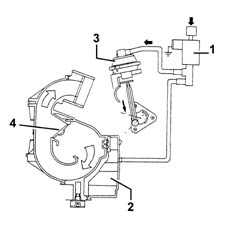
OPERATION
The fuel injection control unit controls the two-way solenoid (1) which places the vacuum accumulator (2) in communication with the pneumatic actuator (3), which in turn, via a linkage, allows the oscillating pipe (4) to move.
The rotation of the rocker duct allows the manifolds to assume the following configurations:
long torque ducts for speeds up to 4700 rpm
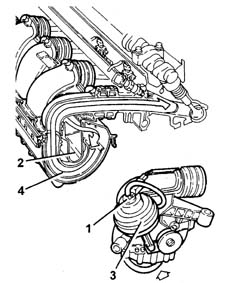
Introduction
intake from short ducts (under 2000 rpm and over 5400 rpm at medium/high load; especially at low rpm): in this position the solenoid is supplied and it places the actuator in communication with the vacuum reservoir, causing the throttles to open, so the engine draws from the short ducts, to obtain the maximum power.
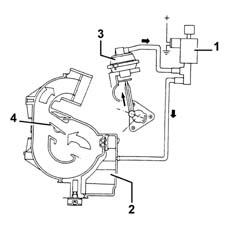
OPERATION
short power ducts for speeds above 4700 rpm
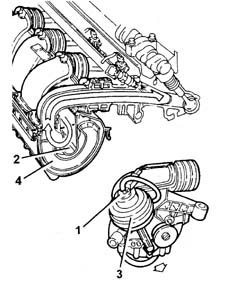
Type
This two-way solenoid is located on the lower part of the intake manifold. It is controlled by the injection control unit.
Its function is to allow the vacuum present in the vacuum tank (inside the inlet chamber) to act on the pneumatic actuator which controls the oscillating pipe.
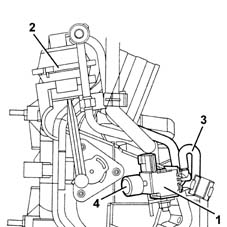
1, Solenoid
2, Actuator
3, Vacuum intake pipe
4, Atmospheric air intake
OPERATION
Modular manifold engagement logic
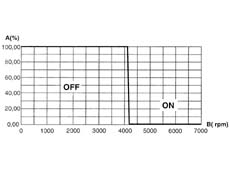
A - Throttle position
B - Engine rpm
Type
This is a two-way solenoid valve integrated in the pneumatic inlet manifold actuator and is operated by the injection control unit.
Its function is to allow the vacuum present in the vacuum tank (inside the inlet chamber) to act on the pneumatic actuator which controls the oscillating pipe.
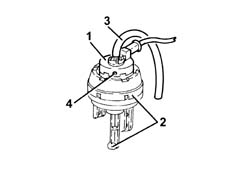
1 - Solenoid
2 - Actuator
3 - Vacuum intake pipe
4 - Atmospheric air intake
Parts & tools for this job For 2001 Fiat Stilo
- PARTExhaust gasketSearch: Fiat Stilo 2001 exhaust gasket
- TOOLPenetrating oilSearch: penetrating oil
- TOOLOBD2 scannerSearch: OBD2 scanner
Links open Amazon search results in a new tab. As an Amazon Associate I earn from qualifying purchases.