Clutch pressure test
- Make
- Rover
- Model
- 400 Workshop Manual
- Year
- 1995–2000
- Section
- Fault diagnosis › Clutch pressure test
Automatic gearboxClutch pressure test
CLUTCH PRESSURE TEST
- Raise front and rear of vehicle.
WARNING: Support on safety stands
- Run engine until it reaches normal operating temperature.
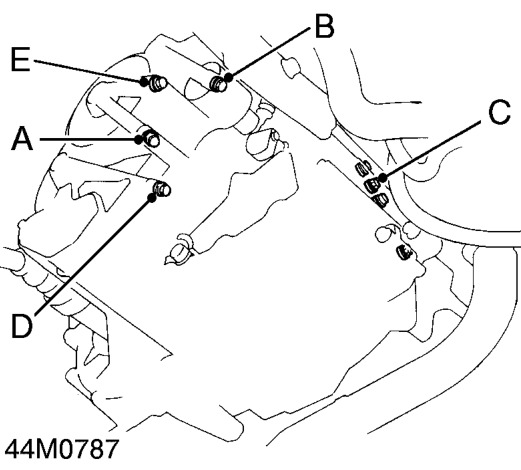
Clutch pressure inspection plugs
A- 1st clutch B- 1st hold clutch C- 2nd clutch D- 3rd clutch E- 4th clutch
NOTE: Clutch pressures should be checked one at a time using the following procedures. Specific instructions for checking individual clutches are given under the appropriate heading.
- Remove inspection plug of clutch to be tested, discard sealing washer.
- Connect one gauge (0 to 20 bar) of gauge set 18G 1554 to inspection plug hole.
- On completion of test, disconnect gauge.
- Fit a new sealing washer to inspection plug, fit and tighten plug to 18 Nm.
WARNING: Ensure that when carrying out pressure tests, personnel keep clear of rotating wheels
1st clutch
- Select ’1’ or ’D4’, release handbrake and allow wheels to rotate freely.
- Run engine at 2000 rev/min and observe pressure recorded on gauge: Standard = 8.2 to 8.9 bar Service limit = 7.5 bar
- If pressure is non-existent or low, 1st clutch is faulty.
- Check 1st hold clutch pressure.
1st hold clutch
- Select ’1’, release handbrake and allow wheels to rotate freely.
- Run engine at 2000 rev/min and observe pressure recorded on gauge: Standard = 8.2 to 8.9 bar Service limit = 7.5 bar
- If pressure is non-existent or low, 1st hold clutch is faulty.
2nd clutch
- Select ’D4’, release handbrake and allow wheels to rotate freely.
- Allow engine to idle and using assistance, hold throttle control drum fully closed and observe pressure recorded on gauge: Pressure = 3.4 to 3.9 bar
- Select ’2’, allow wheels to rotate freely.
- Run engine at 2000 rev/min and using assistance, hold throttle control drum slightly more than 1/8 open.
- Observe pressure recorded on gauge: Standard = 8.2 to 8.9 bar Service limit = 7.5 bar
- If either pressure reading is non-existent or low, 2nd clutch is faulty.
Parts & tools for this job For 1995 Rover 400
- PARTClutch kitSearch: Rover 400 1995 clutch kit
- TOOLClutch alignment toolSearch: clutch alignment tool
- FLUIDGear oilSearch: Rover 400 manual gearbox oil
Links open Amazon search results in a new tab. As an Amazon Associate I earn from qualifying purchases.