
Disc thickness and parallelism (Brakes)
- Make
- Rover
- Model
- 400 Workshop Manual
- Year
- 1995–2000
- Section
- Adjustments › Disc thickness and parallelism
BrakesDisc thickness and parallelism
Disc thickness and parallelism
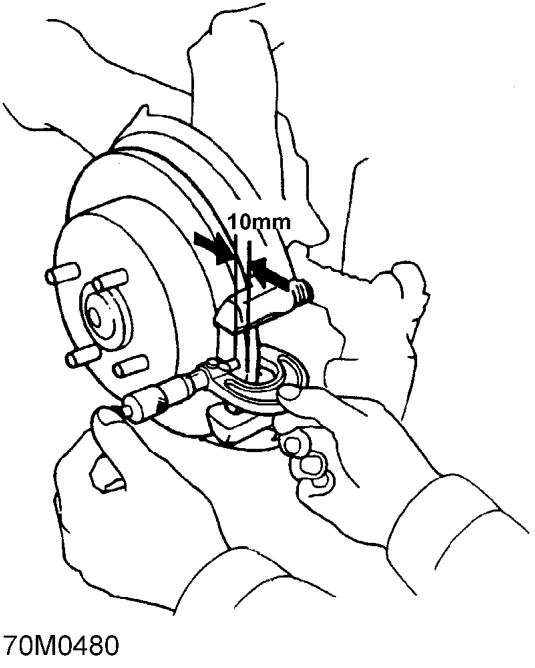
- Using a micrometer positioned 10 mm from outer edge of disc, measure thickness of disc at four points. Disc thickness: New = 9.9 - 10.1 mm Service limit = 8.0 mm Maximum thickness variation = 0.015 mm.
- Renew disc if below service limit.
CAUTION: Brake discs must be renewed in pairs unless one disc requires changing before 1000 miles (1500 km) from new.
NOTE: Brake discs can be refaced using an on car disc lathe providing the disc thickness is sufficiently great to be 1 mm over service limit after machining.
Disc run-out
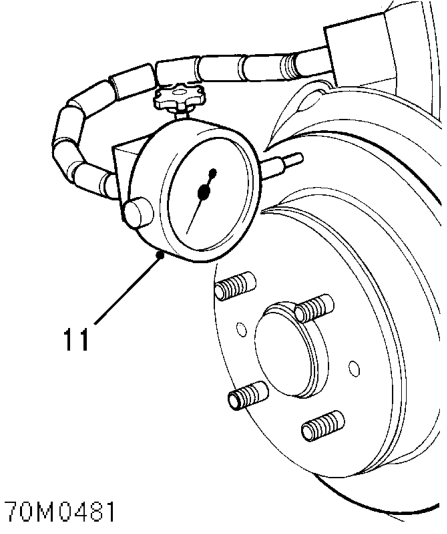
- Mount a dial test indicator and position indicator probe 10 mm from outer edge of disc.
- Rotate disc at least one complete turn and measure disc run-out. Disc run-out limit = 0.10 mm
Run-out exceeds limit
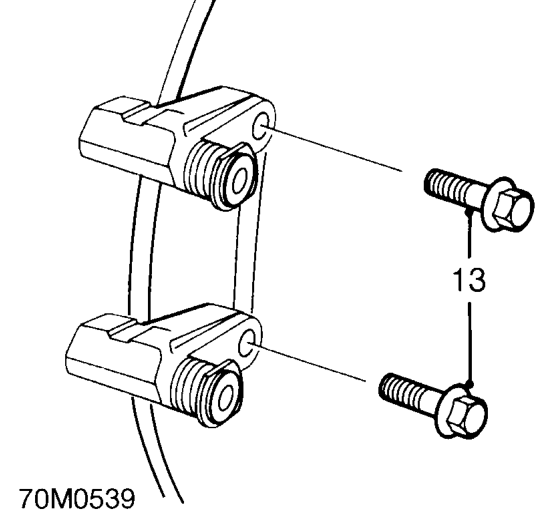
- Remove 2 bolts securing caliper carrier and remove carrier.
- Mark disc to flange relationship, and remove disc from drive flange. Clean disc mounting faces, rotate disc 180°and secure with screws. Recheck run-out.
Parts & tools for this job For 1995 Rover 400
- PARTBrake padsSearch: Rover 400 1995 brake pads
- TOOLBrake bleeder kitSearch: one man brake bleeder kit
- FLUIDBrake fluidSearch: brake fluid
Links open Amazon search results in a new tab. As an Amazon Associate I earn from qualifying purchases.