
Evaporator
- Make
- Volkswagen
- Model
- Tiguan Mk2
- Year
- 2016–2023
- Section
- Refrigerant circuit › Evaporator
Evaporator
There are different types of evaporator. Depending on the design and function, the thermal energy that is needed to evaporate the refrigerant is drawn from the air flowing through the system (e.g. with the evaporator in heater and air conditioning unit or in the battery cooling module) or the coolant flowing through the system (e.g. with the heat exchanger for the high-voltage battery) Heating, air conditioning systemRep. gr.87Refrigerant circuit; System overview - refrigerant circuit (vehicle-specific workshop manual).
Note
- The following describes 2 versions of the evaporator.
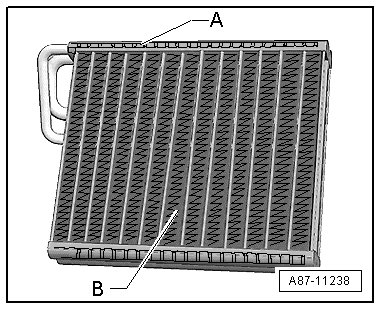
- The liquid refrigerant evaporates in the pipelines of the evaporator (A). The heat required to do this is drawn from the air flowing over the evaporator fins (B). The air cools. The refrigerant evaporates and is drawn into the air conditioner compressor carrying with it the heat it has absorbed.
- A defined quantity of refrigerant is fed to the evaporator through an expansion valve (restrictor). In systems with an expansion valve, the flow is regulated such that only gaseous refrigerant exits the evaporator.
- When R1234yf refrigerant was introduced, the evaporators were adapted to the refrigerant, hence the need to observe the correct version Electronic parts catalogue.
The liquid refrigerant evaporates in the evaporator (heat exchanger). The heat required to do this is drawn from the coolant that flows through the evaporator. The coolant cools. The refrigerant evaporates and is drawn into the air conditioner compressor carrying with it the heat it has absorbed.
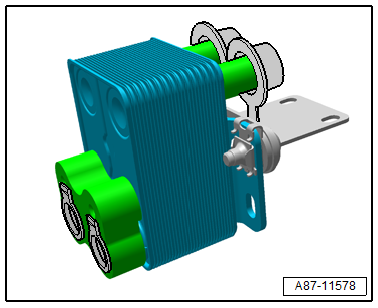
A defined quantity of refrigerant is fed to the evaporator through a restrictor (or an expansion valve) and a shut-off valve. The flow rate of the coolant (or refrigerant) is regulated in such a way that only gaseous refrigerant escapes at the evaporator outlet Heating, air conditioningRep. gr.87Refrigerant circuit; System overview - refrigerant circuit (vehicle-specific workshop manual).
Parts & tools for this job For 2016 Volkswagen Tiguan
- TOOLA/C manifold gauge setSearch: AC manifold gauge set
- TOOLUV leak detection kitSearch: AC UV leak detection kit
- PARTCabin filterSearch: Volkswagen Tiguan 2016 cabin filter
As an Amazon Associate we earn from qualifying purchases.