
Refrigerant shut-off valves
- Make
- Volkswagen
- Model
- Tiguan Mk2
- Year
- 2016–2023
- Section
- Refrigerant circuit › Refrigerant shut-off valves
‹ Prev Expansion valve (with and without shut-off valve)Next › Refrigerant line with internal heat exchanger
Air conditioning systems with R1234yf refrigerant - General informationRefrigerant shut-off valves
Refrigerant shut-off valves
- Shut-off valves come in different versions, with different functions and different designations Heating, air conditioningRep. gr.87Refrigerant circuit.
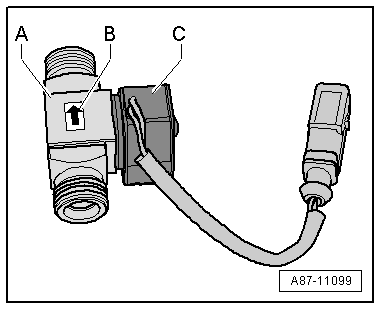
- If the shut-off valve (A) is not actuated by the electronics, it is open and allows refrigerant to flow through.
- The shut-off valve (A) is installed on vehicles with high-voltage system, for example. It is actuated when no climate control is wanted for the passenger compartment but battery cooling is required for the hybrid battery unit AX1.
- Note the arrow (B) on the shut-off valve (A), which shows the direction of refrigerant flow (from condenser to evaporator in the heater and air conditioning unit).
- The solenoid (C) attached to the shut-off valve (A) is actuated by different control units depending on the vehicle Current flow diagrams, Electrical fault finding and Fitting locations and Vehicle diagnostic tester in “Guided fault finding” mode - air conditioning system and battery regulation.
- If, on a vehicle with 2 evaporators (one in the heater and air conditioner unit and one in the battery cooling module, e.g. the Audi Q5 Hybrid), the temperature measured at an evaporator meets the specification or falls below the specification, while on the other evaporator however the requisite specification is not reached, regulation works as follows: the respective control unit makes the electrical air conditioner compressor run at a higher speed (which results in the cooling output of the air conditioning system rising and pressure on the low pressure side falling along with the evaporator temperature). If the temperature at an evaporator then falls below the specified level, the respective control unit actuates the shut-off valve in such a way that the evaporator that is too cold no longer has refrigerant flowing through it Heating, air conditioningRep. gr.87Refrigerant circuit and Vehicle diagnostic tester in “Guided fault finding” mode.
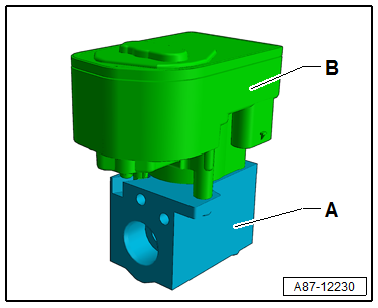
- The shut-off valve (A) is actuated via an incremental motor (B) by the respective control unit with characteristic curves (open or closed).
- If the shut-off valve acts as a control valve (e.g. refrigerant expansion valve 1 N636 as is the case with the Audi Q7), it is only opened enough to allow the temperature set for the heat exchanger to be reached Heating, air conditioningRep. gr.87Refrigerant circuit.
- Shut-off valves actuated via incremental motors do not have a defined rest position. For this reason, they have to be set to a certain position (open or closed) before work on the refrigerant circuit is performed Heating, air conditioningRep. gr.87Refrigerant circuit.
- Depending on layout of the refrigerant circuit there could be a cluster of shut-off valves forming a valve block (e.g. on the e-Golf or Audi Q7 e-tron) Heating, air conditioningRep. gr.87Refrigerant circuit.
- The incremental motor is programmed and actuated via data lines (LIN-Bus) by the respective control unit in relation to its installation location Heating, air conditioningRep. gr.87Refrigerant circuit and Vehicle diagnostic tester in “Guided fault finding” mode.
‹ Prev Expansion valve (with and without shut-off valve)Next › Refrigerant line with internal heat exchanger
Parts & tools for this job For 2016 Volkswagen Tiguan
- PARTEngine gasket setSearch: Volkswagen Tiguan 2016 engine gasket set
- TOOLTorque wrenchSearch: 3/8 inch torque wrench
- TOOLFeeler gauge setSearch: feeler gauge set
As an Amazon Associate we earn from qualifying purchases.