
Removing and installing condenser
- Make
- Audi
- Model
- Q7 Mk2
- Year
- 2015–2023
- Section
- Refrigerant circuit › Removing and installing condenser
Removing and installing condenser
Note
- Even if fitted correctly, there may be slight pressure marks on the radiator and condenser fins. This is not to be viewed as damage. Neither radiator nor condensers are to be replaced on account of such minor pressure marks.
- If the condenser and radiator are no longer parallel as a result of slight deformation at the securing lugs on the sides of the condenser (e.g. following an accident), this can be remedied by bending the lugs back into position, provided that the condenser (refrigerant circuit) is still functioning properly and that there is no leakage. If the lugs are slightly deformed, the condenser need not be renewed.
- Slight bending of the condenser (up to 4 mm) is not a problem as long as there is enough of a gap (at least 4 mm) between the condenser and the radiator, the condenser (refrigerant circuit) is still functioning properly and there is no leakage. Slight deformation does not necessitate replacement of the condenser.
- There are different condenser versions depending on vehicle model (e.g. with or without connection for high-pressure sender G65) Electronic parts catalogue.
- The high-pressure sender G65 will be dispensed with shortly after the start of production on vehicles with high-voltage system (deadline tbc). On these vehicles, the G65 function will be performed by the refrigerant pressure and temperature sender G395.
Vehicles with high-voltage system (Audi Q7 e-tron)
Initiate the basic settings of the air conditioner via the thermal management control unit J1024 and use a routine stored there “Extract, evacuate and charge refrigerant circuit” to open the electrically operated valves Vehicle diagnostic tester in “Guided Fault Finding” mode.
Note
- To drain, evacuate and fill the refrigerant circuit on vehicles with high-voltage system, the valves in the coolant circuit that are operated electrically must be open. Activate and open valves via a routine stored in the thermal management control unit J1024Vehicle diagnostic tester in “Guided Fault Finding” mode.
All vehicles
Switch off ignition.
Discharge refrigerant circuit Air conditioner with refrigerant R134aRep. gr.87Refrigerant circuit.
Remove lock carrier cover General body repairs, exteriorRep. gr.63Bumper (front); Removing and installing attachments.
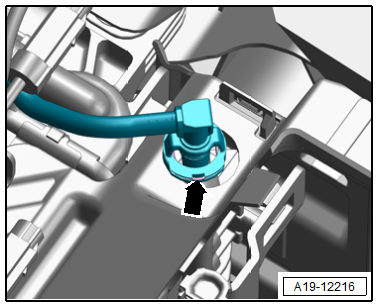
Petrol engine: Raise retaining clip (arrow) and detach coolant line from radiator for charge air cooling circuit.
Note
- Seal off open connections in the lines at the connection point using clean plugs, e.g. from engine bung set VAS 6122.
Unscrew bolts (2) and move back bracket (1) with cables.
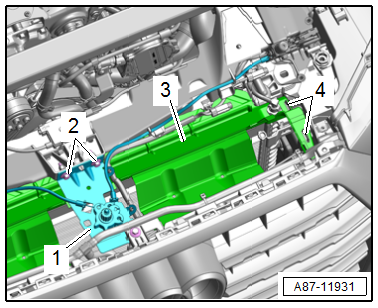
Release the catches (4) on the left and right and remove the top air duct (3).
Separate refrigerant lines from condenser → Chapter.
Unplug electrical connector (2) for high-pressure sender G65 (if present).
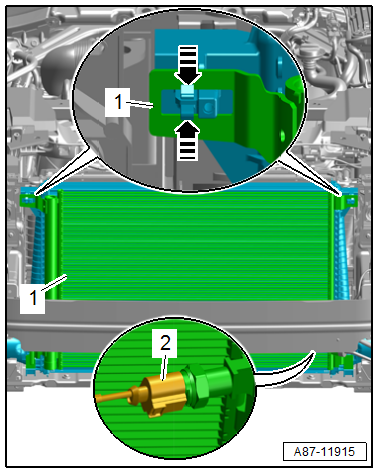
Release catches (arrows) and pull condenser (1) a short distance away from the radiator while pushing the air ducts on the left and right to the side slightly.
Pull condenser upwards out of the mountings on the radiator.
Install in reverse order of removal; note the following:
Note
- When it has been removed, the condenser contains refrigerant oil which must be returned to the refrigerant circuit (together with the new condenser) Air conditioner with refrigerant R134aRep. gr.87Renewing components of refrigerant circuit.
Attach refrigerant lines to condenser Chapter“Separating refrigerant lines from condenser/connecting”.
Evacuate and charge refrigerant circuit Air conditioner with refrigerant R134aRep. gr.87Refrigerant circuit.
Re-install remaining components (removed earlier).
Switch on ignition.
On vehicles with high-voltage system (Audi Q7 e-tron), initiate air conditioner basic settings via the thermal management control unit J1024and, using a routine stored there, enable the electrically operated valves“Stop routine: Filling/flushing refrigerant circuit”Vehicle diagnostic tester in “Guided Fault Finding” mode.
Interrogate the event memory of the front air conditioner operating and display unit E87 and erase any faults displayed Vehicle diagnostic tester in “Guided Fault Finding” mode.
Start up air conditioner after charging refrigerant circuit Chapter“Starting up air conditioner after charging refrigerant circuit”.
Note
- Also observe notes on starting up air conditioner after charging Air conditioner with refrigerant R134aRep. gr.87General notes on air conditioning systems.
Parts & tools for this job For 2015 Audi Q7
- TOOLA/C manifold gauge setSearch: AC manifold gauge set
- TOOLUV leak detection kitSearch: AC UV leak detection kit
- PARTCabin filterSearch: Audi Q7 2015 cabin filter
As an Amazon Associate we earn from qualifying purchases.