
8.2.2. brake discs
- Make
- Peugeot
- Model
- J5 Pocket Mechanic, 1.8 and 2.0 petrol
- Year
- 1987–1994
- Section
- Front disc brakes › 8.2.2. brake discs
Brake system8.2.2. brake discs
carry out the operation at a petrol station.
- From the inside of the cylinder bore remove the cylinder sealing ring(s) with a blunt, pointed instrument. Do not damage the bore(s).
- Clean all parts in clean brake fluid or alcohol. All parts in the repair kit must be used, i.e. do not use any of the old parts.
- Coat the cylinder seal(s) with clean brake fluid and insert them into the groove(s), using the fingers only.
- Fit the dust seals to the pistons and slowly insert the piston into the caliper bore. Insert the deal lip into the cylinder groove and push the piston fully in. Check that the dust seals are correctly fitted.
- Fit the brake hoses to the caliper body and tighten them to 1.3 kgm (11 ft.lb.).
- Thoroughly clean the mounting face of caliper and steering knuckle, coat the caliper bolts with "Loctite", fit the caliper assembly in position and fit the bolts. Tighten the bolts in several stages to a final torque of 14.5 kgm (105 ft.lb.).
- Fit the brake pads (Section 8.1.2).
- Insert the brake hoses into the bracket and secure with the spring plates. Fit the brake pipes and tighten the union nuts. Move the wheels from one lock to the other and check that the brake hoses cannot rub against other parts of the front suspension. If necessary, slacken the union nuts and rotate the hose(s) accordingly.
- Finally bleed the brake system as described later on.
8.2.2. BRAKE DISCS
Brake discs must be replaced if the friction faces show grooves or other damage. Grooves can develop if the brake pads have been allowed to wear down to the metal plates. Measure the thickness of the brake discs with a micrometer or a caliper and compare the results with the dimensions given in Section 8.1. If in doubt, you may be able to get information for your particular vehicle from your dealer. If the discs shows slight wear, you may have them re-ground.
Replace brake disc as follows:
- Slacken the wheel bolts, place the front end of the vehicle on chassis stands and remove the wheel.
- Remove the brake pads as described.
- Remove the two bolts from the outside of the wheel hub. One is used to guide the wheel, the other one secures the disc. The brake disc has a tight fit on the hub. Three M10 x 1.25 bolts can be screwed into the visible threaded bores and
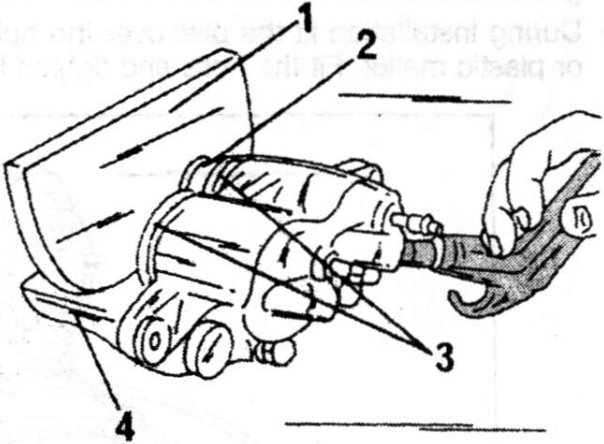
- piece of hardwood
- piston
- dust seal
- caliper opening
Parts & tools for this job For 1987 Peugeot J5
- PARTFront brake padsSearch: Peugeot J5 1987 front brake pads
- TOOLCaliper piston rewind toolSearch: brake caliper piston rewind tool
- FLUIDBrake fluidSearch: brake fluid
Links open Amazon search results in a new tab. As an Amazon Associate I earn from qualifying purchases.