Control in "assist" position (page 2 of 3)
- Make
- Rover
- Model
- 600 Rover 600 Repair Manual - Volumes 1 and 2 - 2nd Edition
- Section
- Information
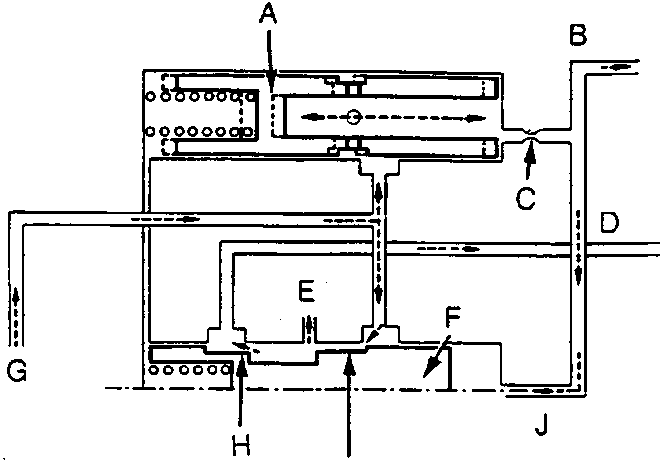
57M0058
| A | Pressure Control Valve |
| B | To power steering speed sensor |
| C | Sensor Orifice |
| D | To reservoir |
| E | To reaction chamber |
| F | Gain Control Valve |
| G | Feed |
| H | Tank Side Orifice |
| I | Feed Side Orifice |
| J | Pressure in response to vehicle speed |
The power steering speed sensor turns only when the car is moving, controlling the gain control valve. The constant pressure is generated by the pressure control valve.
This pressure is used as a reference pressure for the response to the car speed. By introducing this pressure to the power steering speed sensor through the sensor orifice, the pressure downstream of the orifice is changed according to the speed of the car.
This pressure is then used to operate the gain control valve.
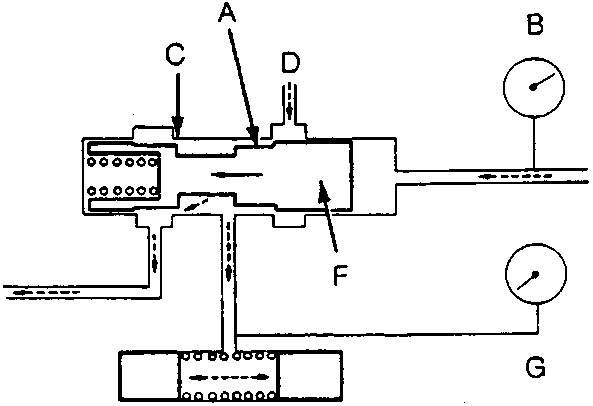
57M0059
| A | Feed Side Orifice |
| B | Hydraulic pressure in response to vehicle speed (High) |
| C | Reservoir Side Orifice |
| D | Feed |
| E | Return |
| F | Gain Control Valve |
| G | Pressure in reaction chamber |
| H | Reaction Chamber |
With the engine running at idle in a parked car, fluid flow through the sensor rotors is blocked because the rotors are not turning. Therefore, the gain control valve moves left.
On the gain control valve, the orifice resistance is high on pump side, while it is low on the reservoir side, with the result that pressure in the reaction chamber is lowered and steering wheel operation is easy.
Parts & tools for this job For Rover 600
- TOOLTie rod end toolSearch: tie rod end puller
- TOOLBall joint separatorSearch: ball joint separator
- FLUIDPower steering fluidSearch: Rover power steering fluid
Links open Amazon search results in a new tab. As an Amazon Associate I earn from qualifying purchases.