Decrease pressure phase (Brakes)
- Make
- Rover
- Model
- Coupé, Cabriolet & Tourer 200/400 Coupé, Cabriolet & Tourer Workshop Manual
- Section
- Description and operation › Decrease pressure phase
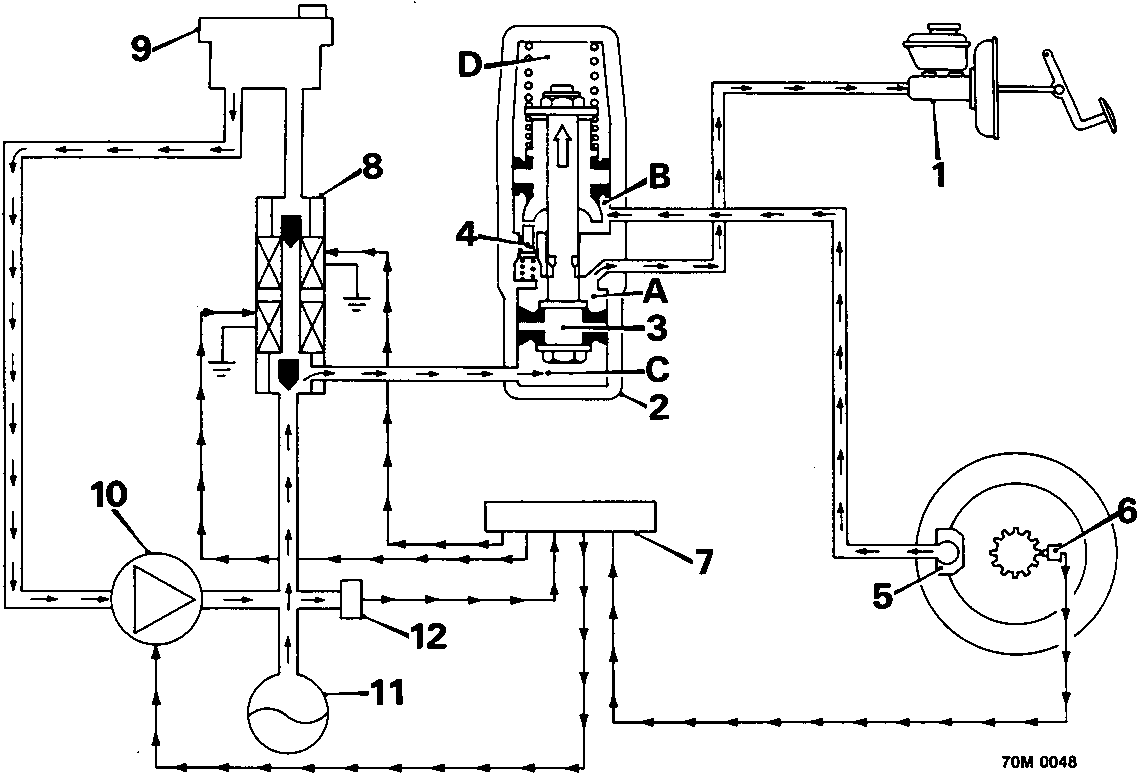
- Master cylinder
- Hydraulic modulator
- Piston
- Cut - off valve
- Wheel Caliper
- Speed sensors
- ECU
- Solenoid valve
- Modulator reservoir
- Pump
- Accumulator
- Pressure switch
Decrease pressure phase
If the force exerted on the brake pedal is sufficiently large to cause a potential wheel locking condition, the ECU sends a signal to the relevant solenoid valve directing pressure from the accumulator into chamber C of the modulator.
The high pressure forces the modulator piston upwards against the spring pressure in chamber D. The modulator cut - off valve closes preventing any further fluid pressure at the master cylinder being transmitted to the brake caliper. This is known as the maintain pressure phase. If by removing the pressure transmitted by the master cylinder to the brake caliper the potential wheel locking condition has receded, then the ECU operates the solenoid valve to relieve pressure from chamber C of the modulator, returning braking to normal.
If the potential wheel locking condition is still present, the pressure in chamber C is increased, the modulator piston moves further upwards increasing the volume of chamber B allowing fluid to flow from the brake caliper into the chamber, thereby reducing the pressure at the brake caliper. At the same time the volume of chamber A is
Parts & tools for this job For Rover Coupé, Cabriolet & Tourer
- PARTBrake padsSearch: Rover Coupé, Cabriolet & Tourer brake pads
- TOOLBrake bleeder kitSearch: one man brake bleeder kit
- FLUIDBrake fluidSearch: brake fluid
Links open Amazon search results in a new tab. As an Amazon Associate I earn from qualifying purchases.