Brakes (Handbrake operation): Description and operation
- Make
- Rover
- Model
- Coupé, Cabriolet & Tourer 200/400 Coupé, Cabriolet & Tourer Workshop Manual
- Section
- Description and operation › Handbrake operation
reduced causing fluid to be forced back into the master cylinder. The returning fluid into the master cylinder causes a noticeable pulse on the brake foot pedal. This is known as the decrease pressure phase.
When the potential wheel locking condition has receded, the ECU operates the solenoid valve to relieve pressure from chamber C of the modulator, returning braking to normal.
HANDBRAKE OPERATION
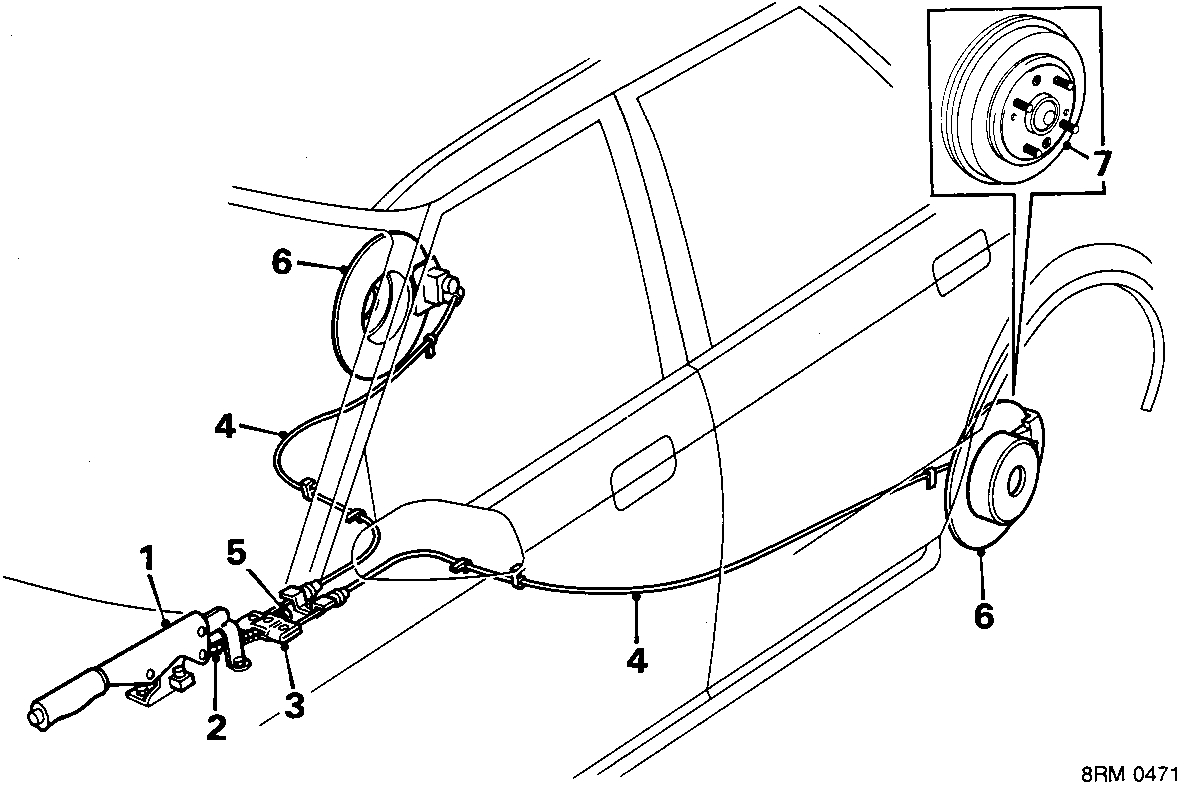
The handbrake operates on both rear discs or rear drums via two rear cables, a compensator and an intermediate cable which connects to the handbrake lever.
As the handbrake lever (1) is applied, movement is transmitted through the intermediate cable (2) to the compensator (3) which, in turn, transmits movement to the two rear cables (4). Each rear cable pulls on a lever on a rear caliper (or brake shoe). On rear disc brakes (6), rotational movement of the lever is changed to linear movement by a strut which, via a push rod, pushes the piston along its bore to force the brake pads into contact with the disc. On rear drum brakes (7), the lever operates a cam which forces the brake shoes apart to bring the brake linings into contact with the drum.
Automatic adjustment of the disc brake pads (or the brake shoes) is maintained by operation of the foot brake. Manual adjustment of the handbrake cables is effected via a nut (5) on a threaded extension to the intermediate cable (2) bearing upon the compensator (3).
Parts & tools for this job For Rover Coupé, Cabriolet & Tourer
- PARTBrake padsSearch: Rover Coupé, Cabriolet & Tourer brake pads
- TOOLBrake bleeder kitSearch: one man brake bleeder kit
- FLUIDBrake fluidSearch: brake fluid
Links open Amazon search results in a new tab. As an Amazon Associate I earn from qualifying purchases.