
Sound insulation
- Make
- Alfa Romeo
- Model
- 147 Factory Service Manual
- Year
- 2000–2002
- Section
- General › Sound insulation
SOUND INSULATION
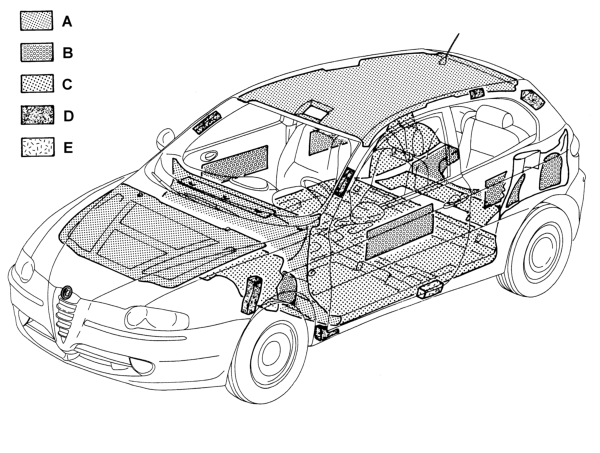
- A - Sound-insulating materials
- B - Soundproofing materials
- C - Sound-deadening materials
- D - Heat expandible materials
- D - Preformed synthetic blocks
According to EU regulations, exterior noise levels must be lower than 74 decibels. At a speed of 125 km/h when driving in fifth gear, noise level inside the passener compartment is 70 decibels.
Driving comfort (i.e. passenger compartment noise levels and roominess) has been improved mainly by insulating against road surface and mechanical noise by applying heat-expandible soundproofing materials and also taking special care over parts
assembly and aerodynamics.
The soundproofing materials used to lower noise level are mainly bituminous. Their role is to deaden the noise generated by mechancial vibrations from areas such as the underbody, door interior and external environment.
The heat-expandible materials are synthetic rubbers or resins. Their function is to fill in boxed sections to eliminate sound propogation (wind noise). When the body is placed inside the paint-stoving ovens, these materials expand (up to ten times)
and vulcanise so that they bond to the inner surfaces of panels with which they come into contact and fill the cavity.
The following measures have been taken to achieve an optimum level of sound insulation:
- insertion of heat-expandible septa in the rails, windscreen and rear window pilars, central pillars and spoilers;
- insertion of preformed synthetic blocks into central pillar body nodes to prevent vibrations being transmitted into the passenger compartment
- damping lining for panels through application of bituminous heat labile materials before painting
- sound-deadening linings for the front of the dashboard, the front and rear running boards, the load platform and side panels with pre-formed, composite panels
- sound-absorbent trim for the bonnet and roof;
- use of double-faced seals in the cable ducting holes between engine bay and passenger compartment;
- a thorough check of the sealants.
All the engines and mechanical components fitted to the car belong to a new generation engineered for improved acoustic/vibrational qualities.
Good aerodynamics have been ensured by improving car shape and adjusting the profiles of components that impair acoustic comfort:
NOTE:
To maintain the high level of acoustic comfort reached, the vehicle must be restored to its factory configuration in in the case of repairs.
Parts & tools for this job For 2000 Alfa Romeo 147
- TOOLTrim removal tool kitSearch: trim removal tool kit
- PARTTouch-up paintSearch: Alfa Romeo touch up paint
- PARTPanel clip assortmentSearch: Alfa Romeo panel clips assortment
Links open Amazon search results in a new tab. As an Amazon Associate I earn from qualifying purchases.