
Engine (03.00)
- Make
- Aston Martin
- Model
- DB9 Factory Workshop Manual
- Year
- Issue 2, 2005
- Section
- Power Conversion › Engine (03.00)
Engine (03.00)
Power Conversion (03.11)
Description
Crankshaft
The crankshaft is mounted in 7 main bearings with end loads absorbed by thrust washers at number 4 main bearing. Main bearing bolts are of the 'torque to yield' type and must be renewed if removed.
A twin sprocket, installed to the front end of the crankshaft, drives the camshaft timing chains. A damper pulley on the crankshaft drives the engine auxiliaries via the accessory drive belt.
Also at the front of the engine a timing disc is installed together with a crankshaft sensor (RH side). The sensor provides engine position signals to PCMs.
A second crankshaft sensor (LH side) is installed at the front of the engine - but is not used.
Pistons and Connecting Rods
Six crankshaft big end journals each carry a pair of connecting rods. The connecting rods are secured to the crankshaft by individual connecting rod caps enclosing the connecting rod bearing shells. Connecting rod bolts are of the 'torque to yield' type and must be renewed if removed.
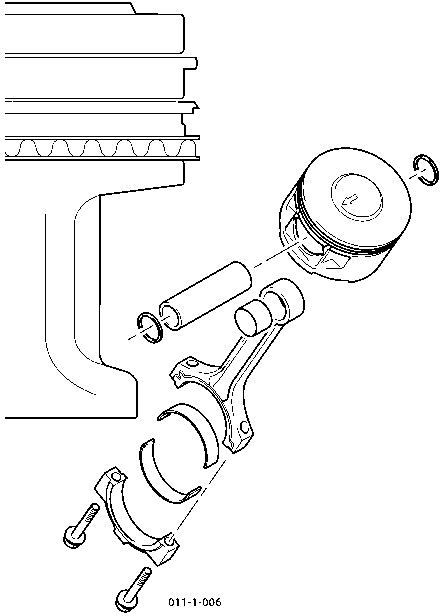
Each piston carries two compression rings and one oil control ring. The arrow on each piston crown must point to the front of the engine during installation.
Connecting rods are manufactured as a single piece with fracture lines at the connecting rod bearing. Each connecting rod cap is cracked from the connecting rod after machining and drilling. Thus each connecting rod cap will only install to, in correct orientation, its matching connecting rod.
Specifications
| Crankshaft | MM |
|---|---|
| Main Bearing Diameter | 67.480 - 67.504 |
| Main Bearing Clearance | 0.025 - 0.050 |
| Refer to the Main Bearing Grade Chart for bearing shell selection. | |
| Connecting Rod Bearing Diameter | 49.97 - 49.99 |
| Connecting Rod Bearing Clearance | 0.028 - 0.066 |
| Crankshaft End Float | 0.130 - 0.301 |
| Turning Torque | Nm. |
|---|---|
| Guideline figures only | |
| Crankshaft and rear seal only | 6 |
| Crank, rear seal + pistons & rods | 16 - 20 |
| Crank, rear seal, pistons & rods + camshafts & tensioned chains | 36 - 44 |
| Crankshaft Sensors | MM |
|---|---|
| Air Gap | 1 (±0.5) |
| Piston Ring Gaps at 89.000 | |
|---|---|
| Cylinder Bore Diameter | MM |
| Upper compression ring | 0.100 - 0.250 |
| Lower compression ring | 0.270 - 0.420 |
| Oil control rings | 0.150 - 0.650 |
| Compression Ring Vertical Clearance | MM |
|---|---|
| Upper compression ring | 0.040 - 0.075 |
| Lower compression ring | 0.040 - 0.885 |
| Piston Pin | MM |
|---|---|
| Piston pin to rod clearance | |
| Interference | 0.005 |
| Clearance at 20°C (68°F) | 0.001 |
| Connecting Rods | MM |
|---|---|
| Piston pin to connecting rod clearance | 0.004 - 0.020 |
| Piston pin to piston interference | -0.005 - 0.001 |
| Big End Side Clearance (2 rods) | 0.225 - 0.625 |
| Piston Height Above the Block Face at TDC | MM |
|---|---|
| Average of two readings taken along the crankshaft axis. A straight line must pass between the two readings and the center of the pistion. | 0.415 (Below) 0.115 (Above) |
Parts & tools for this job For 2005 Aston Martin DB9
- PARTEngine gasket setSearch: Aston Martin DB9 2005 engine gasket set
- TOOLTorque wrenchSearch: 3/8 inch torque wrench
- TOOLFeeler gauge setSearch: feeler gauge set
Links open Amazon search results in a new tab. As an Amazon Associate I earn from qualifying purchases.