
Ignition advance control
- Make
- Fiat
- Model
- Bravo /Brava (182) Factory Service Manual
- Year
- 1995–2001
- Section
- Fuel system (98 range, 1242 16v) › Ignition advance control
Ignition advance control
Starting
During starting the normal management of the advance is not possible on account of the considerable fluctuations in the rotation speed which do not allow the dwell and the advance to be calculated correctly.
The control unit implements a fixed advance for the entire time the engine is driven by the starter motor.
Operation at high temperatures
This strategy is enabled when the intake air temperature exceeds a certain level. The "basic" advance value is reduced according to this temperature.
Operation in cut off conditions
The injection advance is reduced on entry into cut-off: from the moment the supply of fuel is restored, the advance gradually returns to the "basic" value.
Operation during take-off
This strategy is designed to reduce the advance when the vehicle moves off from a stationary position.
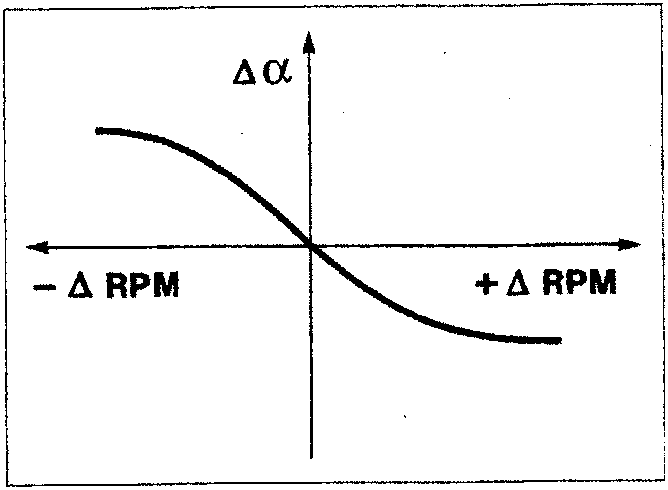
Operation with the engine idling
When the engine is idling, the management of the advance is implemented independently of the "basic" advance.
The advance value during idling is corrected in a manner which is inversely propotional to the variation in the speed in relation to the pre-set speed which, in turn, depends on the temperature of the coolant.
In particular, the advance is increased if the speed decreases and is decreased if the speed increases, in order to ensure the stability of the actual speed.
Δα: correction of the ignition advance during idling
+ ΔRPM: the speed during idling is higher than the nominal speed
- ΔRPM: the speed during idling is lower than the nominal speed
Control of the detonation
This strategy has the task of detecting the presence of the phenomenon of detonation, by processing the signal coming from the relevant sensor. The strategy continuously compares the signal coming from the sensor with a threshold, which is, in turn, constantly updated, to take into account background noise and the ageing of the engine.
If the system recognizes the presence of detonation, the strategy reduces the ignition advance, in steps of 3° up to a maximum of 9° until the phenomenon disappears. Later on, the advance is gradually restored either until the basic value is reached or until the phenomenon occurs again.
The strategy also has a self-adjustment function which memorizes the reductions in the advance which are continuously repeated to adapt the advance to the different conditions in which the engine finds itself (for example, the use of a low octane rating fuel). The strategy is capable of restoring the advance to the map value if the conditions which caused the reduction no longer exist.
Parts & tools for this job For 1995 Fiat Bravo
- PARTFuel filterSearch: Fiat Bravo 1995 fuel filter
- TOOLFuel pressure test kitSearch: fuel pressure test kit
- TOOLFuel line disconnect toolSearch: fuel line disconnect tool
Links open Amazon search results in a new tab. As an Amazon Associate I earn from qualifying purchases.