
Introduction - ENGINE AIR SUPPLY CIRCUIT
- Make
- Fiat
- Model
- Stilo Factory Service Manual
- Year
- 2001–2007
- Section
- Engine air supply circuit › Introduction - ENGINE AIR SUPPLY CIRCUIT
Introduction - ENGINE AIR SUPPLY CIRCUIT
Structure
AIR SUPPLY SYSTEM
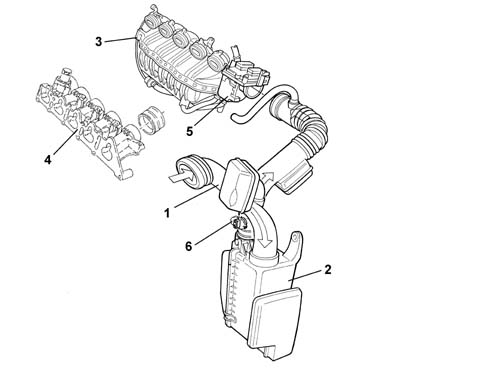
1 - Cold air intake
2 - Complete air filter
3 - Modular intake manifold Characteristic of working principle 1072 INLET AND EXHAUST MANIFOLDS
4 - Intake manifold
5 - Throttle body Characteristic of working principle 1056 PETROL INJECTION SYSTEM
6, Air flow meter incorporating intake air temperature sensor Characteristic of working principle 1056 PETROL INJECTION SYSTEM
STRUCTURE
AIR SUPPLY SYSTEM
The intake air is filtered and directed to the exhaust gas turbocharger.
From there the compressed air is sent, via the throttle casing, to the intake chamber.
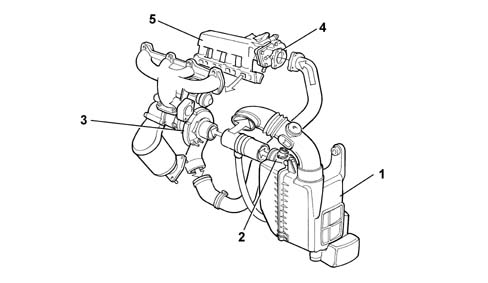
1 - Air filter complete with resonator
2 - Flow meter
3 - Turbocharger
4 - Throttle body
5 - Intake chamber
STRUCTURE
AIR SUPPLY SYSTEM
The intake air is filtered and directed to the exhaust gas turbocharger.
Before reaching the engine, the compressed air is cooled in the air/air heat exchanger.
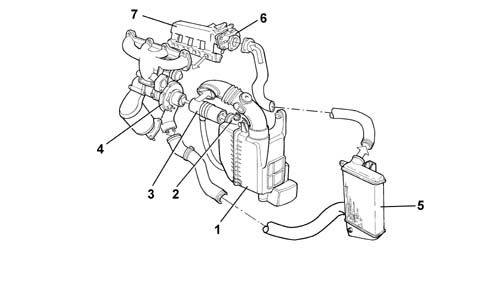
1 - Air filter complete with resonator
2 - Flow meter
3 - Corrugated hose
4 - Turbocharger
5 - Air-Air heat exchanger (intercooler)
6 - Throttle body
7 - Intake chamber
STRUCTURE
AIR SUPPLY SYSTEM
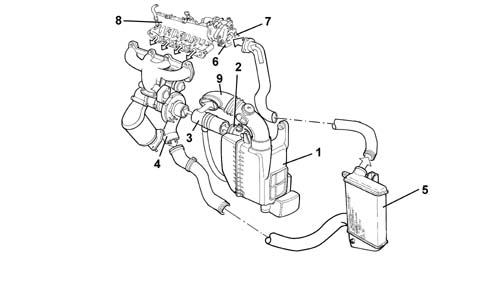
1 - Air filter complete with resonator
2 - Flow meter
3 - Corrugated hose
4 - Turbocharger
5 - Air-Air heat exchanger (intercooler)
6 - Throttle body
7 - Throttle body actuator
8 - Air chamber
9 - Hose with resonator
CONSTRUCTION FEATURES
To reduce engine judder when it is being switched off, a throttle body has been fitted upstream of the air chamber to cut off air flow to the cylinders.
Under all other operating conditions, the throttle body remains open.
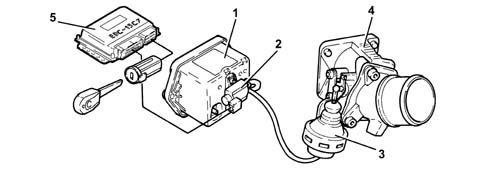
1 - Vacuum reservoir
2 - Solenoid
3 - Throttle body actuator
4 - Throttle body
5 - Fuel injection control unit
CONSTRUCTION FEATURES
To reduce engine judder when it is being switched off, a throttle body has been fitted upstream of the air chamber to cut off air flow to the cylinders.
Under all other operating conditions, the throttle body remains open.
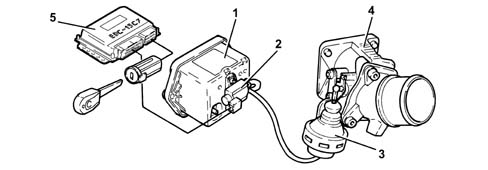
1 - Vacuum reservoir
2 - Solenoid
3 - Throttle body actuator
4 - Throttle body
5 - Fuel injection control unit
CONSTRUCTION FEATURES
To reduce engine judder when it is being switched off, a throttle body has been fitted upstream of the air chamber to cut off air flow to the cylinders.
Under all other operating conditions, the throttle body remains open.
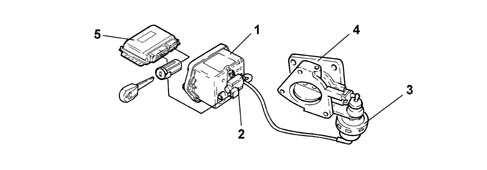
1 - Vacuum reservoir
2 - Solenoid
3 - Throttle body actuator
4 - Throttle body
5 - Fuel injection control unit
OPERATION
With the engine switched off, the throttle is open because there is no vacuum.
With the engine running, the throttle is open because, as the Pierburg solenoid valve is not supplied, it prevents the vacuum from reaching the pneumatic actuator.
The vacuum accumulates in the reservoir whilst the engine is running.
Whilst the engine is being switched off (when the key is turned to the OFF position), the control unit keeps the actuator relay feed supplied for 4 or 5 seconds and, at the same time, places the Pierburg solenoid valve to earth which, on opening, sends the vacuum, which has accumulated in the vacuum reservoir, to the pneumatic actuator which closes the butterfly interrupting the flow of air to the cylinders.
Parts & tools for this job For 2001 Fiat Stilo
- PARTEngine gasket setSearch: Fiat Stilo 2001 engine gasket set
- TOOLTorque wrenchSearch: 3/8 inch torque wrench
- TOOLFeeler gauge setSearch: feeler gauge set
Links open Amazon search results in a new tab. As an Amazon Associate I earn from qualifying purchases.