
Code
- Make
- Fiat
- Model
- Ulysse Factory Service Manual
- Year
- 2002–2010
- Section
- Instrument/gauge electrical circuits › Code
CODE
SPECIFICATIONS
The vehicles are equipped with an electronic system known as the CODE to produce the engine immobilizer function.
The CODE system only allows the engine to be started after a secret code, memorized previously in the NCM, is received.
System details
The second generation Code system is incorporated in the Body Computer Node (NBC).
COMPOSITION
The CODE system comprises 4 basic components (in addition to the Body Computer which acts as a control unit):
- CAN line for dialogue between the NBC and the NCM
- between two and five electronic keys containing a transponder with a secret code;
- an aerial that reads the code contained in the key transponders;
- the NCM.
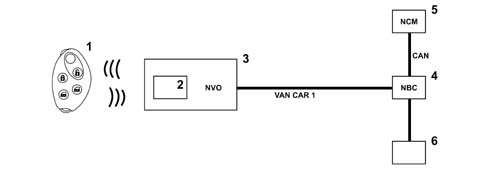
- 1 Key
- 2 Aerial
- 3 Steering Wheel Node (NVO)
- 4 Body Computer Node (NBC)
- 5 Engine Management node (NCM)
- 6 Signal LED
OPERATION
The CODE allows the start of the engine management by the NCM by means of a coded dialogue between the NBC and NCM during the stage that precedes starting.
After the key is turned to the ON position, the NCM sends a code request to the NBC which only responds after having recognized (via the aerial) a known electronic key in the ignition switch. If the secret code in the answer is valid, the NCM continues with the regular engine management activities, allowing the engine to be started up.
The NCM can only memorize the secret code through a special procedure.
The operation of the CODE is guaranteed if any of the other NBC functions are not working properly.
After recognizing an enabled transponder, the CODE switches off any alarm system.
Interaction of Code with the key
Every key contains a transponder with the IDENTIFICATION CODE and the SECRET CODE.
As soon as the key is turned, the transponder sends the identification code to the CODE which, having recognized it as one of the enabled ones, continues with the transponder recognition strategy.
If the identification code is not recognized, the procedure is aborted and the engine cannot be started.
The transponder is recognized by means of an algorithm with an encrypted code exchange.
The code recognition time is less than 160 ms per attempt.
The CODE attempts the transponder acquisition for up to 1 second.
Dialogue between engine management node and NBC
The dialogue between the CODE (NBC) and the NCM takes place via the CAN.
Starting from when the key is turned to the ON position, the flow of code exchanger operations between the NBC and the NCM depends on the NCM status (pristine or programmed).l
If the NCM is pristine, the procedure involves sending the fix-code request to the NBC: in this way the NCM lears the secret code and stores it in its memory. This procedure is known as CODE RECORDING.
If the NCM has already been programmed, the procedure involves checking that the fix-code stored in the engine management control unit memory and the one memorized in the NBC correspond: the NCM asks the NBC for the secret code and compares it with its own. This procedure is known as CODE VERIFY.
CODE RECORDING
The CODE RECORDING procedure is the memorizing of the fix code in the NCM.
Only after the NBC has memorized the identification codes, the secret code and the fix code, is the NBC ready to satisfy the request to transmit a code to a pristine NCM.
After the ignition key has been turned, the NCM initializes its software and, if it is pristine, requests the fix code.
If the NBC is not pristine, it responds by sending the fix code, but only after having recognized an authorized key. If the key is not authorized (unrecognized) or there is no key, the CODE does not respond.
When the NBC is pristine and there is no transponder in the aerial, it does not respond to the NCM''s request for a fix code.
CODE VERIFY
This is the standard procedure that is repeated during the life of the vehicle each time the user insesrts the key in the ignition and turns it ON. this procedure enables the starting of the engine if the key inserted is enabled.
The code verify procedure continues even when the user turns the key to the starting position.
After the key is in the ON position, the NBC recognizes whether the transponder in the key is one of those that is enabled.
At the same time, the NCM initializes its software until it verifies whether a fix code has been memorized. If the answer is yes, it sends a fix code request to the NBC.
In response to this request, the NBC only sends the encrypted fix code to the NCM if the transponder is recognized as enabled.
If the transponder is not recognized (incorrect transponder, no transponder in the aerial, etc.), the NBC will send the code (incorrect transponder or missing transponder) to the NCM.
If the NBC is pristine and the NCM sends a fix code request, after having recognized the transponder, the NBC responds by sending a pristine NBC transponder recognized encrypted code message.
DESCRIPTION OF THE COMPONENTS
NBC CODE function
The CODE is a function of the NBC.
The main CODE functions are:
- recognizing the introduction and rotation of a key in the ignition;
- placing the alarm in a deactivated state after recognizing an enabled key;
- producing an electromagnetic field to read the key transponder;
- sending the random code to the transponder;
- receiving the encrypted code transmitted by the key;
- memorizing up to 5 identification codes;
- memorizing the secret code;
- managing a list of up to a maximum of 5 enabled identification codes;
- managing the CAN line to the NCM;
- managing the lighting up of the warning light;
- carrying out the autodiagnosis.
Aerial
Specifications
Toroid type aerial located around the ignition switch, sends a 125 kHz signal to the transponder.
Operation
The aerial is supplied by the NBC to energize the key transponder.
Since the aerial needs to be as close as possible to the transponder (on account of electro-magnetic immunity, the limited range of the transponder and small dimensions) it is fastened axially to the ignition switch.
Ignition key
Specifications
The mechanical key contains a cipher transponder in the grip.
Operation
The moment the key is inserted in the ignition and turned to the ON position, the transponder is energized by the aerial and responds by emitting the rolling, encrypted secret code.
The emission into the atmosphere is sufficiently powerful to produce a high immunity to electromagnetic interference and the range is such that it can be received by the aerial in the ignition switch.
If the code is recognized as valid, the NBC sends the NCM, on request, a coded signal allowing the engine to be started.
Up to 5 keys can be programmed in the NBC.
Transponder in the key
Specifications
The transponder in the key has the following stored in its memory:
- SECRET CODE which is the same for each transponder in the same key kit;
- IDENTIFICATION CODE which is different for each transponder produced;
- PROGRAMMING DATA for the secret code
The identification code differs from transponder to transponder to guarantee that no two transponders have the same identification code even if there is a request for a duplicate in the Network.
Parts & tools for this job For 2002 Fiat Ulysse
- TOOLDigital multimeterSearch: automotive digital multimeter
- PARTAssorted fuse kitSearch: car fuse assortment kit
- TOOLWire crimper and connector kitSearch: wire crimper connector kit
Links open Amazon search results in a new tab. As an Amazon Associate I earn from qualifying purchases.