
Brakes – Overview
- Make
- Volvo
- Model
- XC90 Factory Service Manual
- Year
- 2003–2016
- Section
- 09 Miscellaneous › Design and Function › Brakes – Overview
Brakes – Overview
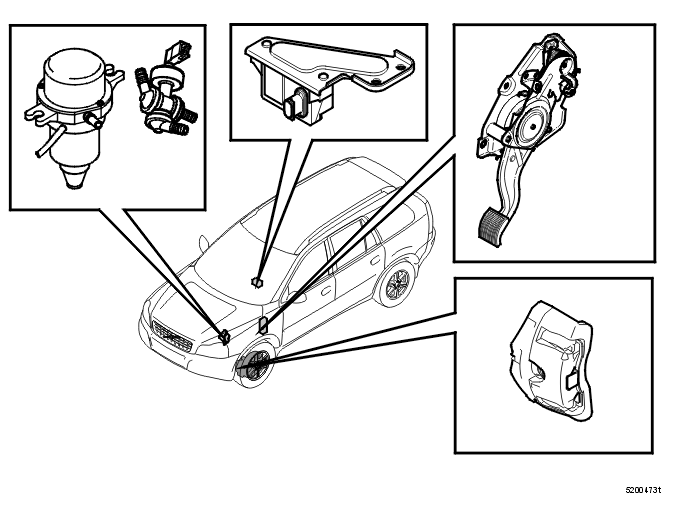
Overview brake system
RSC (Roll Stability Control)
The Volvo XC90 has an active system which counteracts any tendency to roll over, and gives the vehicle stability during violent avoidance manoeuvres.
If there is a risk of the car turning over, RSC is activated. This function is integrated in DSTC (Dynamic Stability and Traction control) / ESC (Electronic Stability Control). It lowers the engine torque and stabilizes the vehicle by braking one or more wheels.
Foot controlled handbrake
The handbrake is applied by pressing the pedal on the floor. The handle in the light switch module (LSM) is used to release the handbrake.
Vacuum pump
B6294T has an electrical vacuum pump to ensure that the pressure is stable in the servo unit.
- The vacuum switch is on the servo unit side
- The switch is controlled via the system relay for the Engine Control Module (ECM) and is connected in series to the vacuum pump.
General
For 17" wheels, the diameter of the brake discs is 316 mm at the front and 308 mm at the rear.
New brake pads, more environmentally friendly. Lead free.
Foot controlled handbrake
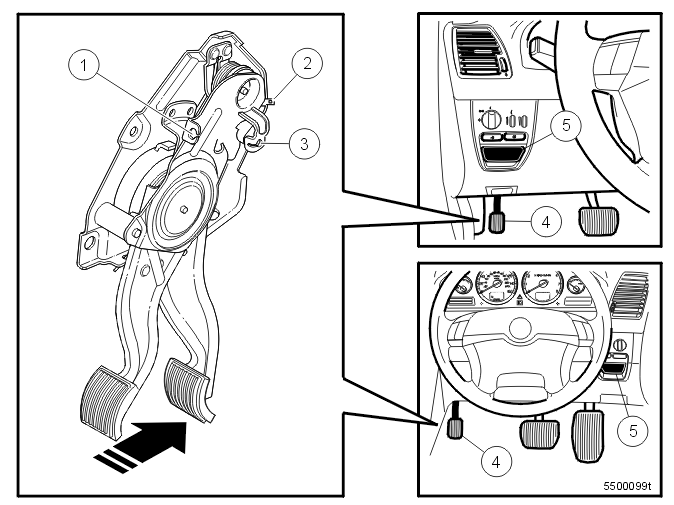
- Cable holder, cable to the brake shoes
- Handbrake switch
- Cable holder, cable to the handle
- Handbrake pedal
- Release handle.
The handbrake is mechanical and acts on the brake shoes in the brake drum on the rear wheels.
The brake pedal is operated when the driver presses the pedal.
The handle in the light switch module (LSM) is used to release the handbrake.
The switch for the handbrake warning lamp is on the mechanism for the handbrake.
The foot controlled mechanism has an integrated adjuster function.
The handbrake pedal is located,
- on the left-hand side at floor height on left-hand drive cars
- on the left-hand side at floor height on right-hand drive cars.
RSC (Roll Stability Control)
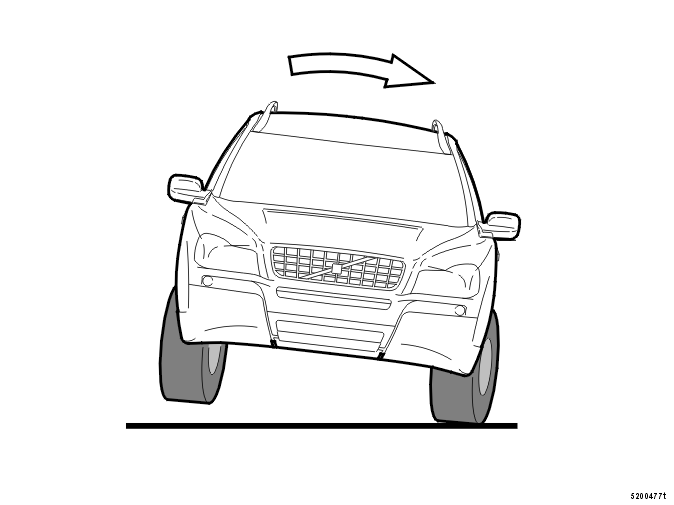
The Volvo XC90 has an active system which counteracts roll over, and increases the vehicle stability during violent avoidance manoeuvres.
An integrated gyroscope in the DSTC/ESC cluster calculates the dynamic angle of lean and therefore the risk of roll over.
If there is a risk of the car turning over, RSC is activated. This function is integrated in the DSTC/ESC system. It lowers the engine torque and stabilizes the vehicle by braking one or more wheels.
- The RSC function cannot be disabled
- RSC is activated at speeds above 10 km/h
- In RSC mode, the all-wheel drive (AWD) function is disengaged via the differential electronic module (DEM).
RSC, basic principles
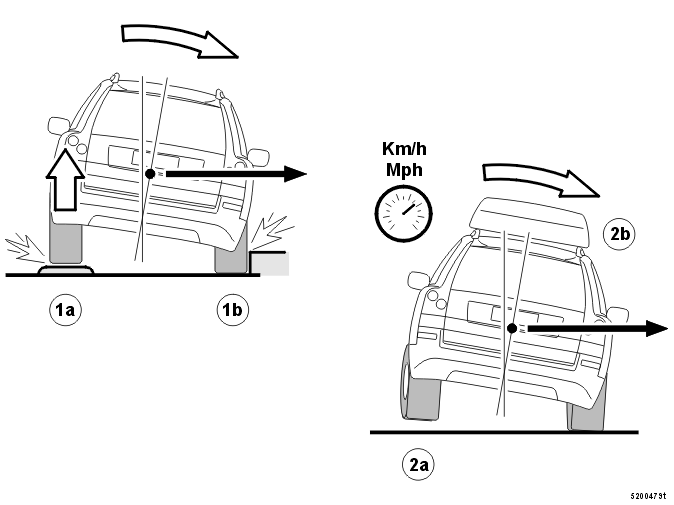
There are number of factors which could cause a wheel to leave the ground.
Caused by an obstacle. (Tripped roll-over):
- the inner wheels hit a raised surface on the road. (1a)
- if the outer wheels hit a fixed object in a corner. (1b).
Caused by friction when cornering. (Un-tripped roll-over):
- the vehicle speed is too high in relationship to the radius of the corner. (2a).
Basic criteria for RSC to activate,
- the vehicle is travelling at a speed in excess of 10 km/h
- one or more wheels is off the ground.
Note that when carrying heaving loads on the roof, the risk of roll over increases when taking sharp corners. (2b)
Overview sensor(s) for RSC
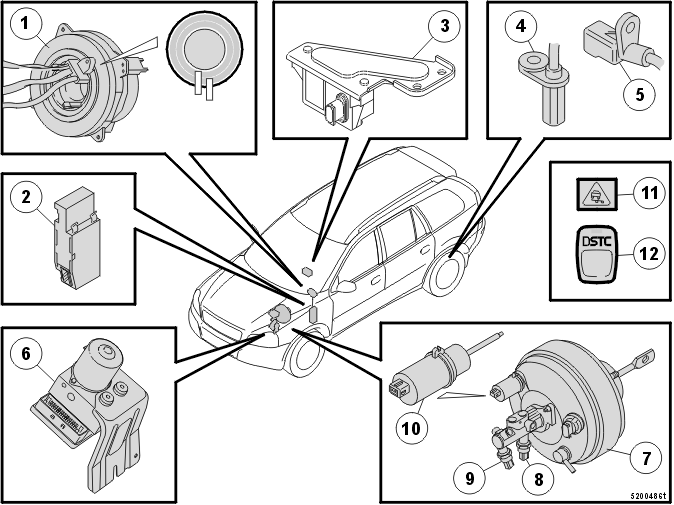
- Steering wheel angle sensor
- Steering wheel angle sensor (SAS)
- Cluster
- Wheel sensor, front
- Wheel sensor, rear
- Brake control module (BCM)
- Servo unit housing
- Brake pressure sensor
- Brake pressure sensor
- Pedal position sensor
- Warning lamp
- Switch DSTC/ESC
RSC is included in the same cluster as DSTC/ESC. The cluster is located under the right-hand seat.
The RSC function cannot be disabled using the DSTC/ESC button.
When switching off the DSTC/ESC switch, only the SC (Stability Control) function is disengaged.
Parts & tools for this job For 2003 Volvo XC90
- PARTBrake padsSearch: Volvo XC90 2003 brake pads
- TOOLBrake bleeder kitSearch: one man brake bleeder kit
- FLUIDBrake fluidSearch: brake fluid
Links open Amazon search results in a new tab. As an Amazon Associate I earn from qualifying purchases.