
Systemöversikt
- Make
- Volvo
- Model
- XC90 Factory Service Manual
- Year
- 2003–2016
- Section
- 09 Miscellaneous › Design and Function › Systemöversikt
Systemöversikt
Introduction
The Mark25 brake control system
The Mark 25 brake control system with the brake control module (BCM) is an electronic control system which prevents wheel lock up during braking (ABS). By preventing wheel lock up, steering control is maintained and maximum braking effect is utilized.
The brake control system is equipped with:
- Antilock Braking System
- Electrical Brake force Distribution (EBD) for the rear wheel brakes.
The brake control system, as a factory installed option, can be supplemented with:
- TRACS (TRAction Control System)
- STC (Stability and Traction Control)
- DSTC (Dynamic Stability and Traction Control) / ESC (Electronic Stability Control).
EBD
EBD (Electrical Brake force Distribution) is a function for electronically controlling the brake force on the rear wheels and is integrated with the ABS system. The purpose of the control module for electronic brake force distribution (EBD) control is to control the hydraulic pressure in the brake circuit for the rear wheels if the rear wheels tend to lock under braking. This ensures optimal and stable braking. The EBD function replaces the relief valve used in the Mark IV version to reduce the pressure in the brake circuit for the rear wheels.
TRACS
TRACS is a traction control system which is integrated with the ABS system. TRACS is only available on all-wheel drive (AWD) cars. The traction control system distributes driven power between the wheels so that the wheel with the best road traction receives the greatest amount of driven power. The system is mainly designed to assist with moving off on slippery surfaces at speeds up to approximately 60 km/h. TRACS has only a very limited effect at speeds over 60 km/h. TRACS (traction control system) is always engaged when the ignition is switched on. TRACS (traction control system) is engaged and disengaged using a switch under the climate control module (CCM). From model year 2003 inclusive, the TRACS function cannot be disabled manually.
STC
STC (stability and traction control) consists of two components:
- Traction Control – this function is described above under TRACS. The traction control function is always engaged when the ignition is switched on. The traction control function together with the stability function is engaged and disengaged using a switch under the Climate Control Module (CCM). From model year 2003 inclusive, the Traction Control function cannot be disabled manually.
- Stability Control - stability system which is integrated in the ABS system and stabilizes the car in the event of wheel spin. The brake control module (BCM) transmits a signal to the Engine Control Module (ECM) to reduce engine torque until the slipping wheel(s) has/have stopped spinning. The stability function is always engaged when the ignition is switched on. The stability function together with the traction control function is engaged and disengaged manually using a switch under the climate control module (CCM).
DSTC/ESC
DSTC (Dynamic Stability and Traction control) /ESC (Electronic Stability Control)- a dynamic anti-slip system which is integrated in the STC (stability and traction control) system. The DSTC /ESC function is engaged when the ignition is switched on but can be disengaged or engaged manually using the switch on the Climate Control Module (CCM).
The DSTC/ESC system consists of the following:
- Traction Control – This function is described above under TRACS
- Stability Control - Described under STC above
- AYC (Active Yaw Control). The system is based upon a number of sensors which sense the driver's steering movements (steering wheel angle) and the directional, both straight and lateral, movement of the car. The information is used to correct the car in the event of oversteer or understeer
- RSC (Roll over stability control) is a function which monitors the tilt angle rate. If the driver turns the steering wheel quickly, during an avoidance manoeuvre for example, and the car is likely to tip over, the tilt angle sensor registers the rate at which the tilt angle is changing. The DSTC/ESC system rights the car. RSC (roll over stability control) is only available on the XC90
- Emergency Brake Assistance is a new function found in cars equipped with DSTC/ESC from model year 2002-. The function is integrated in the Brake Control Module (BCM) and monitors the movement of the brake pedal. A sudden movement of the brake pedal (emergency braking) deploys the emergency brake assistance function to achieve optimum braking (more effective than normal braking). Information from the pedal position sensor is used to start the emergency brake assistance function. Full braking force is maintained for as long as the driver maintains or increases the pressure on the brake pedal. If the driver releases the brake pedal the emergency brake assistance function is immediately interrupted. Emergency brake assistance operates from approximately 10km/h up to the maximum speed. This function cannot be switched off.
Control module
The control module is integrated in the ABS hydraulic modulator and is located in the engine compartment. The control module contains the electrical valve coils for the different hydraulic valves.
The main function of the control module is to process the signals from the different sensors and to control the hydraulic pump and the electromagnetic hydraulic valves (inlet and outlet valves) in the ABS hydraulic modulator when controlling the:
- ABS
- EBD
- TRACS
- STC or
- DSTC/ESC.
Control modules with the DSTC/ESC function also have external sensors which sense the driver's steering wheel movements and the directional behaviour of the car.
The control module communicates with directly connected components and other control modules via the Controller Area Network (CAN).
The control module checks calculations and all input and output signals via the built-in diagnostic functions. When the control module detects a fault certain functions are completely disengaged depending on the severity of the fault. At the same time a warning light comes on or a text message will be displayed depending on the fault (see table). When manually disengaging by activating the STC/ DSTC/ESC switch (pressed in for approximately 1/2 second) all functions are disengaged except for the ABS, Electronic Brake force Distribution, emergency brake assistance and vehicle speed signal. In the event of the temperature of the brake discs being too high traction control is switched off to prevent damaging the brake calliper and brake discs. The general warning lamp is only lit by the Brake Control Module (BCM) in the event of faults which affect the emergency brake assistance function. However it can be lit by other control modules which have been affected by faults in the brake control system.
From model year 2003 inclusive, only the traction control system can be disengaged manually. A traction loss warning lamp and a text message in the combined instrument panel are also used for models from this date.
Warning lamp | ||||
| ABS | Brakes | Wheel spin / text display | General | |
| ABS | X | |||
| EBD | X | |||
| TRACS | X | |||
| STC | X | |||
| DSTC/ESC | X | |||
| EBA | X | |||
Any faults are registered in the control module memory. This information can be read off using VIDA via the Data Link Connector (DLC) in the car.
When the car is driven the control module checks that a signal is received from the wheel sensors. When the car reaches 20 km/h for the first time (40 km/h if the brake lamp switch is activated) the control module checks the pump motor and the hydraulic valves by quickly activating them. A noise is then heard from the hydraulic pump, this is completely normal. The ABS function is first activated when the speed of the car exceeds approximately 7 km/h. Traction control functions from start.
Signals, brake control module (BCM) with or without STC (stability and traction control) / TRACS (traction control system)
The table below summarizes the input signals to and output signals from the brake control module (BCM). The signal types are divided into directly connected signals, serial communication and Controller area network (CAN) communication. The following illustration displays the same information with the Volvo component designations.
Input signals | Output signals |
| Directly connected: | Directly connected: |
Four Wheel sensors (7/31, 7/32, 7/56, 7/57) Pedal position sensor (7/124) | |
| Via Controller Area Network (CAN) communication: | Via Controller Area Network (CAN) communication: |
Central electronic module (CEM) (4/56). Provides information about the car configuration. Gearbox control module (TCM) (4/28). Provides information about the current gear, next gear and lock-up status (automatic gearbox only). Climate control module (CCM) (3/112). Provides information that the driver has switched of the STC (Stability and traction control) function. Engine Control Module (ECM) (4/46):
Differential electronic module (DEM) (4/82). Provides information about the torque distribution to the rear wheels and the function status (All-wheel drive (AWD) only). | Driver information module (DIM) (5/1):
Climate control module (CCM) (3/112). Receives a request to light/turn off the indicator in the STC button. Gearbox control module (TCM) (4/28):
Engine Control Module (ECM) (4/46):
Differential electronic module (DEM) (4/82). Receives information about the brake function (AWD). Road Traffic Information Module (RTI) (16/45). Receives information about the rotation speed of the front wheels. Used to measure distance. Phone Module (PHM) (16/60). Receives information about the travelled distance, used when the Global Positioning System makes calculations. |
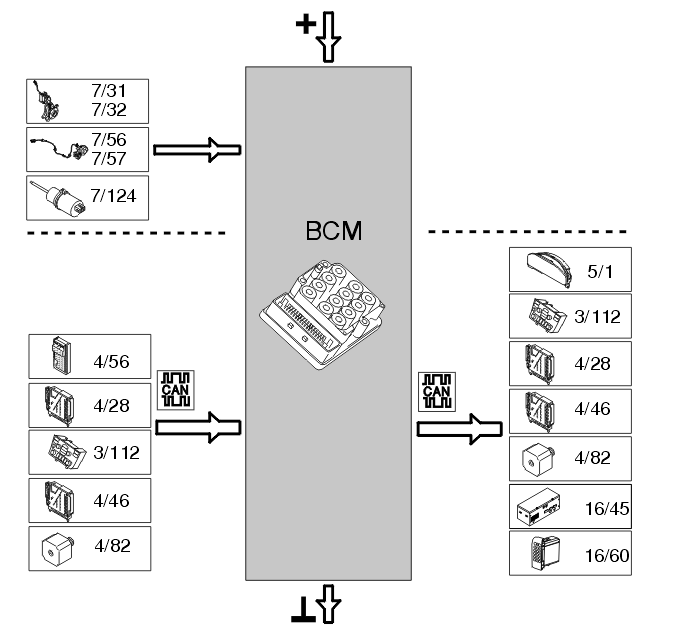
Signals, Brake control modules (BCM) with DSTC/ESC
The table below summarizes the input signals to and output signals from the brake control module (BCM). The signal types are divided into directly connected signals, serial communication and Controller area network (CAN) communication. The following illustration displays the same information with the Volvo component designations.
Input signals | Output signals |
| Directly connected: | Directly connected: |
Four Wheel sensors (7/31, 7/32, 7/56, 7/57) Pedal position sensor (7/124) Activation unit DSTC/ESC (Pedal pressure sensor) (8/46) Two pressure sensors (7/129, 7/139) | Activation unit DSTC/ESC (Pre-pressure valve) (8/46) |
| Via internal Controller Area Network (CAN) communication: | Via internal Controller Area Network (CAN) communication: |
| Sensor module DSTC/ESC (7/164). Provides information about the yaw angle speed, lateral acceleration and, on cars with All-wheel drive (AWD), also forward acceleration. | |
| Via Controller Area Network (CAN) communication: | Via Controller Area Network (CAN) communication: |
Central electronic module (CEM) (4/56).
Gearbox control module (TCM) (4/28).
Climate control module (CCM) (3/112). Provides information that the driver has switched of the traction control function. Steering wheel angle sensor module (SAS) (4/68). Provides information:
Engine Control Module (ECM) (4/46):
Differential electronic module (DEM) (4/82). Provides information about the torque distribution to the rear wheels and the function status (All-wheel drive (AWD) only). | Driver information module (DIM) (5/1):
Climate Control Module (CCM) (3/112). Receives a request to light/turn off the indicator in the STC/ESC button. Gearbox control module (TCM) (5/1):
Engine Control Module (ECM) (4/46):
Differential electronic module (DEM) (4/82). Receives information about the brake function (AWD). Phone Module (PHM) (16/60). Receives information about the travelled distance, used when the Global Positioning System makes calculations. Road Traffic Information Module (RTI) (16/45). Receives information about the rotation speed of the front wheels. Used to measure distance. |
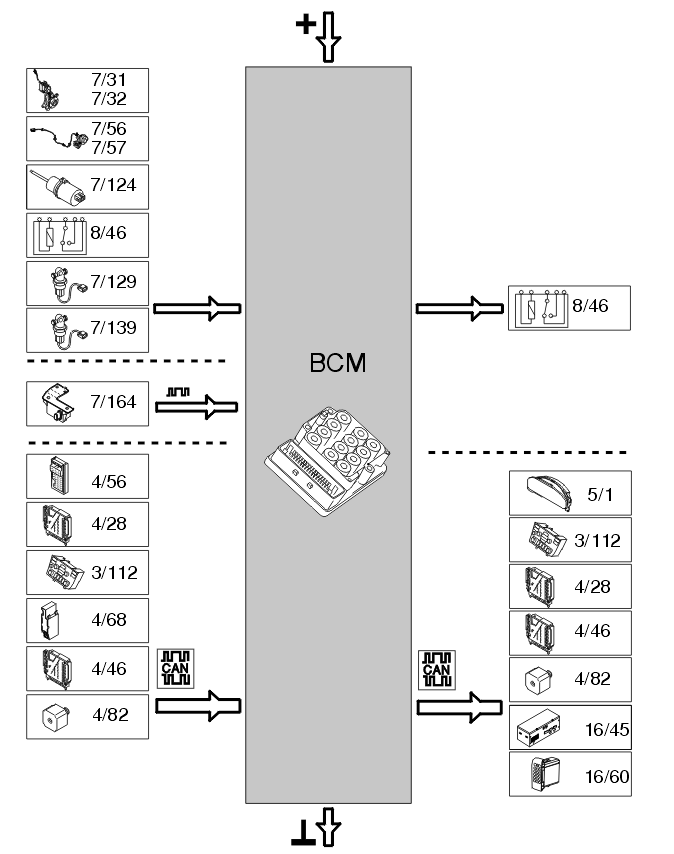
Control module
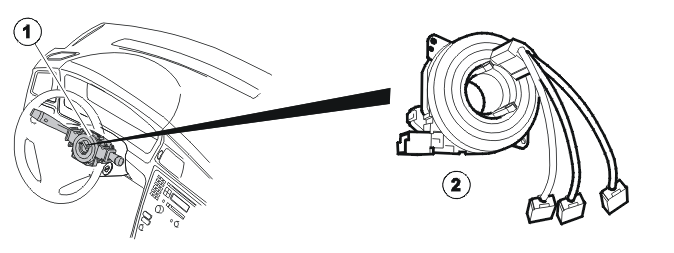
- The steering wheel angle sensor module (SAS) is integrated in the steering wheel module (SWM)
- Steering wheel angle sensor.
Only cars equipped with DSTC/ESC have a Steering Wheel Angle Sensor Module (SAS). The easiest way to determine if a car is equipped with DSTC/ESC is to search for a switch, marked DSTC/ESC, positioned in the panel on the Climate Control Module (CCM).
The Steering Wheel Angle Sensor Module (SAS) is integrated in the Steering Wheel Module (SWM). The only function of the Steering Angle Sensor Module (SAS) is to process the signals from the Steering Wheel Angle Sensor. The signals used by the DSTC/ESC system. The Steering Wheel Angle Sensor is installed on the Steering Wheel Module (SWM). The sensor is directly connected to the Steering Wheel Angle Sensor Module (SAS). The Steering Wheel Angle Sensor Module (SAS) transmits signal information, via the high speed side of the controller area network (CAN), to the Brake Control Module (BCM) and Suspension Module (SUM).
If a fault occurs, the steering wheel angle sensor module (SAS) detects this and a diagnostic trouble code (DTC) is stored. The DSTC function is switched off.
Diagnostic trouble codes (DTCs) are stored in the Steering Wheel Angle Sensor Module (SAS). This information can be readout using VIDA via the Data Link Connector (DLC) in the vehicle.
Signals
The table below summarizes input and output signals to and from the steering wheel angle sensor module (SAS). The signal types are divided into directly connected signals, serial communication and controller area network (CAN) communication.
Input signals | Output signals |
| Directly connected: | Directly connected: |
| — |
| Via Controller Area Network (CAN) communication: | Via Controller Area Network (CAN) communication: |
| — |
|
Parts & tools for this job For 2003 Volvo XC90
- TOOLTorque wrenchSearch: 3/8 inch torque wrench
- TOOLSocket setSearch: socket set metric
- BOOKHaynes manualSearch: Haynes manual Volvo XC90
Links open Amazon search results in a new tab. As an Amazon Associate I earn from qualifying purchases.