
General description
- Make
- Alfa Romeo
- Model
- 145/146 Electrical System Diagnosis Manual, Volume 3
- Year
- 1994–2001
- Section
- Manual Air Conditioner › General description
GENERAL DESCRIPTION
The system with manually operated air conditioner integrates the simple but functional heater with the function of producing cold, dehumidified air obtained by engaging the compressor and the cooling system.
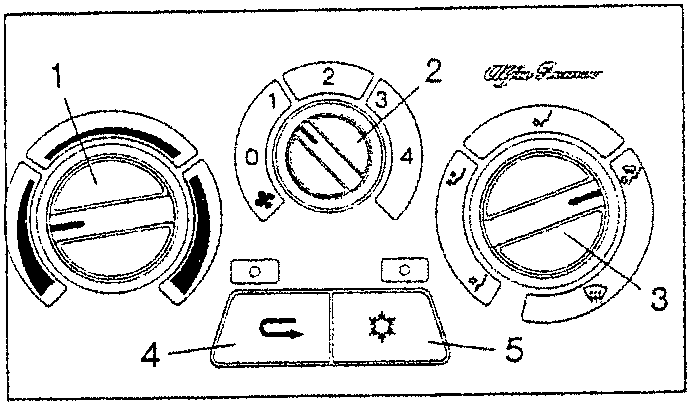
Controls
The control unit on the dashboard comprises three knobs and two push-buttons:
- -the left hand knob (1) mechanically operates the mixing port between warm air (red) and cold (blue); when turned completely counter-clockwise, it cuts off the radiator closing a special tap.
NOTE: the heater comprises a heat exchanger which exploits the engine coolant fluid to release heat to the air that is sent to the passenger compartment; in fact it is supplied by a special pipe of the engine cooling circuit.
- -the centre knob (2) mechanically controls the opening of the ports that adjust the flow of air:
- 0: inlet of outside air without fan (dynamic air)
- from 1 to 4: a switch is controlled which turns on the fan through a regulator with four speeds. The regulator and its resistor are fitted on the duct near the fan.
NOTE: the fan can only be turned on with the ignition key turned.
- -the right knob (3), acting on the distribution ports, still by mechanical transmission, sending the air into the passenger compartment in the directions shown on the pictograms.
- -the button (4) controls the engagement of the "recirculation" function, by operating a motor which closes the outside air duct port and at the same time opens the air duct for recirculation from inside the passenger compartment. The driver is alerted that the recirculation function is operating by the lighting up of a special led.
(The recirculation function makes it possible to withdraw the air to be treated from inside the passenger compartment, shutting off the flow of air from outside which in certain instances may be undesirable: bad smells, smoke, unventilated tunnels, etc...)
- -button (5) controls engagement of the cooling system which produces cold, dehumidified air. A special led lights up to warn that it is operating.
Air cooling system:
This is a closed loop system in which a fluid condenses and evaporates withdrawing heat from the air in the evaporator.
It mainly comprises the following:
- compressor, operated by the crankshaft through a belt: it is turned on and off through an electromagnetic joint operated by the air conditioning system.
- -Petrol version: the compressor is controlled by the engine electronic management system which adapts idle speed when the compressor is engaged, or prevents it from engaging under power absorption conditions that would adversely affect vehicle performance levels.
- -TD version: engagement of the compressor is controlled by a special control unit which takes account of a series of operating conditions of the system itself and of the engine which are described below.
NOTE:
In both cases a variable displacement compressor is used; this configuration is made through a suitable adjustment valve and a sloping plate. This makes it possible to meet the different requirements of cold air without the electromagnetic joint being energised and de-energised continuously: when the requirement is high, the compressor moves to the maximum load configuration and vice versa for low requirements.
- condenser, fitted in front of the engine coolant radiator; if the car is stationary, the air needed for thermal exchange is supplied operating the engine radiator fan;
- evaporator, exchanger which cools the air, located in the duct-distributor;
- accumulator/drier, which separates the fluid in liquid state from gas and also acts as accumulator and filter for any foreign matter
- minimum thermostat (antifrost): - this disconnects the compressor when the temperature is too low as it would risk "freezing" the evaporator.
- four-level pressure switch (trinary): this controls the safety and correct operation of the fluid circuit.
The 4 levels cut in as follows:
- -1. level = minimum pressure for engaging the compressor.
- -2. level = pressure requiring engagement of the of first speed of the fan.
- -3. level = pressure requiring engagement of the second speed of the fan.
Parts & tools for this job For 1994 Alfa Romeo 145/146
- TOOLDigital multimeterSearch: automotive digital multimeter
- PARTAssorted fuse kitSearch: car fuse assortment kit
- TOOLWire crimper and connector kitSearch: wire crimper connector kit
Links open Amazon search results in a new tab. As an Amazon Associate I earn from qualifying purchases.