
Introduction
- Make
- Fiat
- Model
- 500 Factory Service Manual
- Year
- 2007–2024
- Section
- General › Introduction
Introduction
Introduction
The dual circuit crossover braking system allows both sides of the vehicle to brake even if one circuit fails. Each circuit acts on one front wheel and the diagonally opposed rear wheel.
The versions are equipped with:
- ventilated front disc brakes (1.3 Multijet and 1.4 16V petrol engine) and rear drum brakes (1.2 8V petrol engine and 1.3 Multijet),
- ventilated front and rear disc brakes (1.4 16V petrol engine).
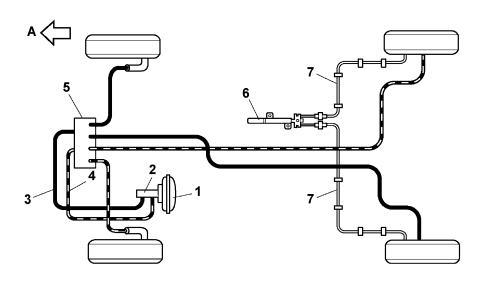
1. Brake servo
2. Master cylinder pump
3. Rigid pipe from master cylinder to A.B.S. control unit: for brake operation: right front and left rear
4. Rigid pipe from master cylinder to A.B.S. control unit: for brake operation: left front and right rear
5. A.B.S. control unit
6. Handbrake lever
7. Handbrake control cables
A. Direction of travel
The braking system employed uses the most sophisticated electronic and mechanical systems, normally found on the latest generation vehicles belonging to a higher class:
- ABS: Antilock Braking System;
- EBD (Electronic Brake force Distribution): electronic brakeforce distribution between the front and rear wheels;
- ESP (Electronic Stability Program): electronic vehicle stability control;
- Hill Holder (with ESP): an automatic function which allows braking and setting off on a hill without the aid of the handbrake.
- HBA (Hydraulic Brake Assistant) system: electro-hydraulic braking assistance which automatically increases the pressure in the braking circuit during emergency braking (with ESP).
The ABS control unit can be equipped on the vehicle in the following trim levels:
- With EBD
- With EBD and ESP (Electronic Stability Program) which includes the ASR/MSR/HBA/HHC functions.
The ABS is the most advanced system currently available: it has a hydraulic control unit with 8 solenoids, 4 active sensors and 4 channels with brake force distributor; in the ESP versions the electrohydraulic unit has 12 solenoids; the steering angle sensor is fitted on the steering column, whilst the yaw sensor is located in the central part of the floor near the centre console (for detecting lateral acceleration, yaw speed and vehicle gradient (the latter for the Hill-Holder function)).
The basic feature of the active sensors consists of the fact that the signal is processed directly by the sensor instead of being sent to the control unit, with the immediate intervention of the system in this way.
Parts & tools for this job For 2007 Fiat 500
- PARTBrake padsSearch: Fiat 500 2007 brake pads
- TOOLBrake bleeder kitSearch: one man brake bleeder kit
- FLUIDBrake fluidSearch: brake fluid
Links open Amazon search results in a new tab. As an Amazon Associate I earn from qualifying purchases.