
Introduction - engine
- Make
- Fiat
- Model
- 500 Factory Service Manual
- Year
- 2007–2024
- Section
- General › Introduction - engine
INTRODUCTION - ENGINE
CURRENT DEVELOPMENTS
These engines are fitted with a high pressure electronic injection system for fast diesel engines. This "Magneti Marelli Common Rail" system is fully managed by a Multijet MJD 6F3 control unit.
PERFORMANCE DELIVERED
This engine is capable of providing the following performances:
- max power 55 kW (75 BHP) EEC at 4000 rpm;
- max torque 145 Nm EEC at 1500 rpm
DEVICES ADOPTED
To reduce polluting emission levels, these engines are equipped with:
- exhaust system with oxidising catalytic converter;
- E.G.R. exhaust gas recirculation system with heat exchanger
- crankcase blowby gas recirculation system.
- particulate filter (DPF) (where applicable)
STRUCTURE
The unit is a system made up of the engine and all circuits required for its operation:
- fuel supply system;
- air turbocharging system;
- engine cooling system;
- exhaust system with catalytic converter;
- oil vapour recirculation system;
- E.G.R. exhaust gas recirculation system with heat exchanger;
The operation of these systems is optimised by an electronic control system governed by a control unit.
An awareness of control unit operating strategies allows an overview of the entire UNIT 10 system.
See descriptions 1060 DIESEL INJECTION SYSTEM
CONSTRUCTION
Direct injection turbodiesel engine without ante-chambers, 4 cylinders in line, 1248 cc, four valves per cylinder with hydraulic tappets, twin overhead camshaft with transmission of power by gears, air supercharging with turbocharger and intercooler, Magneti Marelli MJD 6F3 Common Rail electronic injection system.
GLOSSARY
Hardened and tempered steel
Heat treatment applied to special steels to improve their mechanical properties: involves hardening followed by tempering to make the material much stronger.
Tempering: consists of heating at temperatures < 720°C followed by slow cooling in order to lessen the effects of the tempering without removing them.
In this way, the material returns to conditions that are closer to a stable chemical and physical balance.
Hardening: this is achieved when the metal structure is at a high temperature, when it is harder and more resistant than when cold.
CONTROL AREA NETWORK (CAN)
The CAN is a communication network that allows the transmission of data between the ECU and other vehicle system computers.
The advantage of this system lies in the fact that the need for long wiring is contained and the number of sensors reduced (because, from the moment the computers are connected by the data transmission system, the information supplied by a sensor can be used simultaneously by various devices).
The CAN also allows improvement in the fault diagnosis system capacities, faster transmission of signals and electrical/magnetic compatibility of components (relationship between various electrical and electronic circuits on the vehicle and interaction between the vehicle and surrounding conditions).
The circuit that connects the ECU with the other terminals is an integrated circuit known as a CAN interface. It has the function of converting the messages received via the data transmission system into the appropriate format.
Condensation
This is the change of a substance from a vapour to a liquid state, the opposite of evaporation; it takes place through compression or cooling.
DUCTILE CAST IRON
Ductile cast iron is cast iron that, through the addition of cerium and magnesium, contains globules or balls of carbon in a graphite state in a predominantly ferrous matrix with the consequent improvement of all mechanical and technological properties. It can therefore be forged, welded and worked with tools.
It is used very extensively also because, unlike normal cast iron, it has high resistance and percentage extension values.
Evaporation
The phenomenon, also known as vaporisation, when a body changes from a liquid state to a gaseous state,
occurs at any temperature but, everything else being equal, the lower the temperature, the slower the change.
PWM MODULATION OPERATING CYCLE
This is an impulse frequency and modulated width fixed voltage produced by the ECU for the operation of the solenoids. A PWM voltage supply consists of a series of single polarity square waves whose duration is altered by the ECU in response to demand.
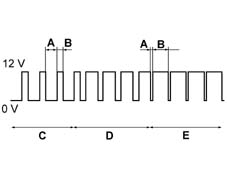
A. Off
B. On
C. Low resulting current
D. Average resulting current
E. Maximum resulting current
The PWM modulation resulting current varies in proportion to the Wave-Space ratio. The Wave-Space ratio is the relationship between periods of "supply - on" and "supply - off". This ratio can be considered as a percentage and, in fact, this is the form of measurement for the Operating Cycle.
Sensor
It is a system that reacts when subject to any form of energy by changing its state, i.e. one or more of its properties (resistance, volume, temperature etc.).
For example, a sensor is a material which undergoes conductivity changes when submerged in a magnetic field.
New-generation sensors are solid-state devices produced using microelectronic processes that can take environmental readings and produce responses in the form of electrical signals for subsequent processing and so that final checks can be conducted.
Sensors are therefore able to measure force, acceleration, pressure and temperature of gases, liquids and solids, concentration of gases such as nitrogen oxides, oxygen, etc.
Viscosity
Material property whereby the particles in a body encounter resistance as they slide over one another.
The resistance value or internal friction depends on the nature of the body: large in solids, very small in viscous liquids, nil in gases.
In liquids, viscosity drops rapidly as temperature rises.
SPECIFICATIONS
4 cylinder in line, 16 valve 1368 cc engine with TOHC with a Bosch ME 7.9.10 electronic injection/ignition system.
POWER - 74 kW -100 bhp EEC at 6000 rpm
TORQUE - 13.1 daNm - 13.2 kgm EEC at 4250 rpm
CYLINDER ARRANGEMENT - 4 in line
BORE - 72 mm
STROKE - 84 mm
CYLINDER CAPACITY - 1368 cc
CYLINDER HEAD - aluminium
CRANKCASE - cast iron
CRANKSHAFT - ductile cast iron with 8 counter-weights and 5 main bearings with torsional damper
TIMING SYSTEM - two overhead camshafts, with drive transmission through gears with clearance recovery by intake and exhaust shafts, hydraulic tappets, 4 valves per cylinder
FUEL SYSTEM - returnless system with phased sequential Bosch injection
IGNITION - completely electronic with individual coils (pencil coils)
POLLUTION-CONTROL DEVICES - three-way catalytic converter
LUBRICATION - forced with lobe geared pump
COOLING - liquid with forced circulation via centrifugal pump and sealed circuit; radiator and supplementary expansion tank
COMPOSITION
The systems involved in the operation of the engine are:
- fuel supply system
- air supply system
- exhaust system with catalytic converter
- fuel vapour recirculation system
- engine cooling system.
The operation of these systems is optimised by an electronic control system governed by a control unit.
See descriptions 1056 PETROL INJECTION SYSTEM
Assembly view
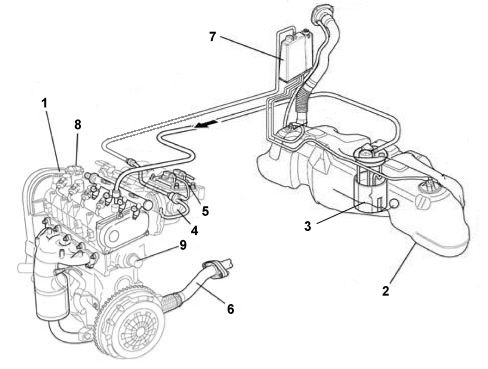
1. Engine and power unit
2. Fuel tank and pipes
3. Pump(s) and supply circuit devices
4. Engine air supply circuit
5. Petrol fuel injection system
6. Exhaust pipes and silencers
7. Emission control system
8. Engine lubrication
9. Engine cooling
Fuel supply system
This is returnless with an electric fuel pump submerged in the tank and enclosed in a container together with the pressure regulator, the level gauge and the filter.
See descriptions 1040 FUEL TANK AND PIPES
Air supply system
Air supply system with plastic intake manifold and large air filter casing to limit intake noise.
See descriptions 1048 ENGINE AIR SUPPLY CIRCUIT
Exhaust system
The exhaust system has a post-treatment system for the exhaust gases with a Lambda sensor and catalytic converter fitted in the engine compartment
See descriptions 1076 EXHAUST PIPES AND SILENCERS
Emission control system
The following emission control systems are used on this model:
- Exhaust emission control system with a three-way catalytic converter and two lambda sensors, one downstream and one upstream of the catalytic converter;
- crankcase vapour/gas recirculation system;
- fuel evaporation control system.
See descriptions 1080 EMISSION CONTROL SYSTEM
Cooling system
Forced circulation with centrifugal vane pump.
See descriptions 1088 ENGINE COOLING
Hardened and tempered steel
Heat treatment applied to special steels to improve their mechanical properties: involves hardening followed by tempering to make the material much stronger.
Tempering: consists of heating at temperatures < 720°C followed by slow cooling in order to lessen the effects of the tempering without removing them.
In this way, the material returns to conditions that are closer to a stable chemical and physical balance.
Hardening: this is achieved when the metal structure is at a high temperature, when it is harder and more resistant than when cold.
CONTROL AREA NETWORK (CAN)
The CAN is a communication network that allows the transmission of data between the ECU and other vehicle system computers.
The advantage of this system lies in the fact that the need for long wiring is contained and the number of sensors reduced (because, from the moment the computers are connected by the data transmission system, the information supplied by a sensor can be used simultaneously by various devices).
The CAN also allows improvement in the fault diagnosis system capacities, faster transmission of signals and electrical/magnetic compatibility of components (relationship between various electrical and electronic circuits on the vehicle and interaction between the vehicle and surrounding conditions).
The circuit that connects the ECU with the other terminals is an integrated circuit known as a CAN interface. It has the function of converting the messages received via the data transmission system into the appropriate format.
Condensation
This is the change of a substance from a vapour to a liquid state, the opposite of evaporation; it takes place through compression or cooling.
DUCTILE CAST IRON
Ductile cast iron is cast iron that, through the addition of cerium and magnesium, contains globules or balls of carbon in a graphite state in a predominantly ferrous matrix with the consequent improvement of all mechanical and technological properties. It can therefore be forged, welded and worked with tools.
It is used very extensively also because, unlike normal cast iron, it has high resistance and percentage extension values.
Evaporation
The phenomenon, also known as vaporisation, when a body changes from a liquid state to a gaseous state,
occurs at any temperature but, everything else being equal, the lower the temperature, the slower the change.
PWM MODULATION OPERATING CYCLE
This is an impulse frequency and modulated width fixed voltage produced by the ECU for the operation of the actuators. A PWM voltage supply consists of a series of single polarity square waves whose duration is altered by the ECU in response to demand.
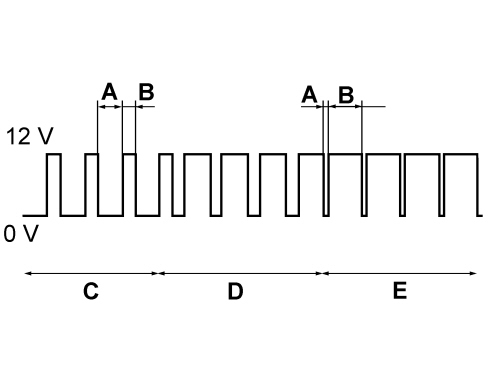
A. Off
B. On
C. Low resulting current
D. Average resulting current
E. Maximum resulting current
PWM MODULATION OPERATING CYCLE
The PWM modulation resulting current varies in proportion to the Wave-Space ratio. The Wave-Space ratio is the relationship between periods of "supply - on" and "supply - off". This ratio can be considered as a percentage and, in fact, this is the form of measurement for the Operating Cycle.
Sensor
It is a system that reacts when subject to any form of energy by changing its state, i.e. one or more of its properties (resistance, volume, temperature etc.).
For example, a sensor is a material which undergoes conductivity changes when submerged in a magnetic field.
New-generation sensors are solid-state devices produced using microelectronic processes that can take environmental readings and produce responses in the form of electrical signals for subsequent processing and so that final checks can be conducted.
Sensors are therefore able to measure force, acceleration, pressure and temperature of gases, liquids and solids, concentration of gases such as nitrogen oxides, oxygen, etc.
Viscosity
Material property whereby the particles in a body encounter resistance as they slide over one another.
The resistance value or internal friction depends on the nature of the body: large in solids, very small in viscous liquids, nil in gases.
In liquids, viscosity drops rapidly as temperature rises.
Compositin of 1.2 petrol 8V engine
4 cylinder in line, 8 valve 1242 cc engine with OHC with an IAW 5SF8 electronic injection/ignition system.
POWER - 67bhp EEC at 5750 rpm
TORQUE - 10.4 kgm EEC at 3500 rpm
CYLINDER ARRANGEMENT - 4 in line
BORE - 70.8 mm
STROKE - 78.86 mm
CAPACITY - 1242cc
CYLINDER HEAD - aluminium
CRANKCASE - cast iron
CRANKSHAFT - ductile cast iron with 8 counter-weights and 5 main bearings with torsional damper
TIMING SYSTEM - overhead camshaft, mechanical tappets, 2 valves per cylinder
FUEL SYSTEM - returnless system with Marelli 5S F phased sequential injection with Pico pintle-less injectors
IGNITION - completely electronic inductive discharge with twin spark
POLLUTION-CONTROL DEVICES - three-way catalytic converter
LUBRICATION - forced with in-line trochoidal geared pump
COOLING - liquid with forced circulation via centrifugal pump and sealed circuit; radiator and supplementary expansion tank
The systems involved in the operation of the engine are:
- fuel supply system
- air supply system
- exhaust system with catalytic converter
- fuel vapour recirculation system
- engine cooling system.
The operation of these systems is optimised by an electronic control system governed by a control unit
See descriptions 1056 PETROL INJECTION SYSTEM
Assembly view
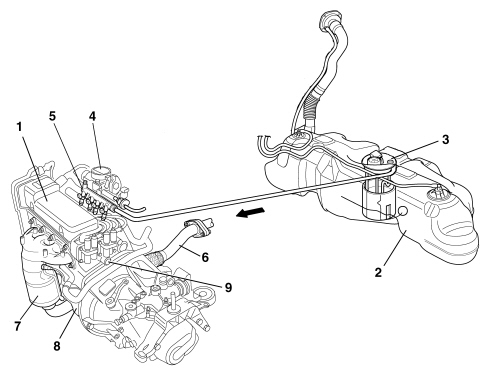
1. Engine and power unit
2. Fuel tank and pipes
3. Pump(s) and supply circuit devices
4. Engine air supply circuit
5. Petrol fuel injection system
6. Exhaust pipes and silencers
7. Emission control system
8. Engine lubrication
9. Engine cooling
Fuel supply system
It is returnless, with an electric fuel pump submerged in the tank and enclosed in a container together with the pressure regulator, the level gauge and the filter.
See descriptions 1040 FUEL TANK AND PIPES
Air supply system
Air supply system with plastic intake manifold and large air filter casing to limit intake noise
See descriptions 1048 ENGINE AIR SUPPLY CIRCUIT
and
See descriptions 1072 INLET AND EXHAUST MANIFOLDS
Exhaust system
The exhaust system has a post-treatment system for the exhaust gases with a Lambda sensor and catalytic converter fitted in the engine compartment
See descriptions 1076 EXHAUST PIPES AND SILENCERS
Emission control system
The following emission control systems are used on this model:
- exhaust emission control system with three-way catalytic converter and Lambda sensor;
- crankcase vapour/gas recirculation system;
- fuel evaporation control system
See descriptions 1080 EMISSION CONTROL SYSTEM
Cooling system
Forced circulation with centrifugal vane pump
Parts & tools for this job For 2007 Fiat 500
- PARTEngine gasket setSearch: Fiat 500 2007 engine gasket set
- TOOLTorque wrenchSearch: 3/8 inch torque wrench
- TOOLFeeler gauge setSearch: feeler gauge set
Links open Amazon search results in a new tab. As an Amazon Associate I earn from qualifying purchases.