
Operation
- Make
- Fiat
- Model
- Bravo /Brava (182) Factory Service Manual
- Year
- 1995–2001
- Section
- Fuel feed system (2000 range, 1910 JTD) › Operation
Operation
With coolant temperature > 20°C and engine speeds between 800 and 3000 rpm, the engine management unit controls the EGR solenoid by means of a square wave signal.
Changes in this signal allow the EGR coil to move a plunger and thus modulate the flow of exhaust gas from the exhaust manifold to the intake manifold; this achieves two results:
- less air is taken in
- combustion temperature is lowered (due to the presence of inert gases), thus reducing the formation of NOx (nitrogen oxides).
The engine management control unit is constantly informed of recirculation gas quantity via data from the debimeter. If the intake of a given quantity of air (Qam) is required for a given rpm and the level sent by the debimeter (Qar) is lower, the difference (Qgr) is the amount of gas recirculated.
Qam – Qar = Qgr
Qam = stored theoretical air quantity
Qar = actual air quantity
Qgr = recirculated gas quantity
An atmospheric pressure signal is used in controlling the EGR valve to detect when the car is being driven at altitude. The recirculation gas quantity can then be reduced to prevent engine fumes.
CRANKCASE VAPOUR RECIRCULATION SYSTEM (BLOW-BY)
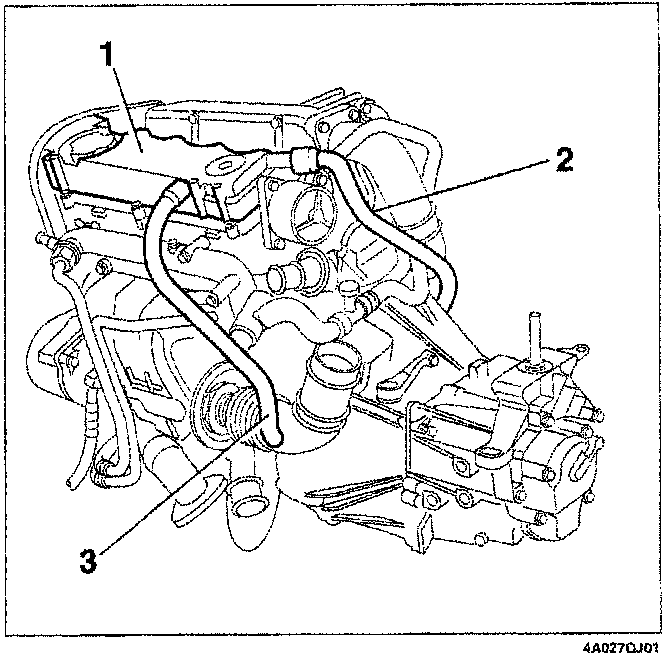
Oil vapour emission control is carried out by a separator (1) (function performed by the cam cover), which collects vapours released from the crankcase in pipe (2).
The temperature difference betwen the separator and oil vapours brings about partial condensation.
The condensed vapours are sent through pipe (3) to the turbocharger air intake sleeve.
Parts & tools for this job For 1995 Fiat Bravo
- PARTEngine gasket setSearch: Fiat Bravo 1995 engine gasket set
- TOOLTorque wrenchSearch: 3/8 inch torque wrench
- TOOLFeeler gauge setSearch: feeler gauge set
Links open Amazon search results in a new tab. As an Amazon Associate I earn from qualifying purchases.