
Emission control - K Series 1.8 (EVAP Control): Description and operation (page 2 of 2)
- Make
- Land Rover
- Model
- Freelander System Description and Operation (UK)
- Section
- Description and operation
Vapour Separator The vapour separator is installed at the front of the RH rear wheel arch, behind the wheel arch liner. The vapour separator prevents the charcoal in the EVAP canister being saturated with fuel, by condensing out some of the fuel in the vapour vented from the fuel tank. Condensed fuel from the vapour separator drains back to the fuel tank through the vent pipe.
EVAP Canister
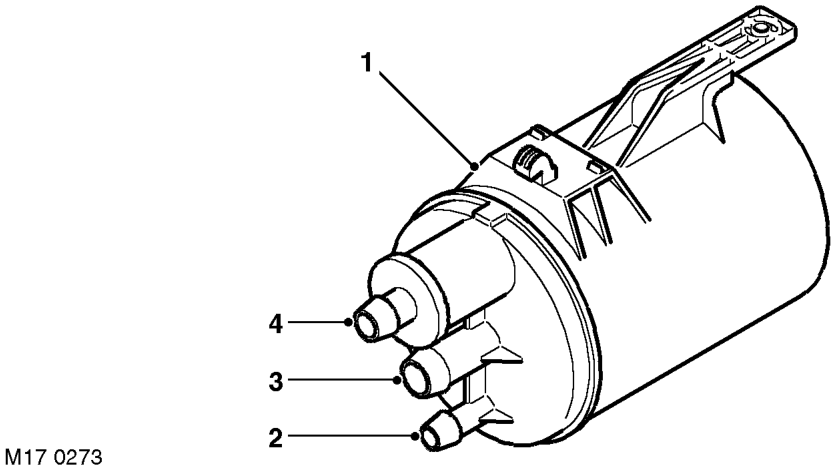
1 Canister housing 2 Vapour separator connection
3 Atmospheric vent connection 4 Purge valve connection
The EVAP canister is installed at the front of the RH rear wheel arch, behind the wheel arch liner. Charcoal in the EVAP canister absorbs and stores fuel from the vapour vented from the fuel tank. When the engine is running, fuel is purged from the EVAP canister by outside air being drawn through the charcoal and the outlet to the purge valve.
Purge Valve The purge valve is installed on the LH suspension turret in the engine compartment, and connected to the EVAP canister by a vent pipe installed on the underside of the vehicle, next to the fuel delivery pipe. A second vent pipe connects the purge valve to the inlet manifold. The purge valve is controlled by the Engine Control Module (ECM) and remains closed below a preset coolant temperature and engine speed, to protect engine tune and catalytic converter performance. If the EVAP canister is purged during cold running or at idle, the additional enrichment of the fuel mixture delays the catalytic converter light off time and causes erratic idle speed. When engine operating conditions are suitable, the ECM opens the purge valve and the depression in the inlet manifold draws fuel vapour from the EVAP canister.
Parts & tools for this job For Land Rover Freelander
- PARTExhaust gasketSearch: Land Rover Freelander exhaust gasket
- TOOLPenetrating oilSearch: penetrating oil
- TOOLOBD2 scannerSearch: OBD2 scanner
Links open Amazon search results in a new tab. As an Amazon Associate I earn from qualifying purchases.