
Lifting the vehicle
- Make
- Volkswagen
- Model
- Amarok 2H
- Year
- 2010–2020
- Section
- Fuel pump › Lifting the vehicle
Lifting the vehicle
- Observe safety notes → Chapter.
- Raising vehicle with wheel lifts → Chapter
- Alternative mounting point → Chapter
- Additional support of vehicle → Chapter
Note
- Raising vehicle with wheel lifts should mainly be done for all assembly work on vehicle.
- Depending on work to be done, support points and variants may be combined with each other.
Safety notes
Warning DANGER!
- If alternative support points are used, it may be necessary to further secure the vehicle for certain repair work → Chapter.
Warning
- Before driving onto a lifting platform, ensure that there is sufficient clearance between low-lying components and lifting platform.
- Before driving a vehicle onto a lifting platform, ensure that the vehicle weight does not exceed the permissible lifting capacity of the platform.
- The vehicle may only be lifted at the points indicated to prevent damage to the underbody and to prevent vehicle from tipping.
- Laden vehicles must be unloaded before being raised.
- The contact surfaces for lifting vehicle must be free of dirt, grease, wax and dust.
- The mechanic must lash the vehicle to the lifting platform.
- If the vehicle is not strapped down, there is a great danger that the vehicle will slip off the lifting platform.
- Never start the engine and engage a gear with vehicle lifted if even one driven wheel has contact with the floor. Disregarding these warnings risks the danger of an accident!
- If the vehicle has been raised with a workshop jack in order to work underneath it, then it must be securely supported using suitable stands.
Raising vehicle with wheel lifts
Observe safety precautions for raising the vehicle → Chapter.
Note
- Raising vehicle with wheel lifts should mainly be done for all assembly work on vehicle.
- Vehicle must under no circumstances be raised on sills, otherwise its body will be seriously damaged.
- The vehicle may only be lifted at points indicated in order to avoid damaging vehicle and to prevent vehicle from tipping.
- The contact surfaces for lifting vehicle must be free of dirt, grease, wax and dust.
- To avoid damage, make sure that no electrical cables, brake lines or fuel lines become trapped.
Re-equip lifting platform so that existing 4 mounting plates are replaced by 4 wheel lift supports (1).
Adjust distances of lifting platform so that all 4 wheels sit exactly in the wheel lift supports (2).
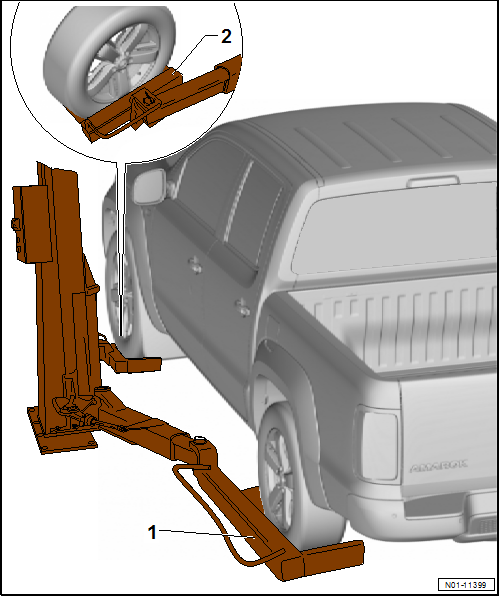
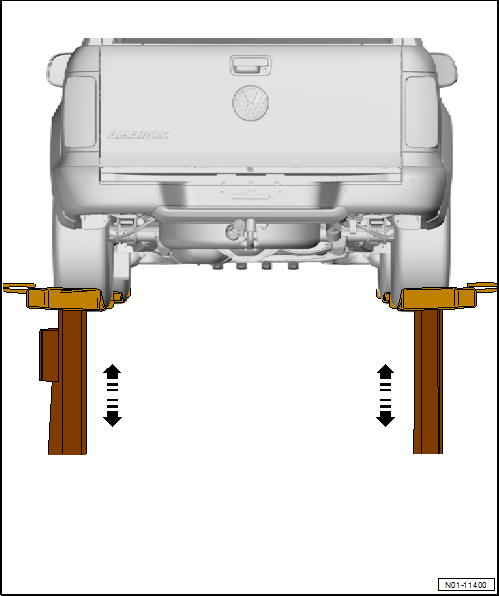
Drive vehicle onto lifting platform until vehicle is located exactly in wheel lifts.
Vehicle can now be raised and lowered to required working height.
Alternative mounting point
Special tools and workshop equipment required4 x tensioning straps T10038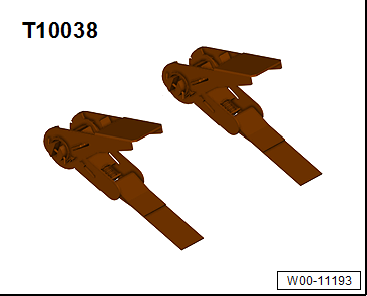
Observe safety precautions for raising the vehicle → Chapter.
Note
- Vehicle must under no circumstances be raised on sills, otherwise its body will be seriously damaged.
- The vehicle may only be lifted at points indicated in order to avoid damaging vehicle and to prevent vehicle from tipping.
- The contact surfaces for lifting vehicle must be free of dirt, grease, wax and dust.
- The support surfaces must be free of dirt, grease, wax and dust.
- To avoid damage, make sure that no electrical cables, brake lines or fuel lines become trapped.
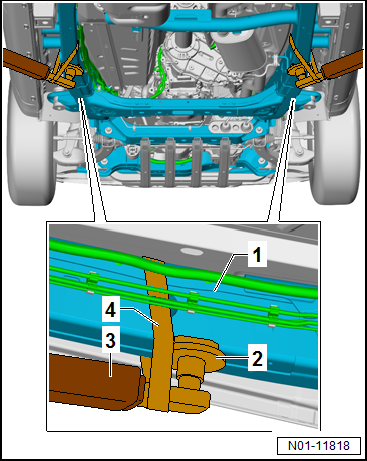
As shown in diagram, align front support arms (3) of vehicle hoist with anti-slip discs VAS 5244/2(2) on both sides under ladder frame (1).
Note
- To prevent damage to the fuel lines, the tensioning strap T10038 must be routed behind the fuel lines.
Secure front support arms (3) with ladder frame (1) using tensioning straps T10038(4) on both sides.
As shown in diagram, align rear support arms (3) of vehicle hoist with anti-slip discs VAS 5244/2(2) on both sides under ladder frame (1).
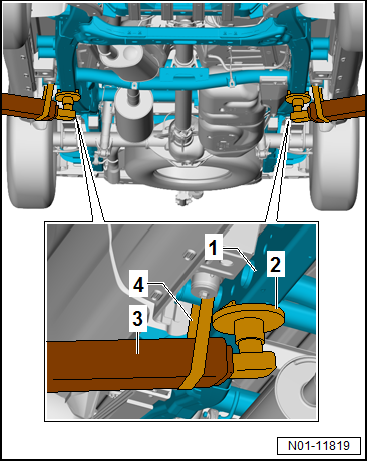
Secure rear support arms (3) with ladder frame (1) using tensioning straps T10038(4) on both sides.
Additional support of vehicle
Note
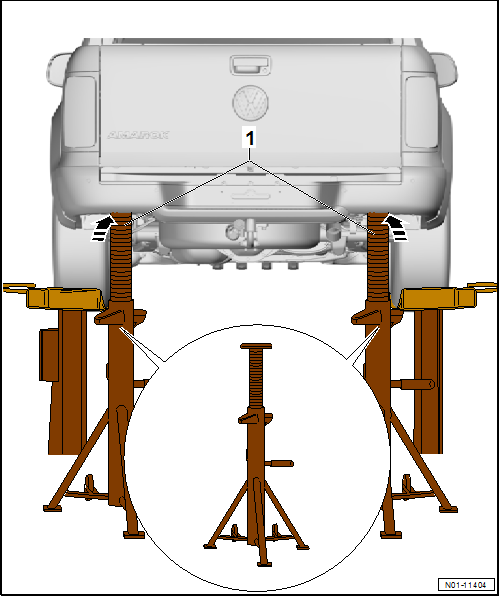
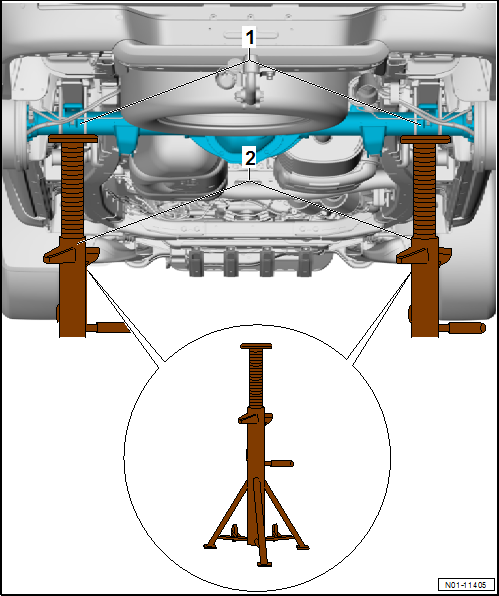
- Depending on assembly condition of vehicle, it can be secured using height-adjustable stands in addition to lashing it to support arms of lifting platform with tensioning straps T10038.
- To avoid damage, make sure that no electrical cables, brake lines or fuel lines become trapped.
Place height-adjustable stands (1) for supporting vehicle under rear longitudinal member (arrows).
Alternatively, height-adjustable stands (2) can be positioned under rear leaf spring brackets (1) on rear axle tube.
Parts & tools for this job For 2010 Volkswagen Amarok
- PARTFuel filterSearch: Volkswagen Amarok 2010 fuel filter
- TOOLFuel pressure test kitSearch: fuel pressure test kit
- TOOLFuel line disconnect toolSearch: fuel line disconnect tool
As an Amazon Associate we earn from qualifying purchases.