
Lambda adjustment
- Make
- Fiat
- Model
- Bravo /Brava (182) Factory Service Manual
- Year
- 1995–2001
- Section
- Fuel system (1370 12v) › Lambda adjustment
Lambda adjustment
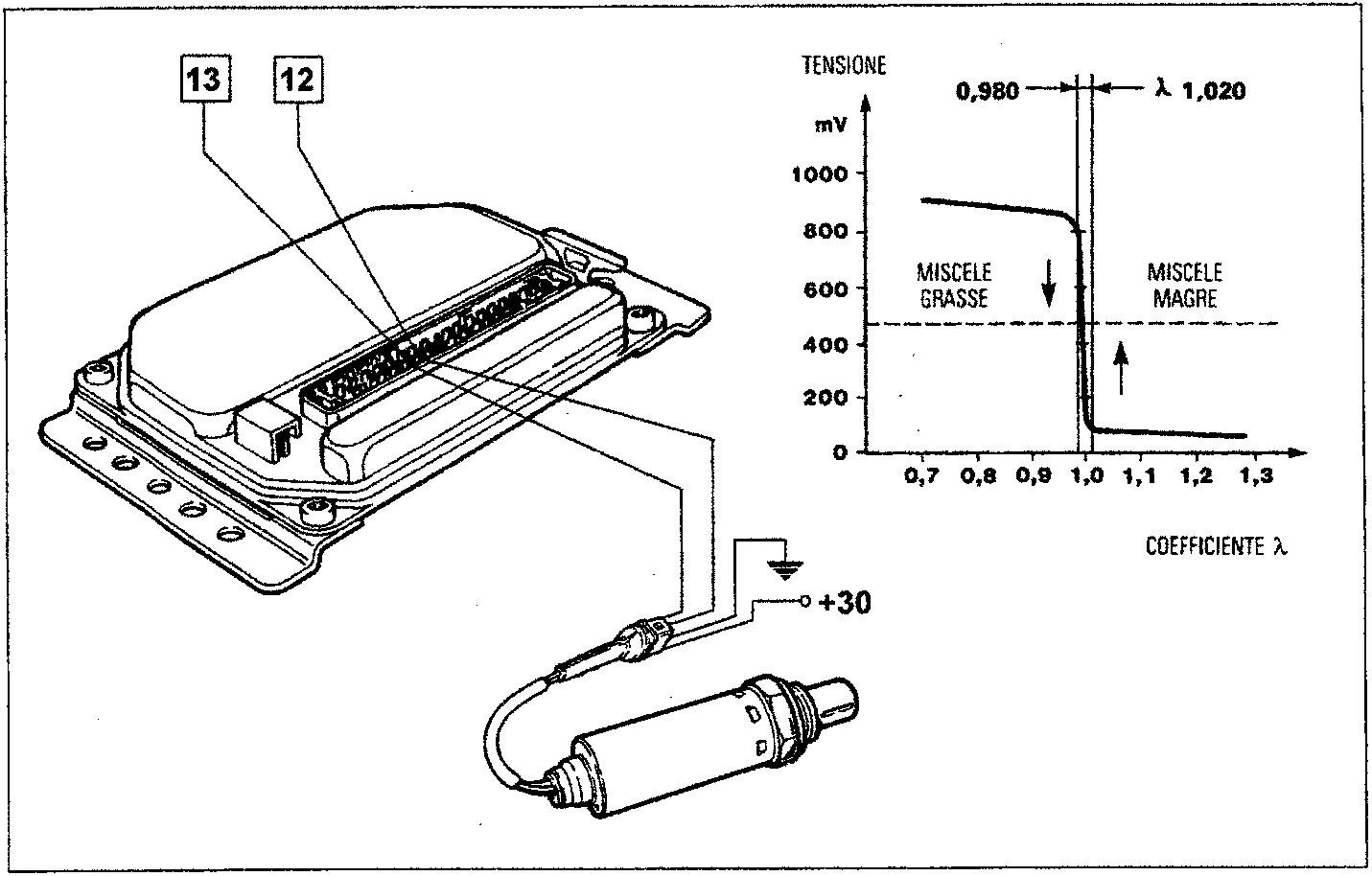
The LAMBDA probe controls mixture concentration by measuring the residual oxygen content of exhaust emissions.
Because the ceramic is not active below 300° C, the LAMBDA probe is heated electrically by a resistance (inside the probe) that is continually supplied by a locked positive and protected by a 10 A fuse.
This heating is necessary during cold starts to maintain sensor efficiency if the engine idles for long periods.
With temperatures in excess of 300° C, the ceramic becomes a conductor of oxygen ions. If the percentages of oxygen present on either side of the sensor differ, a voltage difference is set up across the two end poles.
The LAMBDA probe sends a voltage difference signal to the control unit through terminals (12) and (13).
LAMBDA probe measurements of exhaust gas composition allow the control unit to correct the mixture concentration continually on-line (leaner/richer) in order to maintain it close to a stoichiometric ratio. Efficient catalytic converter operation and low exhaust gas toxicity are dependent on an exact mixture composition.
During the above stages, injection pulse changes made by the control unit on the basis of the LAMBDA probe signal are excluded because they would be at odds with the required driving conditions; the engine thus operates in OPEN LOOP.
With both LAMBDA probe and control unit circuit working properly, the percentages of polluting exhaust gases are self-regulated by the system without the possibility of external regulation.
Parts & tools for this job For 1995 Fiat Bravo
- PARTOxygen sensorSearch: Fiat Bravo 1995 oxygen sensor
- TOOLOxygen sensor socketSearch: oxygen sensor socket
- TOOLOBD2 scannerSearch: OBD2 scanner
Links open Amazon search results in a new tab. As an Amazon Associate I earn from qualifying purchases.