
Introduction - EXHAUST PIPES AND SILENCERS
- Make
- Fiat
- Model
- Stilo Factory Service Manual
- Year
- 2001–2007
- Section
- Exhaust pipes and silencers › Introduction - EXHAUST PIPES AND SILENCERS
Introduction - EXHAUST PIPES AND SILENCERS
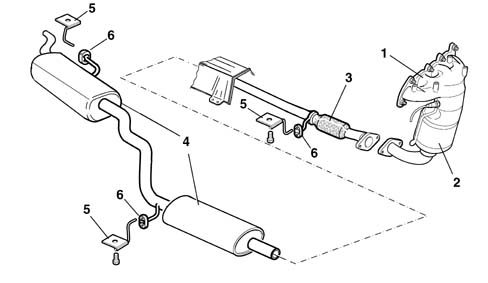
The engine exhaust gases flow through manifold (1) to the three-way catalytic converter (2) (see 1080) to which the exhaust pipe is connected by means of a flange.
At the front of the exhaust pipe, there is a flexible component (3) for limiting the transmission of vibrations.
The rear exhaust section comprises two silencers (4).
Special guards limit the radiation of heat towards the bodyshell.
The various components are supported by mountings (5) and rubber rings (6) secured to the underbody.
The engine exhaust gases flow through the manifold to the three-way catalytic converter (3) (see 1080).
At the front of the exhaust pipe, there is a flexible component (4) for limiting the transmission of vibrations.
The centre and rear sections of the exhaust pipe include two silencers.
Special guards limit the radiation of heat towards the bodyshell.
The various components are supported by mountings and rubber rings secured to the underbody.
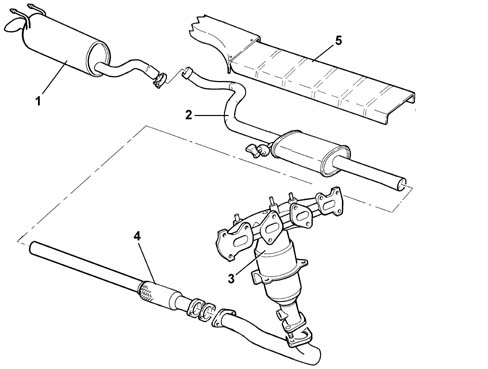
1. Rear exhaust pipe with silencer
2. Centre exhaust pipe
3. Catalytic converter (see 1080)
4. Flexible element
5. Heat shields
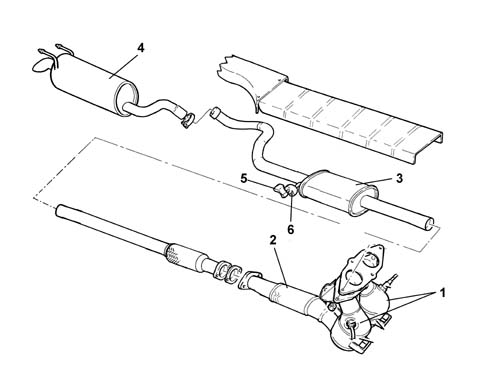
The engine exhaust gases flow through the manifold to the two catalytic converters (1) (see 1080).
At the front of the exhaust pipe, there is a flexible component (2) for limiting the transmission of vibrations.
The centre section of the exhaust pipe includes a second flexible element and the first silencer (3).
The rear section of the exhaust pipe includes the second silencer (4).
Special guards limit the radiation of heat towards the bodyshell.
The various components are supported by mountings (5) and rubber rings (6) secured to the underbody.
STRUCTURE
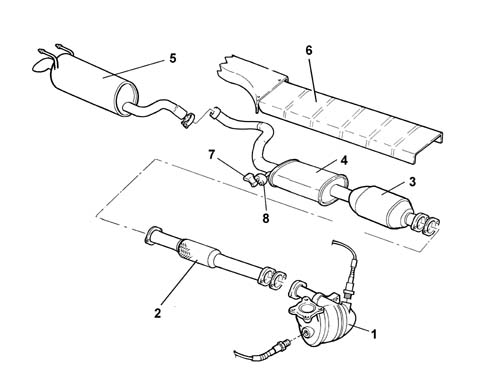
The engine exhaust gases flow through the pre-catalyzer (1) upstream of the exhaust pipe.
The front section of the pipe, which includes a flexible section (2), connects the centre section with the second catalyzer (3) and the first silencer (4).
The rear section with the second silencer (5) is at the end.
Special guards (6) limit the radiation of heat towards the bodyshell.
The various components are supported by means of mountings (7) and circlips (8) fixed to the body.
Structure
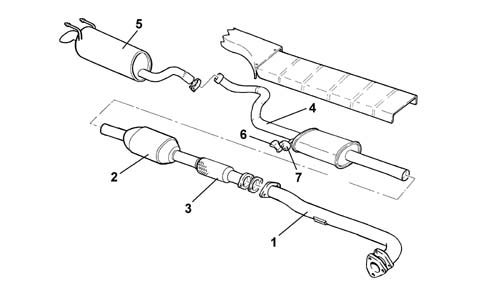
The engine exhaust gases flow through the manifold to the turbocharger and then via a pipe (1) to the oxidizing catalytic converter (2) (Characteristic of working principle 1080B exhaust emission control system).
At the front of the exhaust pipe, there is a flexible component (3) for limiting the transmission of vibrations.
The section of the exhaust comprises an intermediate pipe (4), including the first silencer, and the rear silencer (5).
Special guards limit the radiation of heat towards the bodyshell.
The various components are supported by mountings (6) and rubber rings (7) secured to the underbody.
Structure
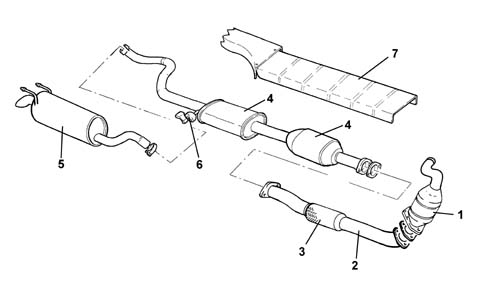
The engine exhaust gases flow through the manifold to the turbocharger and then to the oxidizing catalytic converter (1) Characteristic of working principle 1080B exhaust emission control system.
At the front of the exhaust pipe, there is a flexible component (2) for limiting the transmission of vibrations.
The rear section of the exhaust comprises an intermediate pipe (4) including two silencers (4) and the rear silencer (5).
Special guards (7) limit the radiation of heat towards the bodyshell.
The various components are supported by mountings and rubber rings (6) secured to the underbody.
Parts & tools for this job For 2001 Fiat Stilo
- PARTExhaust gasketSearch: Fiat Stilo 2001 exhaust gasket
- TOOLPenetrating oilSearch: penetrating oil
- TOOLOBD2 scannerSearch: OBD2 scanner
Links open Amazon search results in a new tab. As an Amazon Associate I earn from qualifying purchases.