
Sectioned View of Compressor (Air conditioning) (page 4 of 4)
- Make
- Land Rover
- Model
- Freelander System Description and Operation (UK)
- Section
- Description and operation
Ambient air passing through the heat exchanger due to the ram air effect is supplemented by the two cooling fans, which combine to cool the refrigerant in the condenser sufficiently in order to form a high pressure slightly sub-cooled liquid.
The sub-cooled liquid is then passed to the modulator (which performs the same basic function as a standard receiver/ drier) which is of a canister type construction located at the LH side of the condenser. In the modulator, most of the remaining gas in the refrigerant separates off and the refrigerant passes through the desiccant and filter, to remove moisture and solid impurities before the refrigerant enters the sub-cooled section of the condenser. The refrigerant is cooled even further as it passes through the sub-cooler section of the condenser, resulting in the refrigerant at the outlet to the condenser being almost 100% liquid.
Thermostatic Expansion Valve (TXV)
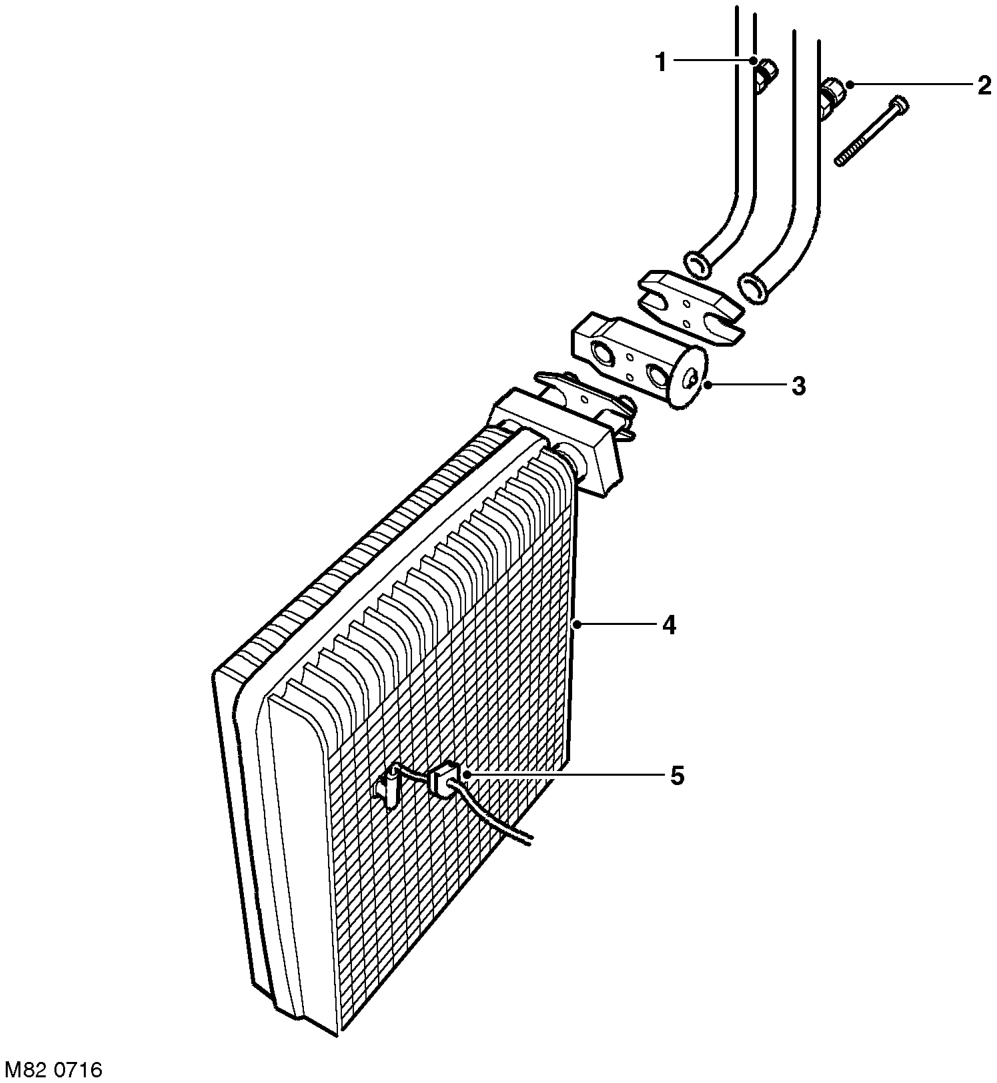
1 High pressure (evaporator inlet) servicing connection 2 Low pressure (evaporator outlet) servicing connection
3 Thermostatic expansion valve (TXV) 4 Evaporator matrix 5 Evaporator temperature sensor
The sub-cooled liquid refrigerant passes from the outlet of the condenser through a pipe to a thermostatic expansion valve (TXV) situated at the engine compartment bulkhead. The TXV connects to the evaporator unit mounted inside the air inlet and blower motor casing in the vehicle cabin.
The thermostatic expansion valve meters the flow of refrigerant into the evaporator, to match the refrigerant flow with the heat load of the air passing through the evaporator matrix.
Parts & tools for this job For Land Rover Freelander
- TOOLA/C manifold gauge setSearch: AC manifold gauge set
- TOOLUV leak detection kitSearch: AC UV leak detection kit
- PARTCabin filterSearch: Land Rover Freelander cabin filter
Links open Amazon search results in a new tab. As an Amazon Associate I earn from qualifying purchases.