
1. Construction
- Make
- Rover
- Model
- 600 Rover 600 Repair Manual - Volumes 1 and 2 - 2nd Edition
- Section
- Brakes - ABS: operation › 1. Construction
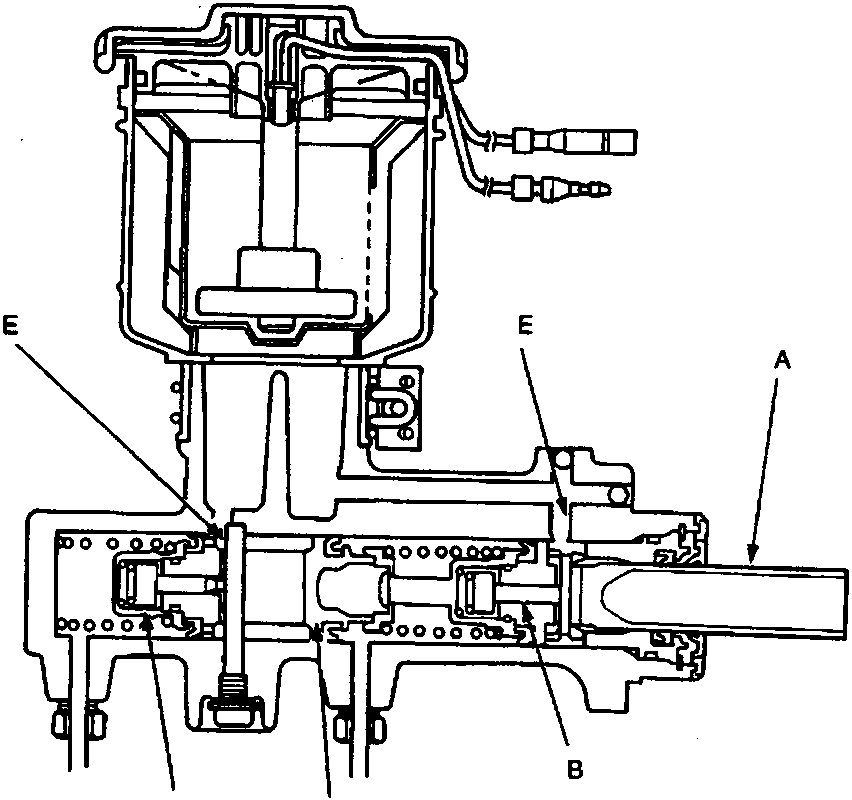
- A Secondary piston
- B Centre valve (B)
- C Primary piston
- D Centre valve (A)
- E Port
1. Construction
A tandem master cylinder is used to improve the safety of the braking system. In addition, centre valves are used to synchronise the anti-lock brake system operation.
The master cylinder has one reservoir tank which is connected to the cylinder sections by two small holes. It has two pistons primary and secondary, which are cross-connected with the calipers so that the fluid pressure works separately on each system (front right wheel & rear left wheel, and front left wheel & rear right wheel.
A stop bolt for controlling movement of the primary piston is provided at the side of the master cylinder body. A reed switch for detecting the brake fluid volume is also provided in the cap of the reservoir tank.
2. Operation
When the brake pedal is depressed, the secondary piston is pushed through the brake booster and the centre valve B is closed so that fluid pressure is generated on the secondary side. At the same time, the primary piston is pushed by the secondary fluid pressure and the centre valve A is closed so that braking fluid pressure is generated both on the primary and secondary sides.
When the brake pedal is released, the primary and secondary pistons are returned to the original position by the brake fluid pressure and piston spring.
Parts & tools for this job For Rover 600
- TOOLOBD2 scanner with ABSSearch: OBD2 scanner ABS SRS
- TOOLDigital multimeterSearch: automotive digital multimeter
Links open Amazon search results in a new tab. As an Amazon Associate I earn from qualifying purchases.