
Features
- Make
- Rover
- Model
- 600 Rover 600 Repair Manual - Volumes 1 and 2 - 2nd Edition
- Section
- Brakes - ABS: operation › Features
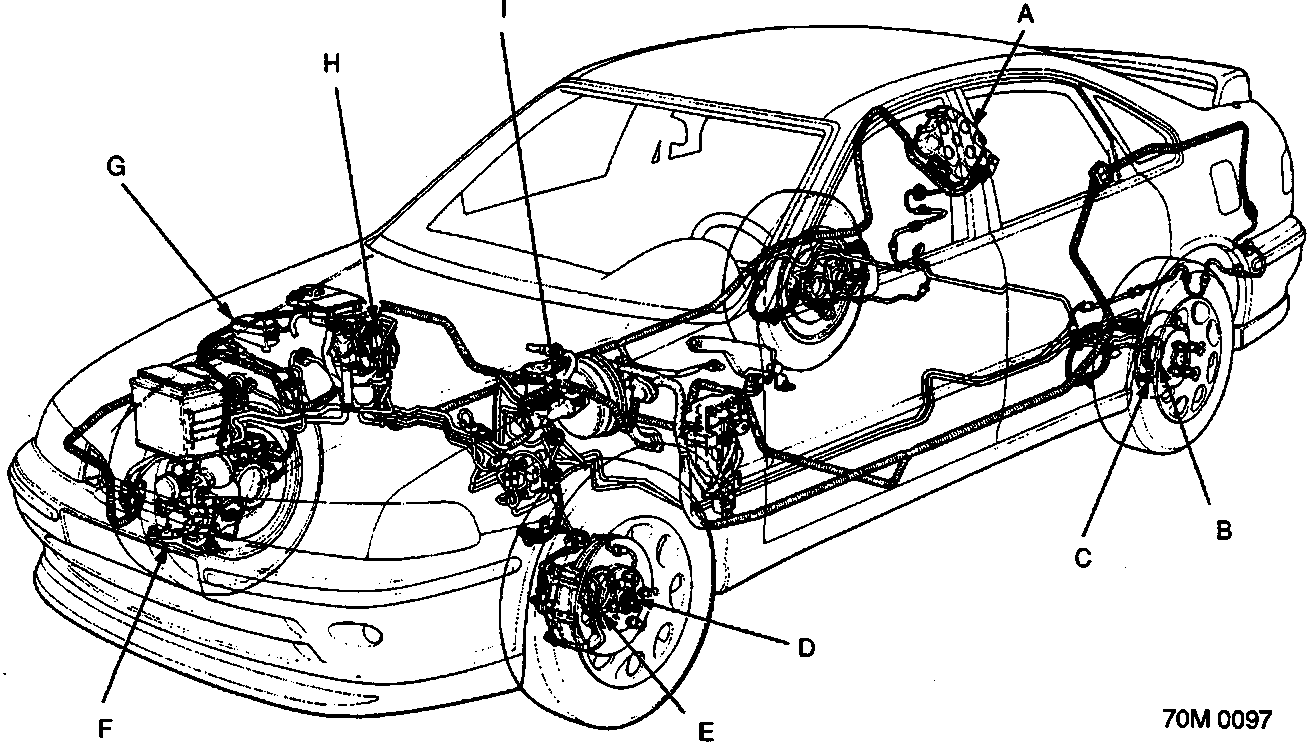
- A ABS control unit
- B Gear pulser
- C Rear wheel sensor
- D Front wheel sensor
- E Gear pulser
- F ABS pump assembly
- G Under-bonnet ABS fuse/relay box
- H Modulator unit
- I Master cylinder
In a conventional brake system, if the brake pedal is depressed very hard, the wheels can lock before the vehicle comes to a stop. In such a case, the stability of the vehicle is reduced if the rear wheels are locked, and manoeuvrability of the vehicle is reduced if the front wheels are locked, creating an extremely unstable condition.
The Anti-lock Brake System (ABS) modulates the pressure of the brake fluid applied to each front caliper or both rear calipers, thereby preventing the locking of the wheels, whenever the wheels are likely to be locked due to hard braking. It then restores normal hydraulic pressure when there is no longer any possibility of wheel locking.
Features
- Increased braking stability can be achieved regardless of changing driving condition.
- The manoeuvrability of the vehicle is improved as the system prevents the front wheels from locking.
- When the anti-lock brake system goes into action, a kickback is felt on the brake pedal.
- The system is equipped with a self-diagnosis function. When an abnormality is detected, the ABS indicator light comes on. The location of the system's trouble can be diagnosed from the frequency of the system indicator light blinks.
Parts & tools for this job For Rover 600
- TOOLOBD2 scanner with ABSSearch: OBD2 scanner ABS SRS
- TOOLDigital multimeterSearch: automotive digital multimeter
Links open Amazon search results in a new tab. As an Amazon Associate I earn from qualifying purchases.