
Lubrication
- Make
- Alfa Romeo
- Model
- GTV / Spider GTV and Spider (916) Factory Service Manual
- Year
- 1995–2000
- Section
- Heating and ventilation › Lubrication
LUBRICATION
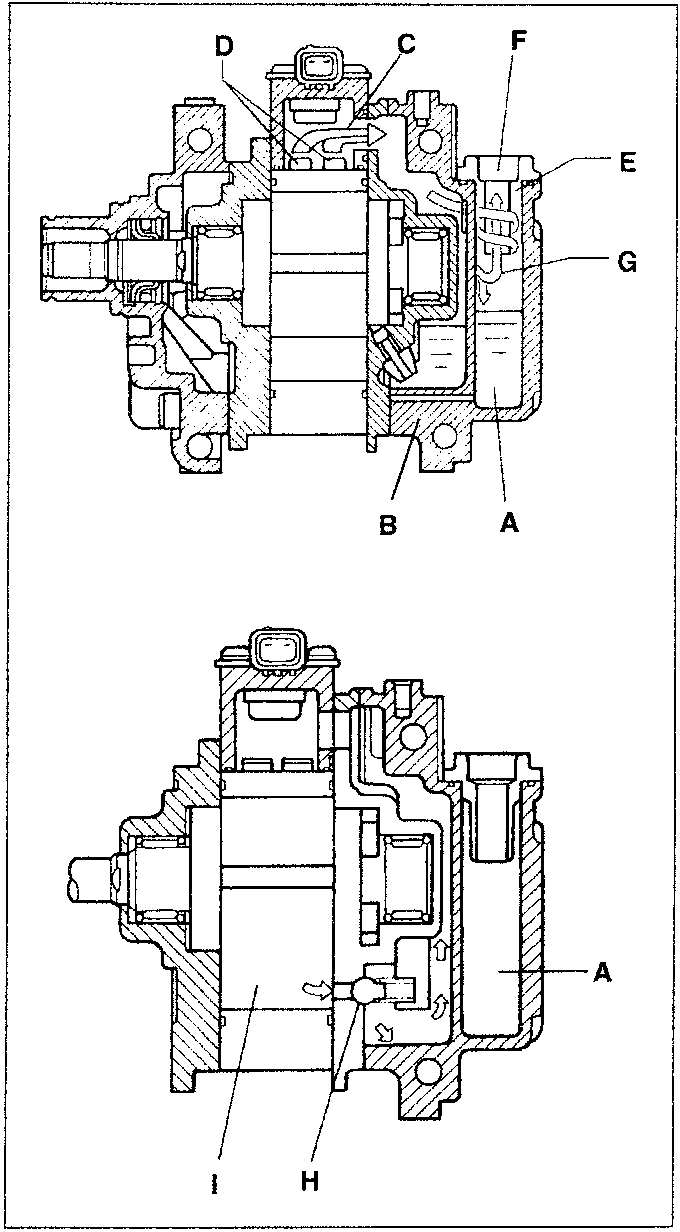
The lubricating oil is contained in the high pressure chamber (A). When the compressor is operating the high pressure in the chamber pushes the oil through the calibrated hole (B) to the moving parts of the compressor.
The oil mixed with gas (C) is pushed through the reed valves (D) into the high pressure chamber.
A separator (E) installed in the gas outlet union separates the gas from the oil which drops to the bottom of the chamber (A) while the gas escapes through union (F).
This device keeps the amount of oil in the system to the minimum and consequently increases the thermal yield.
The compressor is also fitted with two safety valves (H) which release any overpressure occurring in the compression chamber (I).
Compressor engagement/disengagement strategy
The compressor is engaged by the electromagnetic joint controlled by the electronic injection management system of the engine: indeed the compressor absorbs quite an amount of power to the disadvantage of overall engine output, and in certain instances this must be avoided:
- at idle speed the engine must adapt its own rpm taking into account this increase of absorbed power;
- when the engine is started or when high load is required, the compressor is cut out to leave all the available power to the engine.
M3.7 injection system (3.0 V6 engine)
The injection system control unit carries out the following strategies:
- it adapts the engine idle speed each time the compressor is engaged; if the idle speed drops below 700 rpm, the compressor is disengaged;
- if high power (high throttle opening speed, starting from below 3500 rpm) or full load is needed, or the engine temperature is high (over 117°C), it momentarily cuts off the compressor;
- when the engine is started it does not enable the compressor to cut in until normal operating conditions have been reached.
M2.10.3 injection system (2.0 T.S. 16v engine)
The injection system control unit carries out the following strategies:
- it adapts the engine idle speed each time the compressor is engaged; if the idle speed drops below 700 rpm, the compressor is disengaged;
- in the event of the need for high power (high speed - above 6000 rpm - full load - max. throttle opening), it momentarily disengages the compressor;
- when the engine is started it does not enable the compressor to cut in until normal operating conditions have been reached.
NOTE: remember that the NIPPONDENSO TV14SC compressor with which this version is fitted automatically prevents the compressor from operating if the temperature of the refrigerant fluid inside the compressor exceeds 160°C.
Parts & tools for this job For 1995 Alfa Romeo GTV / Spider
- PARTOil filterSearch: Alfa Romeo GTV / Spider 1995 oil filter
- TOOLOil filter wrenchSearch: oil filter wrench
- FLUIDEngine oilSearch: Alfa Romeo GTV / Spider engine oil
Links open Amazon search results in a new tab. As an Amazon Associate I earn from qualifying purchases.