
Description
- Make
- Alfa Romeo
- Model
- GTV / Spider GTV and Spider (916) Factory Service Manual
- Year
- 1995–2000
- Section
- Body › Description
DESCRIPTION
The bodies of the Spider and of the GTV have been designed to achieve the highest levels of safety for the occupants in the event of an accident.
For this reason, from the structural point of view the front part of the car has been designed to crumple and "sacrifice itself" in the event of head-on collision to shield the passenger compartment which is a rigid and undeformable structure.
This way, in a crash, the two front struts bend in a pre-established manner, attenuating and absorbing the force of impact.
The struts are also restrained to the side panel of the car through specific joining pieces which help to absorb energy in the front part, while the engine frame relieves the forces onto special boxed sections under the floor.
Additionally, the structure of the passenger compartment is very rigid. The reinforcements of the doors and their coupling to the pillars offer high resistance to squeezing.
The Spider also has reinforcements in the windscreen pillars to make them undeformable if the car overturns and the partition behind the seats stiffens the rear part of the body.
When designing these parts, consideration was given to the complexity of true situations. The result is that the front structure, unlike other solutions studied only for impacts against a fixed perpendicular barrier, is capable of absorbing energy both in the event of collision against rigid structures such as walls and posts and against deformable objects such as cars, minimising the forces and accelerations that reach the passenger compartment.
STRUCTURAL REINFORCEMENTS
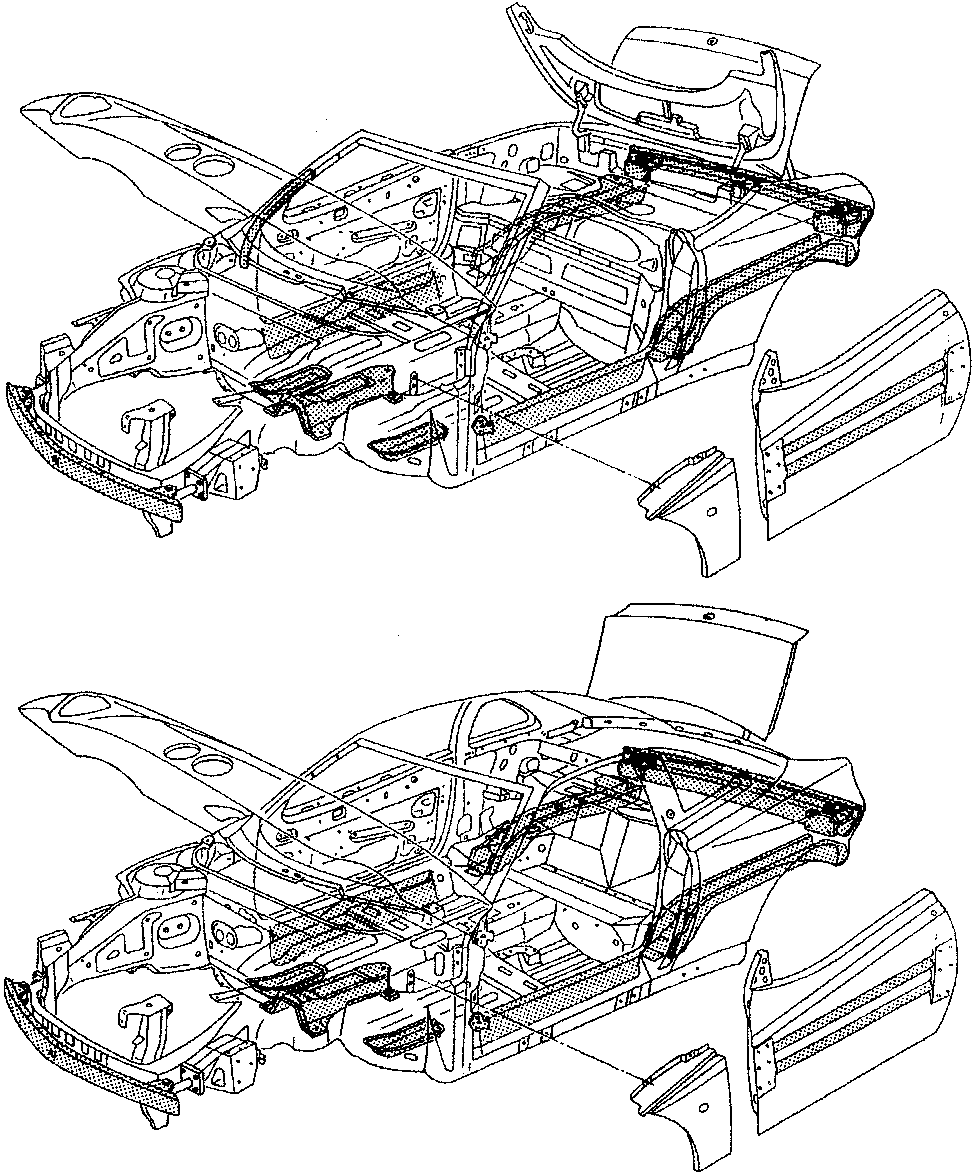
(*) From chassis no. ... there is only one anti-intrusion bar.
Parts & tools for this job For 1995 Alfa Romeo GTV / Spider
- TOOLTrim removal tool kitSearch: trim removal tool kit
- PARTTouch-up paintSearch: Alfa Romeo touch up paint
- PARTPanel clip assortmentSearch: Alfa Romeo panel clips assortment
Links open Amazon search results in a new tab. As an Amazon Associate I earn from qualifying purchases.