
Introduction
- Make
- Fiat
- Model
- 500 Factory Service Manual
- Year
- 2007–2024
- Section
- Hydraulic braking system › Introduction
Introduction
Introduction
The vehicle has a pedal assembly, separated from the power unit, comprising a support with the clutch and accelerator pedals made from plastic and the brake pedal from pressed steel. The solution adopted has made it possible to fit a brake servo oversized by 9" and achieve a significant reduction in weight.
The pedal assembly has a pedal/brake ratio that guarantees reduced pedal travel, permits improved exploitation of the brake servo specifications and also allows optimum gradual braking.
The arrangement of the pedals has been made more user-friendly taking into consideration heel angle parameters and the position of and space between the pedals. On versions with a robotized gearbox the pedal assembly does not have a clutch pedal as this function is carried out automatically.
The accelerator control is the drive by wire type on all versions.
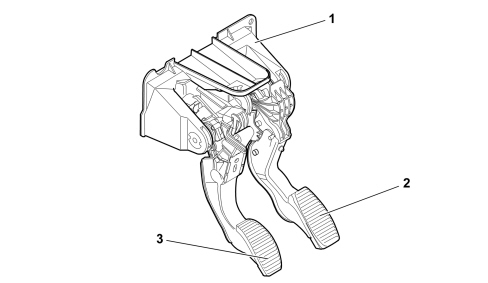
1. Pedal assembly
2. Brake pedal
3. Clutch pedal
Introduction
The brake pump, made from aluminium, is in one piece with the brake servo.
The hydraulic braking system reserve fluid reservoir is press-fitted on the top part of the pump.
There is an insufficient fluid level sensor on the reservoir which is activated when the fluid is below the minimum level, signalling this condition to the Body Computer, which then lights up the warning light on the instrument panel.
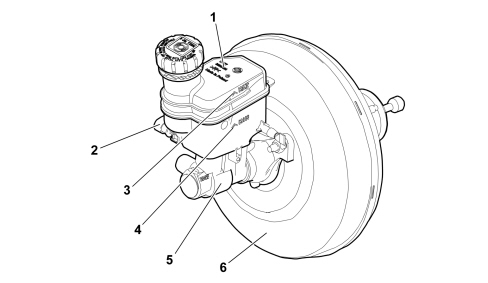
1. Brake fluid reservoir
2. Insufficient brake fluid level sensor
3. MAX brake fluid level
4. MIN brake fluid level
5. Pump
6. Brake servo
Introduction
The vacuum braking system consists of:
- intake manifold (for versions with petrol engine), which provides (with the engine running) the vacuum required for the operation of the brake servo;
- vacuum unit (on versions with diesel engine) which receives the power from the camshaft controlling the inlet valves and produces the vacuum required for the operation of the brake servo;
- a pipe connected to the brake servo;
- control pump, also known as the master cylinder, fitted on the brake servo.
The pump is connected by two pipes, each of which supplies a section of the crossover circuit, to the ABS electro-hydraulic control unit.
See descriptions 3340 ANTI-LOCK BRAKING SYSTEM (ABS)
The vacuum unit fitted on the 1.3 Multijet engine is illustrated below.
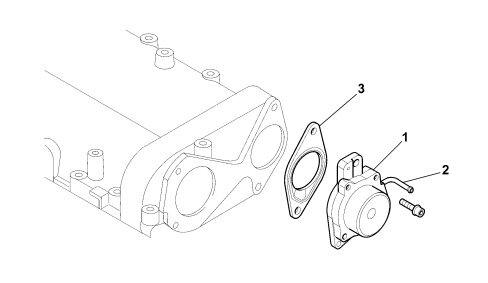
1. Vacuum unit
2. Vacuum intake
3. Gasket
The connection from the vacuum unit or from the intake manifold to the brake servo is illustrated below.
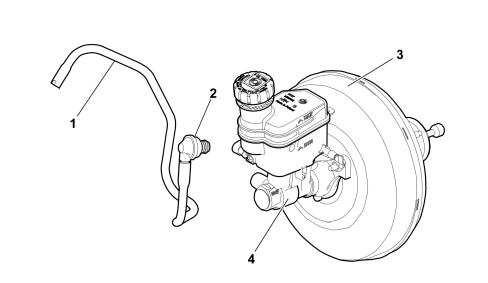
1. Vacuum intake pipe
2. Valve on the brake servo
3. Brake servo
4. Brake pump
The system offers smoother, more powerful braking through the action of the brake servo. The brake servo is a pneumatic device which, using the effect of the vacuum created inside the intake manifold (with the engine running), provides power for the brake pedal action at the pump and allows smoother braking.
If there is a problem with the vacuum system (or with the engine not running), the operation of the braking system is guaranteed because the connection between the pedal and the brake pump remains operational.
In these emergency conditions, the action on the brake pedal becomes very tiresome and the braking system does not maintain the same responsiveness.
Parts & tools for this job For 2007 Fiat 500
- PARTBrake padsSearch: Fiat 500 2007 brake pads
- TOOLBrake bleeder kitSearch: one man brake bleeder kit
- FLUIDBrake fluidSearch: brake fluid
Links open Amazon search results in a new tab. As an Amazon Associate I earn from qualifying purchases.