
Checking engine idle speed
- Make
- Fiat
- Model
- Bravo /Brava (182) Factory Service Manual
- Year
- 1995–2001
- Section
- Fuel system (1998 20v) › Checking engine idle speed
CHECKING ENGINE IDLE SPEED
If the engine idle speed is not 750 ± 50 rpm and the injection/ignition control unit is the self-adjusting type, it is not possible to adjust it, therefore it is necessary to check that the accelerator linkage is correctly adjusted and to then search for the cause of the problem by carrying out a complete fault diagnosis using the Fiat/Lancia Tester.
CHECKING CONCENTRATION OF POLLUTANT EMISSIONS
The Motronic M 2.10.4 system ensures a constant check on the idle speed and the CO percentage through the self-adjustment of the system, thereby making any outside adjustments superfluous (there are no adjustment screws). However, a check on the content of the exhaust gases downstream of the catalyzer can provide precious indications on the operation of the injection/ignition system, the engine parameters and the catalyzer.
Checking idle concentration of CO and HC
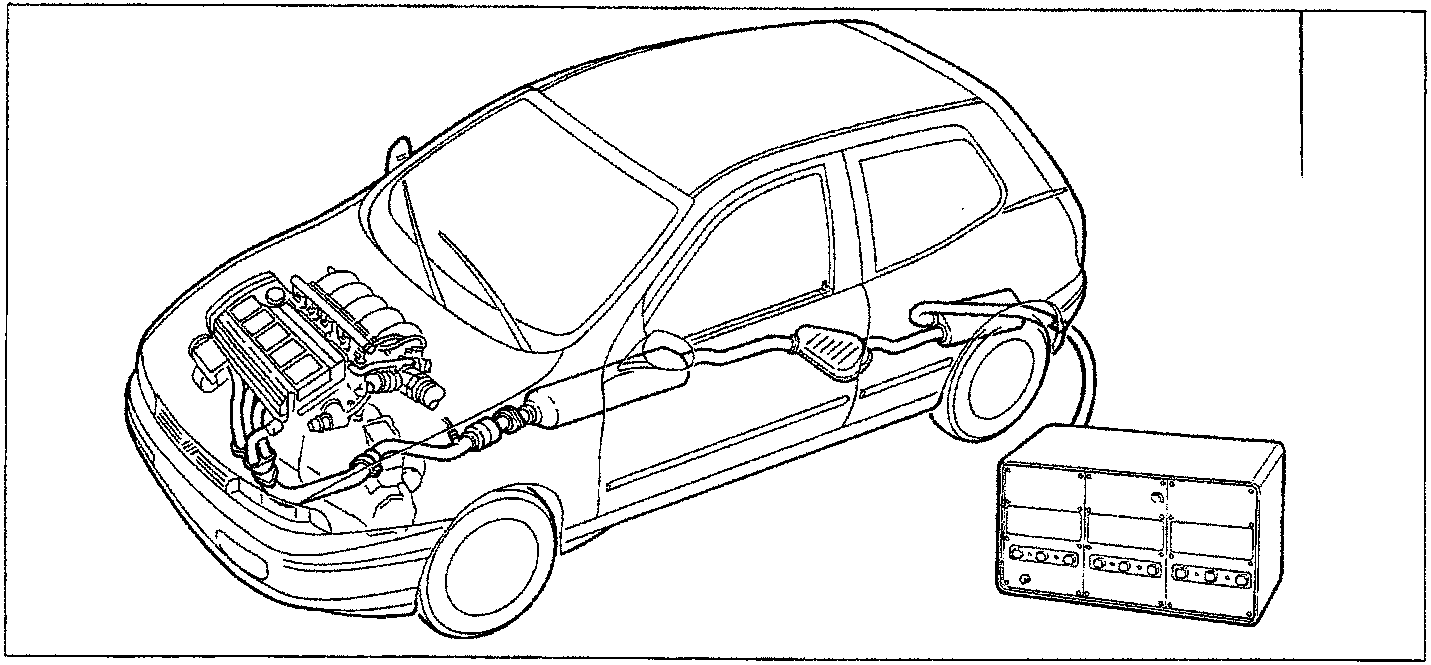
The concentration of carbon monoxide (CO) and unburnt hydrocarbons (HC) is measured with the catalyzer at operating temperature (300 - 350 °C) (it is advisable to drive "hard" for around 5 - 10 minutes to make sure that the catalyzer reaches operating temperature), then insert the suitably tester probe at least 30 cm into the end of the exhaust pipe as shown in the diagram.
If the shape of the end section of the exhaust pipe is such that the sensor cannot be completely introduced, a special extension pipe must be added which ensures the seal in the join area.
- Check that the CO and HC concentrations are within the values given in the table;
- If the CO value is not within the recommended figures, it is necessary to check:
- the correct operation of the Lambda sensor, using the Fiat/Lancia Tester;
- the presence of air penetration in the area surrounding the Lambda sensor housing;
- the injection and ignition system (in particular the state of wear of the spark plugs).
- If the HC value is outside of the recommended limits, the cause of the problem should be sought in the incorrect engine timing or the decreased efficiency of the catalyzer.
| CO (%) | HC (p.p.m.) | CO₂ (%) |
|---|---|---|
| ≤ 0,35 | ≤ 90 | ≥ 13 |
Table summarizing pollutant emission tolerances downstream of the catalyzer
Parts & tools for this job For 1995 Fiat Bravo
- PARTEngine gasket setSearch: Fiat Bravo 1995 engine gasket set
- TOOLTorque wrenchSearch: 3/8 inch torque wrench
- TOOLFeeler gauge setSearch: feeler gauge set
Links open Amazon search results in a new tab. As an Amazon Associate I earn from qualifying purchases.