
Handling Refrigerant
- Make
- Aston Martin
- Model
- DB9 Factory Workshop Manual
- Year
- Issue 2, 2005
- Section
- Air Conditioning (A/C) System › Handling Refrigerant
Handling Refrigerant
Warning
Avoid breathing A/C refrigerant or lubricant vapor. Exposure may irritate eyes, nose and throat. Also, due to environmental concerns, Aston Martin recommend the use of a recovery / recycling / recharging unit when draining R-134a from the A/C system.
If accidental A/C system discharge occurs, ventilate work area before resuming service.
Warning
Do not perform a pressure test or leak test for R-134a service equipment and or vehicle A/C using compressed air. Some mixtures of air and R-134a have been shown to be combustible at elevated pressures. These mixtures, if ignited, may cause injury or property damage. Additional health and safety information may be obtained from refrigerant manufacturers.
Warning
Do not allow refrigerant to leak near a fire or any kind of heat. A poisonous gas may be generated if refrigerant gas contacts fire or heat such as from cigarettes and heaters. When carrying out any operation that can cause refrigerant leakage, extinguish or remove the above mentioned heat sources and maintain adequate ventilation.
Warning
Handling liquid refrigerant is dangerous. A drop of refrigerant on the skin can result in localized frostbite. When handling refrigerant, wear gloves and safety goggles. If refrigerant splashes into the eyes, immediately wash them with clean water and consult a doctor.
Storing Refrigerant
Warning
The refrigerant container is highly pressurized. If it is subjected to high heat, it could explode, scattering metal fragments and liquid refrigerant that can seriously injure personnel. Store refrigerant at temperatures below 40 °C (104 °F).
Handling Insufficient Refrigerant Level
Caution
If an insufficient refrigerant level is detected while troubleshooting, do not charge (add) the refrigerant. Because an accurate amount of refrigerant cannot be determined from the pressure indicated on the recovery / recycling / recharging unit, never charge the refrigerant.
Caution
If there is too much or too little refrigerant from the refilling, there may be secondary problems such as damage to the refrigerant cycle parts, or a decrease of cooling performance. Therefore, if it is determined that the refrigerant level is insufficient, completely remove refrigerant from the refrigerant cycle and refill with refrigerant to the specified amount.
Handling Compressor Oil
Caution
Use only ND8 compressor oil for this vehicle. Using a PAG oil other than DENSO OIL8 compressor oil can damage the A/C compressor.
Caution
Do not spill the ND8 compressor oil on the vehicle. A drop of compressor oil on the vehicle surface can damage the paint work. If oil gets on the vehicle, wipe it off immediately.
Caution
ND8 compressor oil has a high moisture absorption efficiency. If moisture mixes with the compressor oil, the refrigerant system could be damaged. Ensure caps are installed immediately after using the compressor oil or removing refrigerant system parts to prevent moisture absorption.
Refrigeration Cycle
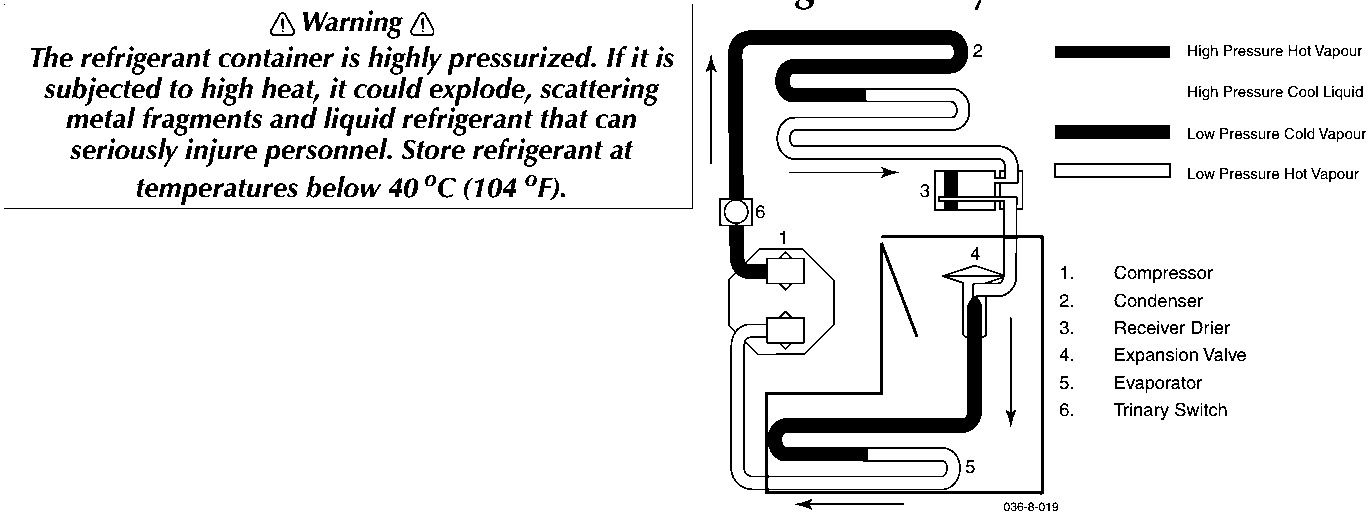
- Compressor
- Condenser
- Receiver Drier
- Expansion Valve
- Evaporator
- Trinary Switch
Parts & tools for this job For 2005 Aston Martin DB9
- TOOLA/C manifold gauge setSearch: AC manifold gauge set
- TOOLUV leak detection kitSearch: AC UV leak detection kit
- PARTCabin filterSearch: Aston Martin DB9 2005 cabin filter
Links open Amazon search results in a new tab. As an Amazon Associate I earn from qualifying purchases.