
Air Conditioning (A/C) System: Specifications
- Make
- Aston Martin
- Model
- DB9 Factory Workshop Manual
- Year
- Issue 2, 2005
- Section
- Air Conditioning (A/C) System › Specifications
- The Compressor (1) draws low pressure, low temperature, refrigerant vapour from the evaporator (5) and compresses it, raising the refrigerant pressure and temperature.
- This high pressure, hot, refrigerant vapour enters the condenser (2), where it is cooled by the flow of ambient air and changes state into a cooler, high pressure liquid.
- From the condenser, the liquid passes into the receiver drier (3) which has three functions:
- Removes moisture from the refrigerant using a desiccant
- Filters the refrigerant to remove system contaminants
- Stores the refrigerant to cope with varying system refrigerant demands
- The filtered liquid refrigerant, still at high pressure, then enters the expansion valve (4). Here it passes through a controlled orifice and emerges as an atomised liquid spray. This has the effect of reducing the refrigerant pressure and temperature. The cold refrigerant spray now flows into the evaporator (5).
- As refrigerant passes through the evaporator core, it cools the incoming airflow. Heat is absorbed by the refrigerant, during this process and it once again changes state, from an atomised cool liquid into a vapour. The refrigerant vapour then returns to the compressor for the cycle to be repeated.
An automatic safety valve is incorporated in the compressor, which will open if the system pressure rises above 41 bar. The valve will reseat when the pressure drops below 27,6 bar. When the safety valve is open, the compressor will 'free wheel' and the excess pressure will be dissipated through the expansion valve. When the pressure drops below 27.6 bar, the safety valve will close again and the compressor will be operative.
The terms 'high' and 'low' pressure (or side) refer to the pressure differential between the compressor and expansion valve ports. This differential is critical to system fault diagnosis and efficiency checks.
The high side starts at the compressor and includes the trinary switch, condenser, receiver drier and expansion valve.
The low side starts at the expansion valve outlet and includes the evaporator and all connections back to the compressor. The trinary switch (6) monitors system pressure between the compressor and condenser. If the pressure rises above 30 bar or falls below 2 bar the compressor clutch is de-energised to prevent damage to system components.
Specifications
Refrigerant and Lubricant
| Refrigerant | R-134a |
|---|---|
| Compressor Lubricant | ND8 (DENSO) |
Capacities
| Refrigerant charge | Weight 850g (30 oz.) |
|---|---|
| Compressor Lubricant | Sealed volume (approx. quantity) 150 cc (pre-charged) |
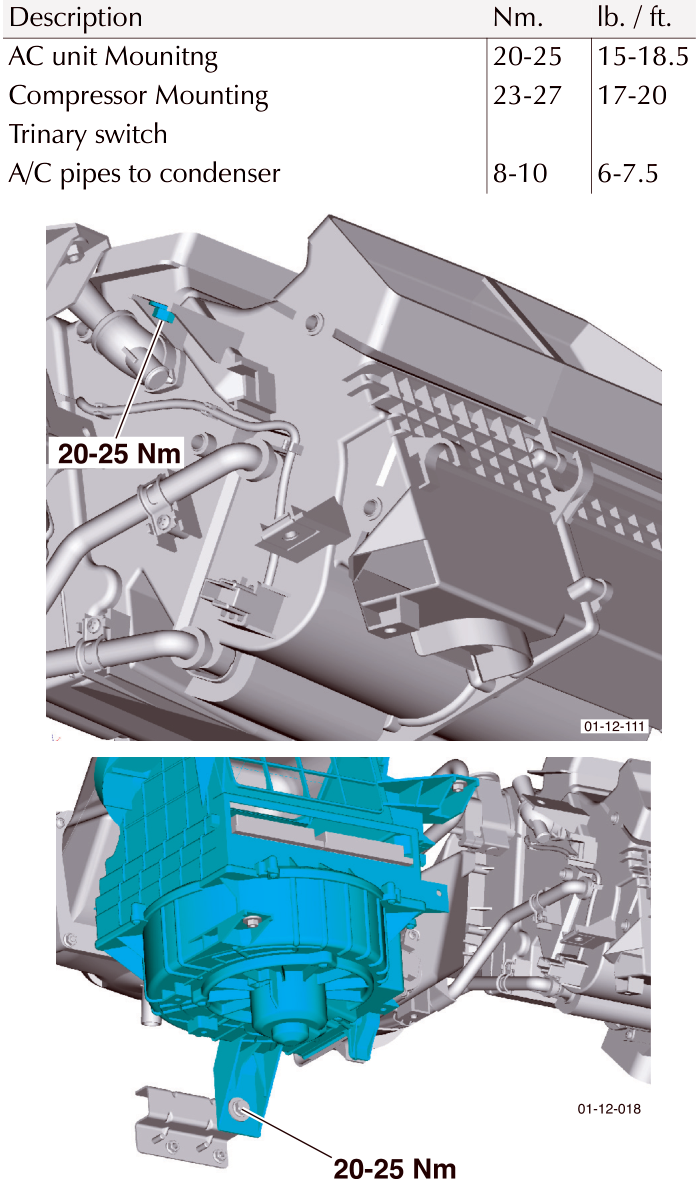
Torque Figures
| Description | Nm. | lb. / ft. |
|---|---|---|
| AC unit Mounting | 20-25 | 15-18.5 |
| Compressor Mounting | 23-27 | 17-20 |
| Trinary switch | ||
| A/C pipes to condenser | 8-10 | 6-7.5 |
Parts & tools for this job For 2005 Aston Martin DB9
- TOOLA/C manifold gauge setSearch: AC manifold gauge set
- TOOLUV leak detection kitSearch: AC UV leak detection kit
- PARTCabin filterSearch: Aston Martin DB9 2005 cabin filter
Links open Amazon search results in a new tab. As an Amazon Associate I earn from qualifying purchases.