
Catalytic silencer
- Make
- Fiat
- Model
- Bravo /Brava (182) Factory Service Manual
- Year
- 1995–2001
- Section
- Fuel system (1747 16v) › Catalytic silencer
The devices used have two objectives:
- to keep down the pollutant substances present in the exhaust, via the catalytic silencer;
- to eliminate the dispersion towards the outside of the unburnt hydrocarbons, via the (fuel) anti-evaporation system and the (lubrication) oil vapour recirculation system.
CATALYTIC SILENCER
The catalytic silencer is a device which makes it possible to simultaneously keep down the three main pollutant compounds present in the exhaust: unburnt hydrocarbons (HC), carbon monoxide (CO) and nitrogen oxide (NOx).
Two types of chemical reaction take place inside the catalyzer:
- oxidation of the CO and the HC, converted into carbon dioxide (CO2) and water (H2O);
- reduction of the NOx, converted into Nitrogen (N2).
These reactions can take place in extremely short periods of time thanks to the presence inside the catalyzer structure (ceramic support) of a layer of active substances (platinum and rhodium) which greatly accelerate the conversion speed of the harmful substances.
The effectiveness of this conversion process is conditioned by the fact that the mixture strength at which the engine operates is constantly oscillating around the stoichiometric value, which is achieved thanks to the feed-back control carried out by the control unit on the basis of the Lambda sensor signals. Lastly, the conversion processes are activated at temperatures in excess of 300 - 350°C: it is therefore vital that the catalyzer reaches this temperature as soon as possible in order to work properly.
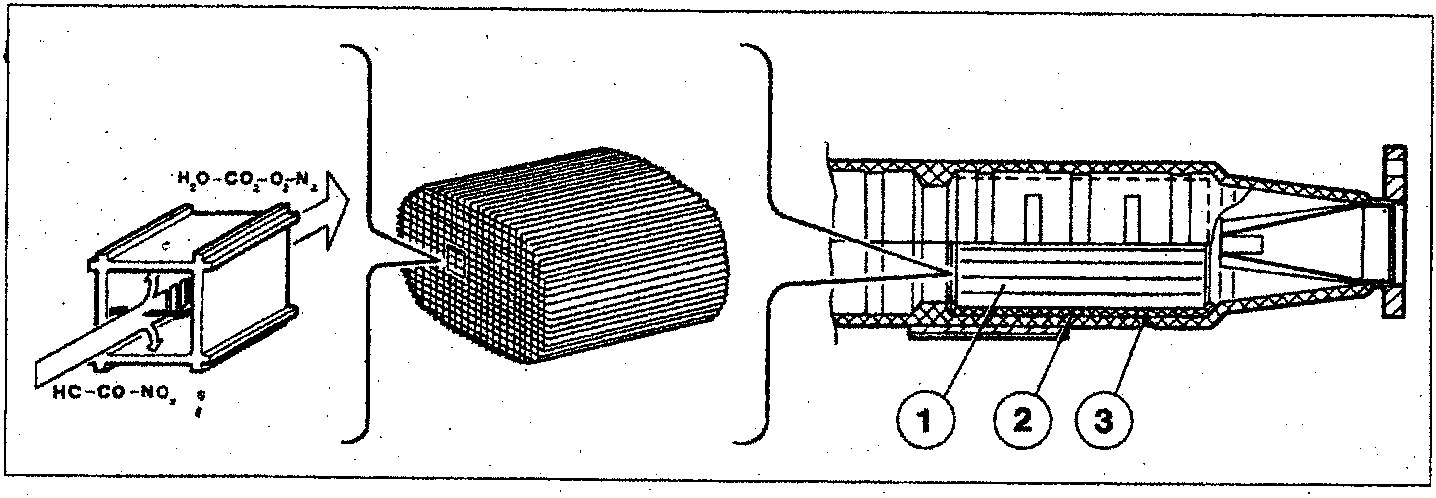
- Ceramic monolith
- Metal support
- Steel outer casing
When it is necessary to operate near the catalytic silencer, it is necessary to leave the vehicle to rest for some time, since the (internal) operating temperature of the catalyzer is between 500 and 850°C.
There are basically two causes of the destruction of the inside of the catalyzer:
- the presence of lead in the fuel which lowers the degree of conversion at levels of practically nil ("lead poisoning") and which also irreparably damages the Lambda sensor;
- the presence of totally unburnt fuel in the exhaust gases, due to failed ignition, which causes an increase in the temperature which involves the fusion of the ceramic support. As a result, the connector for the coils should never be disconnected with the engine running: in the case of tests, the silencer should be replaced first with an equivalent section of pipe.
Parts & tools for this job For 1995 Fiat Bravo
- PARTExhaust gasketSearch: Fiat Bravo 1995 exhaust gasket
- TOOLPenetrating oilSearch: penetrating oil
- TOOLOBD2 scannerSearch: OBD2 scanner
Links open Amazon search results in a new tab. As an Amazon Associate I earn from qualifying purchases.