
Engine Timing Sensor
- Make
- Fiat
- Model
- Bravo /Brava (182) Factory Service Manual
- Year
- 1995–2001
- Section
- Fuel system (1747 16v) › Engine Timing Sensor
Engine Timing Sensor
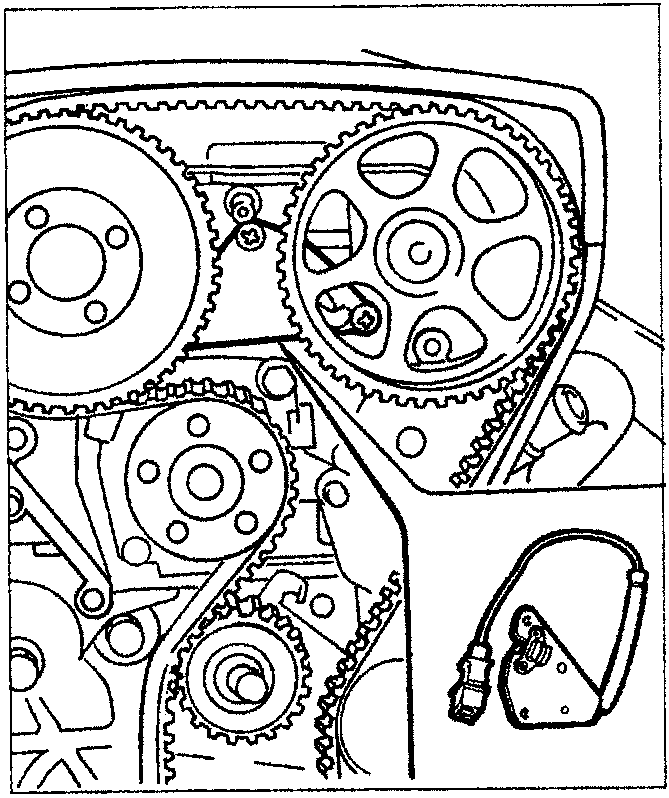
The engine timing signal, together with the engine rpm and TDC signal, allows the control unit to recognize the succession of cylinders to implement the injection timing. This signal is generated by a Hall effect sensor, fitted by the exhaust camshaft drive pulley.
NOTE It is not possible to carry out any adjustments to the angular position of the sensor.
Operating principle
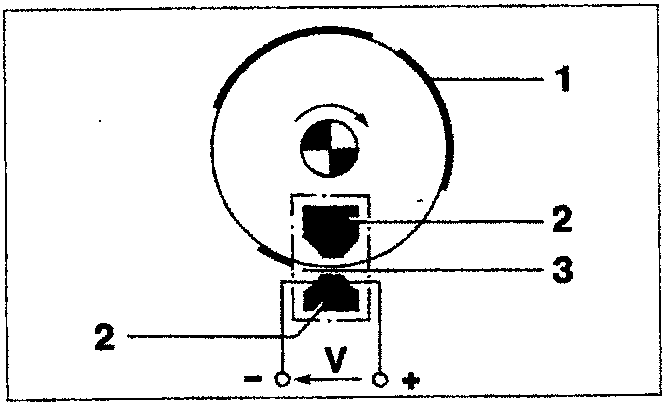
- Deflector
- Magnetic material
- Gap
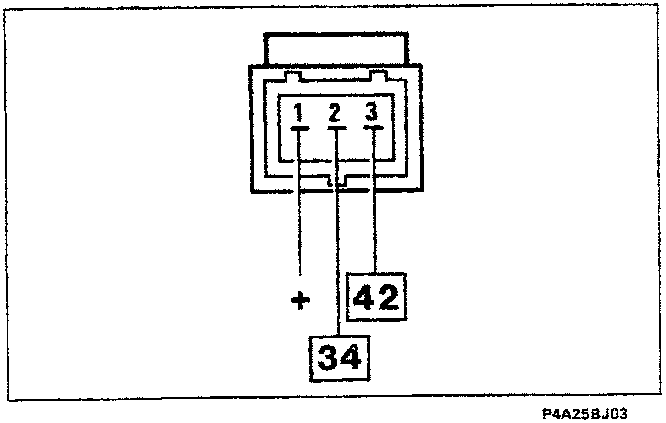
Wiring connector
A semi-conductor layer through which the current flows, immersed in a normal magnetic field (lines of force perpendicular to the direction of the current) generates a difference in power, known as Hall effect voltage. If the intensity of the current remains constant, the voltage generated only depends on the intensity of the magnetic field. It is therefore sufficient if the intensity of the field varies periodically to obtain a modulated electrical signal.
In pratice, to obtain this change, the sensor has a metal ring passed through it (fixed to the inner part of the timing pulley) equipped with a series of openings: as it moves, when the ring covers the sensor, it blocks the magnetic field and the signal remains low, whilst as it passes the openings, the field closes and the signal becomes high.
The alternating of the signals therefore depends on the succession of the openings (see "signal management" chapter).
Parts & tools for this job For 1995 Fiat Bravo
- TOOLOBD2 scannerSearch: OBD2 scanner
- TOOLDigital multimeterSearch: automotive digital multimeter
- TOOLBack-probe test leadsSearch: back probe test leads
Links open Amazon search results in a new tab. As an Amazon Associate I earn from qualifying purchases.