
EMS Sensors (page 2 of 5)
- Make
- Land Rover
- Model
- Freelander System Description and Operation (UK)
- Section
- Siemens (NAS) – description and operation
The signals from the APP sensor are monitored by the ECM for short and open circuits and plausibility. If a fault is detected, the ECM: l Stores a related fault code in memory. l Illuminates the SERVICE ENGINE warning lamp in the instrument pack. l Inhibits the driver demand message on the CAN bus, which disables the Hill Descent Control (HDC) function of the ABS modulator and reduces the performance of the automatic gearbox (harsh gear changes and loss of kickdown). l Adopts a throttle limp home mode.
The throttle limp home mode adopted depends on the nature of the fault: l If a fault is detected with one potentiometer track, the ECM limits vehicle acceleration by limiting throttle plate opening. l If a fault is detected with both potentiometer tracks, the ECM uses the throttle plate to run the engine at a fixed speed of 1472 rev/min while the brake pedal is released, and idle speed (750 rev/min) while the brake pedal is pressed or if there is a brake pedal sensor fault. l If there is a process fault in the ECM, the ECM either uses fuel injection cut-off to limit engine speed to 1300 rev/ min or disables fuel injection to stop the engine.
CKP Sensor
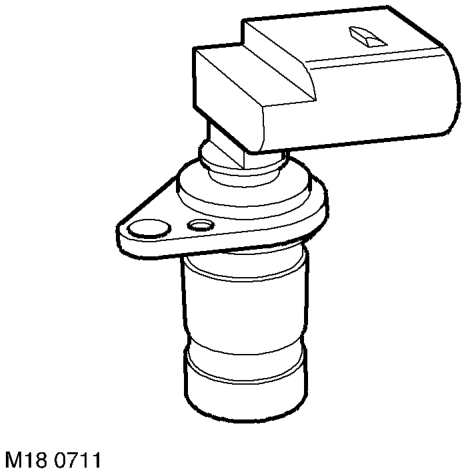
The CKP sensor provides the ECM with a digital signal of the rotational speed and angular position of the crankshaft, for use in ignition timing, fuel injection timing and fuel injection quantity calculations. To determine the exact position of the crankshaft in the engine cycle, the ECM must also use the input from the CMP sensor.
The CKP sensor is mounted on the front of the gearbox housing, in line with the outer circumference of the torque converter. The sensing tip of the CKP sensor is adjacent to a reluctor ring formed in the periphery of the torque converter. The reluctor ring has 58 teeth spaced at 6° intervals. A gap equivalent to two missing teeth, 36° After Top Dead Centre (ATDC) of No. 1 cylinder, provides the ECM with a reference point.
The CKP sensor operates using the Hall effect principle. A permanent magnet inside the sensor applies a magnetic flux to a semiconductor, which receives a power supply from the main relay. The output voltage from the semiconductor is fed to the ECM. As the gaps between the poles of the reluctor ring pass the sensor tip the magnetic flux is interrupted, causing a fluctuation of the output voltage and producing a digital signal.
If the CKP sensor fails the ECM immediately stops the engine.
Parts & tools for this job For Land Rover Freelander
- TOOLOBD2 scannerSearch: OBD2 scanner
- TOOLDigital multimeterSearch: automotive digital multimeter
- TOOLBack-probe test leadsSearch: back probe test leads
Links open Amazon search results in a new tab. As an Amazon Associate I earn from qualifying purchases.