
Steering (Operation): Description and operation (page 2 of 2)
- Make
- Land Rover
- Model
- Freelander System Description and Operation (UK)
- Section
- Description and operation
Pump Flow Control Valve Operation
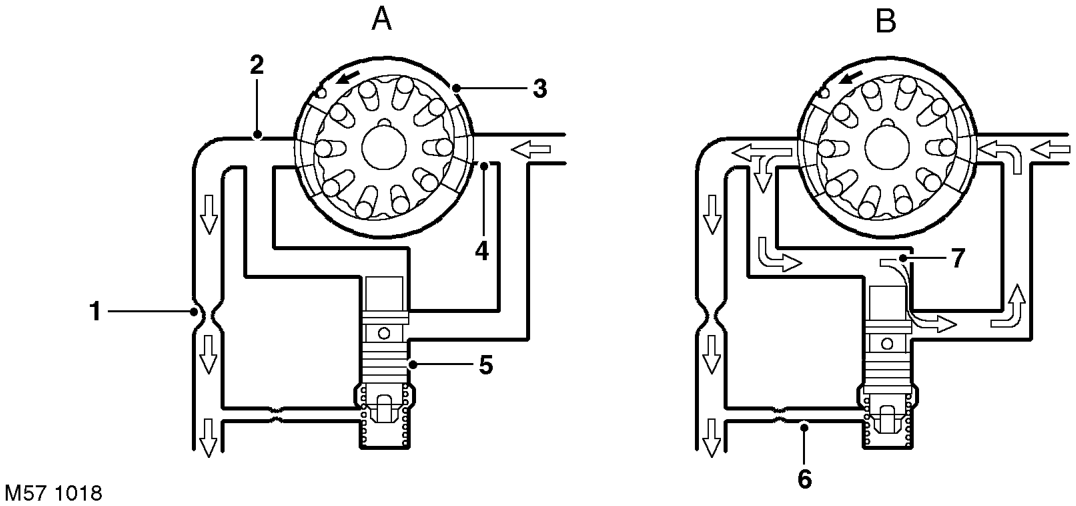
1 Metering orifice 2 Discharge port 3 Pump 4 Inlet port
5 Flow control valve 6 Relief valve passage 7 Recirculation passage
The pump is a positive displacement type pump and potential output from the pump increases proportionally with engine speed. The flow control valve maintains a constant predetermined flow to the control unit regardless of engine speed. The flow control valve controls the flow of fluid and increases or decreases the flow discharged from the pump to compensate for engine speed variations.
With the engine at idle the discharge flow from the pump is low and the full flow from the pump is delivered to the valve unit. As engine speed increases, the flow delivered by the pump increases proportionally. A pressure difference is created between each side of the metering orifice as the engine speed increases, the higher pressure being felt at the pump side of the metering orifice. This higher pressure is also felt at the top of the flow control valve via the recirculation passage. The lower pressure on the discharge side of the metering orifice is felt at the bottom of the flow control valve via the relief valve passage.
When the pressure at the top of the flow control valve exceeds the rating of the flow control valve spring, the valve begins to open against the spring pressure and the lower pressure at the discharge side of the metering orifice. Fluid is allowed to flow through the recirculation passage and recirculate through the pump.
As engine speed increases, the flow control valve is pushed down further, increasing the flow through the recirculation passage.
Parts & tools for this job For Land Rover Freelander
- TOOLTie rod end toolSearch: tie rod end puller
- TOOLBall joint separatorSearch: ball joint separator
- FLUIDPower steering fluidSearch: Land Rover power steering fluid
Links open Amazon search results in a new tab. As an Amazon Associate I earn from qualifying purchases.