
Crankshaft Position (CKP) Sensor
- Make
- MG
- Model
- MGF Factory Workshop Manual
- Year
- 1995–2000
- Section
- Description and operation › Crankshaft Position (CKP) Sensor
The HO2S consists of a sensing element, the outer surface of which is exposed to exhaust gases, whilst the inner surface is exposed to ambient air. The sensor has a ceramic coating to protect the sensing element from contamination and heat damage.
The amount of oxygen in ambient air is constant at approximately 20%. The oxygen content of the exhaust gases varies with the AFR with a typical value for exhaust gas of around 2%.
The difference in oxygen content of the two gases produces an electrical potential difference across the sensing element. Rich mixtures, which burn almost all of the available oxygen, produce high sensor voltages. During lean running, there is an excess of oxygen in the mixture and some of this oxygen leaves the combustion chamber unburnt.
In these conditions, there is less difference between the oxygen content of the exhaust gas and the ambient air, and a low potential difference (voltage) is output by the HO2S.
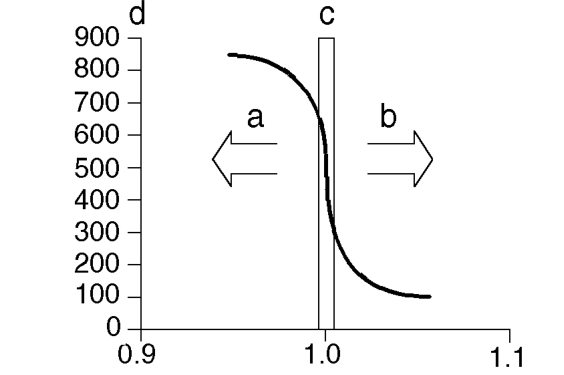
a.Rich AFR b.Lean AFR c.Lambda window d.H02S Output in mV.
The material used in the sensing element only becomes active at a temperature of 300 °C (572 °F), therefore it is necessary to provide additional heating via an electrical resistive element. The element uses a 12V supply provided by the ECM and allows a short warm up time and minimises emissions from start-up. The resistance of the heating element can be measured using a multimeter and should be 6 Ω at 20 °C (68 °F).
Crankshaft Position (CKP) Sensor
The variable reluctance CKP sensor is mounted at the rear of the engine with the sensor tip facing the engine face of the flywheel and is secured in the casting with a single screw. The sensor tip of the CKP sensor is adjacent to a profiled target ring formed on the inner face of the flywheel.

The signal produced by the CKP sensor allows the ECM to calculate the rotational speed and angular position of the crankshaft. This information is required by the ECM to calculate ignition timing, fuel injection timing and fuel quantity during all conditions when the engine is cranking or running. If the CKP sensor signal is missing, the vehicle will not run as there is no substitute signal or default.
Parts & tools for this job For 1995 MG MGF
- TOOLOBD2 scannerSearch: OBD2 scanner
- TOOLDigital multimeterSearch: automotive digital multimeter
- TOOLBack-probe test leadsSearch: back probe test leads
Links open Amazon search results in a new tab. As an Amazon Associate I earn from qualifying purchases.