
Bosch 2e ABS
- Make
- Alfa Romeo
- Model
- 145/146 Factory Service Manual
- Year
- 1994–1999
- Section
- Anti-lock braking system (A.B.S.) › Bosch 2e ABS
BOSCH 2E ABS
(up to chassis no. ..........................)
DESCRIPTION
The BOSCH 2E A.B.S. wheel anti-lock system, integrated with the conventional hydraulically-operated system can be split into the following parts:
- a control unit (3) which, compared with other types of anti-lock systms, integrates the electronic one with the electrohydraulic one controlling both electronic and system management;
- a diagnosis socket (6) for the Alfa Tester;
- four sensors (1), integral with the fixed part suspension facing the same number of phonic wheels (2);
- a switch (4), in correspondence with the brake pedal, for controlling the stop lights;
- a warning light (5), in the instrument cluster, to alert the driver of faults in the A.B.S. system.
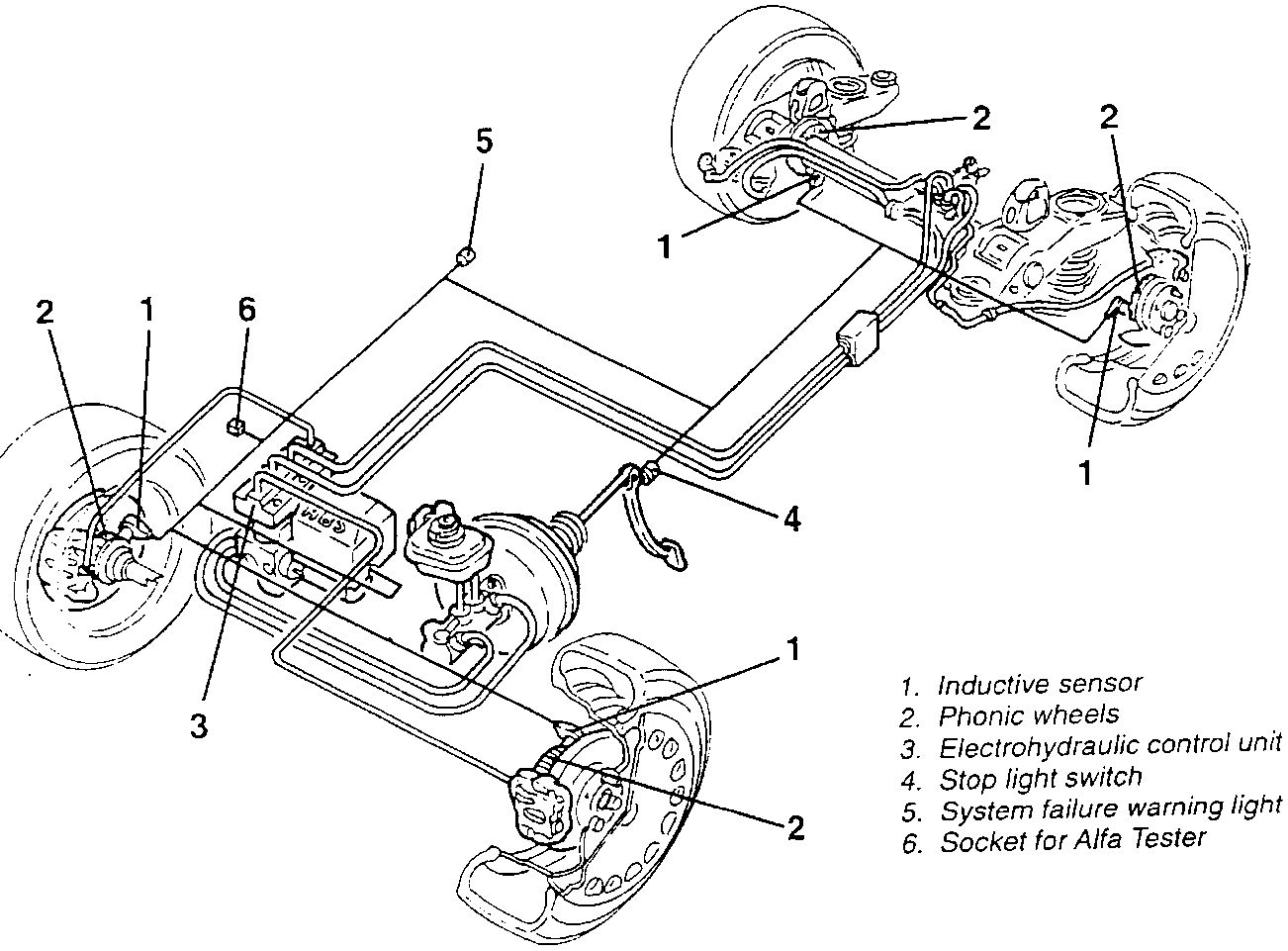
- Inductive sensor
- Phonic wheels
- Electrohydraulic control unit
- Stop light switch
- System failure warning light
- Socket for Alfa Tester
OPERATING PRINCIPLE
During daily use of the vehicle we are used to pressing the brake pedal according to the slowing down required of the vehicle. When the road surface is dry and clean, no particular inconveniences generally occur, as it is possible to reach heavy pressures before the tyre begins to skid.
Conversely, if the asphalt and tyre conditions is not perfect, it would be instinctive to keep higher safety distances as lengthening of the braking distance is foreseeeable. owing to both physical problems of grip and in considerable difficulty in dosing the braking force in the best way possible.
If one finds oneself in an unexpected situation (such as uneven road surface, braking on road surfaces at the limit of grip, or panic braking) it would be extremely fiddicult to control the vehicle, resulting in longer stopping distances and the possible loss of control. All this takes place because the wheels skid during braking and it is therefore impossible for the tyre to absorbe the lateral forces acting on it.
During braking, the peripheral speed of the wheel tends to lower more than that of the vehicle; if the wheel locks and the car is still moving, the difference between these two speeds is at its highest level.
Parts & tools for this job For 1994 Alfa Romeo 145/146
- TOOLOBD2 scanner with ABSSearch: OBD2 scanner ABS SRS
- TOOLDigital multimeterSearch: automotive digital multimeter
Links open Amazon search results in a new tab. As an Amazon Associate I earn from qualifying purchases.