
Introduction - exhaust gas recirculation system (e.g.r.)
- Make
- Fiat
- Model
- Bravo Factory Service Manual
- Year
- 2007–2014
- Section
- Emission control system › Introduction - exhaust gas recirculation system (e.g.r.)
INTRODUCTION - EXHAUST GAS RECIRCULATION SYSTEM (E.G.R.)
CONSTRUCTION SPECIFICATIONS
This system makes it possible to send some (5 - 15%) of the exhaust gases to the intake in certain operating conditions.
This lowers the peak temperature in the combustion chamber, restricting the formation of nitrogen oxides (NOx).
The E.G.R. solenoid (1) operated by the injection control unit (2) recycles a proportion of the exhaust gases taken from the exhaust manifold (4) back into the engine intake.
A heat exchanger (3) allows the partial cooling of the exhaust gases further lowering the temperature of the combustion chamber.
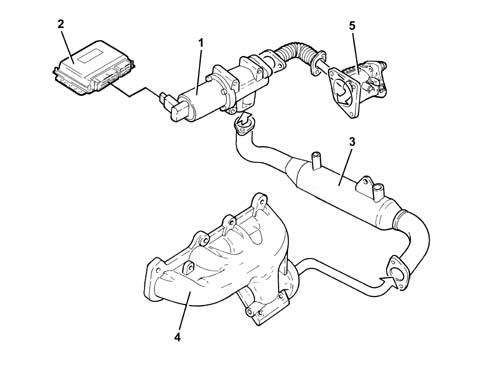
1 - EGR solenoid
2 - Injection control unit
3 - Heat exchanger
4 - Exhaust manifold
5 - Throttle body
OPERATION
At coolant temperatures of > 20°C with the engine speed between 800 and 3000 rpm, the injection control unit operates the E.G.R. solenoid valve with a square wave signal.
The variation in this signal allows the E.G.R. coil to move a shutter, thereby regulating the flow of exhaust gases from the exhaust manifold to the intake manifold; there are two results:
- less air is introduced;
- the combustion temperature is reduced (on account of the presence of inert gases) resulting in a decrease in the formation of NOx (nitrogen oxides).
The injection control unit is constantly informed of the quantity of gas recirculated by information coming from the flow meter: in effect, if there is an intake of a certain quantity of air (Qam) for a given engine speed and the value sent by the flow meter (Qar) is lower, then the difference (Qgr) is the value for the quantity of gas recirculated
Qam - Qar = Qgr
Qam - Theoretical quantity of air memorized
Qar - Actual quantity of air
Qgr - Quantity of recirculated gas
The atmospheric pressure signal is used in controlling the E.G.R. solenoid to recognize the condition of driving at altitude in order to reduce the quantity of gas recirculated and to prevent engine fumes.
DESCRIPTION OF COMPONENTS
E.G.R. SOLENOID VALVE
The Pierburg E.G.R. solenoid valve, fitted on the intake manifold, modulates the flow of exhaust gases to the intake according to commands from the injection control unit.
This modulation is performed by the internal solenoid, which is controlled by a PWM signal from the control unit that activates the internal valve control rod.
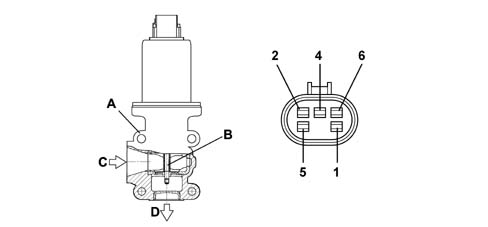
A - E.G.R. valve casing
B - Internal valve
C - Gas intake from exhaust manifold
D - Gas outlet to intake manifold
1 - Solenoid positive
2 - Potententiometer power supply 5V
4 - Potentiometer negative
5 - Solenoid negative
6 - Potentiometer position signal
Parts & tools for this job For 2007 Fiat Bravo
- PARTExhaust gasketSearch: Fiat Bravo 2007 exhaust gasket
- TOOLPenetrating oilSearch: penetrating oil
- TOOLOBD2 scannerSearch: OBD2 scanner
Links open Amazon search results in a new tab. As an Amazon Associate I earn from qualifying purchases.